Monday, November 21, 2016

Monday photo feature


This is a photo Sonny Salomon shot of me during a late-1990s trip to the Caney Fork River in Rock Island State Park.  He was taking pictures of members of our group surfing on the top wave, and in most cases this would be a throw-away shot because I've just been blown off of it.  But I like it.  My not-unbiased opinion has long been that a C1 paddler cuts the most striking figure on a whitewater river, and at least for this one instant I assumed that iconic image against the backdrop of the Great Falls of Middle Tennessee.

Saturday, November 19, 2016

The gears are grinding

This week I started up a strength routine for the first time since August.

Each fall I take a bit of time off after my last race of the year.  How much of a break I take depends on a whole variety of circumstances.  In some years I've stayed out of the boat entirely for as much as six weeks; in other years, like this one, I've kept up a paddling routine of once or twice a week.

In no year have I ever had trouble finding other things to do.  And every fall, these other things promptly expand to fill the time I have freed up by backing off the paddling and training for a while.  There's always work to do in my workshop, and this fall I've had a couple of projects going on.  Also this fall I've been having some major renovation work done on a rental property I own.  Even without canoe and kayak racing to think about, I have felt nothing but busy-busy-busy.

I've mentioned here a number of times before that strength work is my least favorite part of training.  Sitting inside lifting weights or doing repetitive exercises just doesn't appeal to me that much.  But my biggest challenge in getting a routine going again is not the tedium or the discomfort, but the time that I must take back from my non-training activities.

This week I took back that time.  This little routine is what I hope to do three times a week for the next few weeks:

1.  Torso twists with 10-lb. medicine ball
2.  Pullups
3.  Core exercise demonstrated by Jing-Jing Li at 1:34 of this video
4.  Shoulder "pre-hab" exercise demonstrated by Michele Ramazza at 5:47 of this video

I started on Wednesday, doing just one set of each exercise to ease my muscles into their new jobs.  Not surprisingly I was quite sore Thursday and yesterday, but yesterday I moved into my normal practice of doing two sets of each exercise.

After the strength work yesterday I went down to the river for a 60-minute paddle.  Still quite sore, I slogged toward the mouth of the harbor against the stiff south wind that was blowing.  Once out on the river I played around a bit in the small downwind conditions that said wind had created.

With a high temperature around 75 degrees Fahrenheit, yesterday might have been the last day that was warm enough for me to do so without a serious threat of hypothermia should I swim.  Indeed, a front came through in the late afternoon, and today's high will be in the mid 50s.  Winter is on its way.

Monday, November 14, 2016

Monday photo feature


Okay, one more shot from my recent Go Pro obsession and then maybe I'll give it a rest.  In this one I'm heading downriver toward the entrance to the harbor.  You can sort of see the flags on the southern tip of Mud Island: they're right next to that tree at the left side of the photo.  You can also see the Harahan, Frisco, and Memphis-Arkansas bridges off to the right.

I got this effect by clicking the "Fade" button a whole bunch of times.  The iPhoto program on my laptop offers all kinds of ways to make my paddling world look surreal.

Saturday, November 12, 2016

Cuttin' loose with my paddle and my photo-editing software

Fall is low-water season on the lower Mississippi River, and the river has indeed been low this fall, but not as low as it can be.  Below-zero readings on the Memphis gauge are typical, but through September and October the level hovered between 5 and 10 feet.  As the dry weather drags on across the U.S., the river is only just now dropping lower: when I paddled yesterday the gauge reading was about 2.8 feet, and the forecast has it dropping below zero in the middle of next week.

I paddled for 60 minutes yesterday morning, and revved the engines more than I had done lately.  After doing three 8-stroke sprints in the harbor, I paddled out onto the Mississippi and headed for the waves behind an upstream-bound barge rig.  In the beginning my surfing attempts were on the timid side due to the cooler air and water temperatures, but eventually my confidence grew and I threw in some hard sprints that resulted in several decent rides.

Once the waves petered out I paddled up the Arkansas side toward the Hernando DeSoto Bridge until there were less than 20 minutes left in my hour; then I surged long and hard across the river and up the harbor to the monorail bridge.  It wore me out, but it felt really good just to paddle as hard as I could.

I haven't taken the Go Pro camera out since my last post, but I've been playing around a little with some of the editing features on iPhoto.  Here are a few more shots from last Sunday's set:


Number Four

My boat is pointed south/southwest; that's the Hernando DeSoto Bridge on my right, and you can see the Harahan and Frisco and Memphis-Arkansas bridges off to my left.  I clicked the "cooler" button several times to enhance the cooler colors in this photo.


Number Five

This photo got taken just a few moments later, by which time I was turning upstream toward the Hernando DeSoto Bridge.  I clicked the "cooler" button a bunch of times to make this photo look really cool.


Number Six

In this photo I'm heading into the mouth of the harbor toward the central part of downtown Memphis.  Here, I availed myself of iPhoto's option to turn a photo from color to black-and-white.


Number Seven

Now I'm a bit farther up into the harbor.  For this photo I clicked the "sepia" button, which I guess is supposed to give it sort of an old-timey look.


Thanks to everybody who commented on the photos in my last post.  If you have an opinion on any of these, feel free to share it.

Monday, November 7, 2016

Amateur photography

I continue to paddle a couple of times a week.  When Joe and I get together on Tuesdays our pace allows for conversation.  When I get back out by myself on Saturday or Sunday I push the pace a bit more to keep my body used to the idea of training and racing.

I won't bore you with the details, but I've been exceptionally busy on numerous fronts lately, and as much as ever an hour or so on the river has been a welcome respite from all the other things going on.  Each time I prepare to head downtown I ask myself if paddling is the best use of my time that day, or if I shouldn't be "getting things done" in one of those other areas.  But once I'm down at the dock stretching and readying my boat and gear, the sudden relaxation I feel gives me confidence that I'm doing the right thing.

Of course, even in the boat I have to have a side project, and my project for the last few weeks has been to try to get a really good photograph of the Memphis riverfront with my Go Pro camera.  I usually set the camera to take a shot every ten seconds and have hundreds of photos by the time I'm finished, and you'd think surely I'd end up with at least one winner each time out.  But while I've gotten a lot of pretty good pictures, and certainly some very interesting ones, that iconic image that begs to be on the cover of Life magazine hasn't quite materialized yet.

Anytime I see a thing or a landscape I like, I just point my boat in that direction and paddle toward it... not the most precise method of point-and-shoot.  I'm often disappointed when I try to get a particular object in a photo because the camera's lens has a very wide angle and the object looks much smaller and more distant in the picture than it had appeared to my eyes.  Back in August when I paddled on the Hudson River I tried several times to get shots of Amtrak and Metro North trains going by, but they're barely visible in the photos.

Perhaps what I'll do for the next little while is share a few photos here and see what readers think.  I hope you might be inclined to say something in the "Comments" section or, if you're my Face Book friend, to tell me what you think there.  Here's today's offering:

Number One

This one has many of the elements I'm looking for: the Hernando DeSoto Bridge, the river, a good chunk of the downtown skyline.  And the late-afternoon light looks pretty good.  I wish the sky were a bit more interesting... it's lovely and blue, but I like some clouds and stuff.


Number Two

This was taken in the late morning.  I remember being all excited to get a barge rig in the photo: one of the things I love about the Mississippi is that it has incredible natural beauty and recreational value even while being a major artery for commercial transportation.  But just like those trains on the Hudson, it turned out not quite as prominent in the photo as I would have liked.  Another problem with Number Two is that the camera was tilted farther upward than I realized and the Outdoors, Inc., sticker didn't get in the photo.  Outdoors has been a good friend and sponsor of mine for many years, and is largely responsible for the very existence of sports like paddling in Memphis and the Mid South, so I'd like it to be acknowledged in that one great photo I come up with.


Number Three


Number Four

Numbers Three and Four were both taken yesterday when the sky was much more overcast, and I like the effect that has on the lighting.  Both photos have pretty good composition, with the bridge and the skyline and The Pyramid on display.  But is either of them the photo?  Hmmm....


Anyhoo, I'd be grateful to anybody who weighs in.  If nothing else, I'm always thrilled to know when somebody has actually read all this stuff I write.

Monday photo feature


Fall has been slow to arrive this year.  Through last week the daytime Fahrenheit temperatures in the Mid South were still well into the 80s.  It was nice in a way, but in another way it didn't feel quite right for the beginning of November.

Some cooler weather finally moved in over the weekend--the kind that makes you want to put on a sweater or even a jacket between 5 PM and 9 AM or thereabouts.

It's always with a sigh of resignation that I start pulling out more clothes to wear in the boat.  Soon wetsuit pants and a paddle jacket and a variety of layering garments will be part of my everyday gear, and I'll yearn for those carefree days when I could head out the door with nothing on but a pair of swim trunks and a short-sleeve shirt.

But winter isn't here just yet.  Yesterday I decided it was cool enough for a long-sleeve shirt, but I stubbornly stuck to wearing shorts.  And it turned out I felt just fine in the boat.

Monday, October 31, 2016

Monday photo feature


Fall usually means low water levels in the lower Mississippi basin, and with that comes dredging.  For the last couple of weeks there has been a dredge operation in the lower reaches of the harbor at downtown Memphis.  As I approached the mouth of the harbor yesterday I had to go to the right of the outflow apparatus that extended out into the Mississippi.

Sunday, October 30, 2016

Autumn update

I apologize to anybody who has wandered onto this blog only to find nothing new.  Some of the out-of-the-boat aspects of life have seized my attention and aren't letting go very easily.  Most of it is actually interesting--some projects in the workshop and some renovation work on a rental property I own.  But I feel out of balance without some pure unadulterated physical activity in the outdoors, and I'm trying my best to get on the water a couple of times a week.

Last month I got out my flatwater K1 for the first time in a couple of years. The boat is unbelievably tippy, and even after paddling it and paddling it and paddling it through the summers of 2013 and '14 I never was able to achieve the sort of balance and confidence I needed to relax my body and take good strokes.

This time around I paddled it twice, and remembered why I had put it away for so long.  Paddling it for a mere 30 or 40 minutes leaves me exhausted because of the concentration it takes to paddle effectively, with all the relevant muscle groups firing, while keeping the boat upright.

I really hate this feeling of having been "beaten" by a boat, but I'm afraid it's time to admit that I just don't have the specific type of athletic ability to make it do what it's supposed to.  As an athlete I want to challenge myself and to be fit and strong and skilled and to do well in races, but more important than any of that is I want to have fun, and paddling this boat is simply not fun for me.

I'll be putting the boat up for sale soon so that another paddler might use it to its full potential.  Stay tuned for more information.

Now I'm back in the surf ski and much happier on the water as a result.  I'm trying to relish this unseasonably warm weather while we've still got it.  I've been getting out for 60 or 70 minutes at a time, once or twice a week.  My friend Joe and I get together most Tuesdays for a loop in the harbor, and if I'm not too busy I make it out there on Saturday or Sunday as well.

One thing I try to emphasize in this blog is that it is not written by an elite paddler.  The advice, information, and ramblings here are not really aimed at elite paddlers, though occasionally an elite paddler makes my day by telling me he or she reads it.  This blog is simply the journal of a middle-aged guy who continues to pursue an activity he loves while dealing with all the usual challenges of getting older.  I recently read a short article about South African paddler Hank McGregor, a many-time world champion in marathon racing, and what strikes me about his approach to the sport is that he's taking a long view, seeking clever ways to stay strong through middle age and beyond rather than pouring all his energy into a dominant but brief career.  In so doing he advocates a few things that have occurred to me as well, things that I've tried to share in this blog.  The article is posted here.

Wednesday, September 28, 2016

Boat repair project update: fussing with the little stuff now

I took my repaired V12 down to the riverfront yesterday and paddled with Joe in the harbor for some 70 minutes.  It had been an entire week since I'd last paddled, and I felt stunningly fresh, as if I could lay down a sub-four-minute 1000-meter sprint right then and there.

But I was more concerned with how the boat's rudder system would do.  It worked, but like I said before, the rudder wasn't responding to the pedals as promptly as I prefer... there was sort of a mushy feeling in my feet that I didn't like at all.  Part of the reason is the slack in the tube I talked about in my last post, and I've brought the boat back into the shop to try to secure the tube a bit better.  Also, I think the new lines have a bit of stretch in them and need to be broken in.  Even though I'd fussed with them a lot before paddling yesterday, the pedals were uneven and I'll have to fuss with them some more.

Monday, September 26, 2016

Monday photo feature


Do you ever get so engrossed in some project that you start seeing reminders of it in the most unlikely places?  Such as in your dreams, or in the things you see while driving across town, or in the food on your plate, or in the word puzzles in the daily newspaper?

Finishing up

I completed the epoxy work by covering each of the tube ends in the cockpit with a piece of fiberglass, mostly to leave a slightly nicer-looking surface and to lock them in place a bit better:


I have a feeling that if there's a weakness in the job I've done, it's at the ends of the tubes, where I'm relying on globs of G-flex epoxy to hold them in place.  In trimming the tube ends at the stern I tried to leave as much of that epoxy there as I could while giving the rudder bracket room to move freely.  I used a slicing motion with a sharp chisel to cut off the excess tubing:


Here's how the tubes look post-trimming:


I also used the chisel to cut away the excess tubing up in the cockpit:


Not the most sightly things, I know, but they should be functional.

And now, all that was left was to re-rig the rudder.  I got out the new rudder lines that the nice folks at Epic headquarters in Charleston, South Carolina, sent me, and was quickly reminded of what a chore it is to feed them through the tubes.  I finally had success with Oscar Chalupsky's vacuum cleaner method.  The first challenge was mounting my vacuum cleaner's hose to the tube ends up in the cockpit; I finally managed it with the help of a couple of spring clamps:


The top clamp is holding the hose to the boat's foot strap, and the bottom clamp is holding a scrap of minicell that acts as a seal to concentrate all the suction through the rudder-line tube.  Sure enough, I tuned the vacuum on and fed the rudder line into the stern end of each tube, and it worked, though it took a few tries.  The line would snag from time to time, and I'd have to pull it out a little and re-feed it.  But eventually the line emerged up in the cockpit:


O praises be!!!  Then I tied the lines off at the rudder post:


...and fed them through the pedals and attached them to the tension adjuster:


I'd forgotten how tedious this process is--getting the pedals adjusted the way I like them, getting the right tension in the lines, trimming off the excess line without cutting away too much... whew.  I'm glad to have this job done.

Of course, I can't truly pronounce the job done until I've put the boat in the water and paddled it.  I already have one worry: the rudder is a bit sluggish in its response to the pedals.  The reason is that there's some slack in the tubes where they detour around the seat bucket.  I really couldn't avoid this problem because of my limited reach from the hole I cut in the boat.  I plan to paddle the boat tomorrow and I'll know then whether this is an issue I can live with.

Anyway, I thank everybody who has read this series of posts and I hope this information will be useful as you strive for a satisfying relationship with your boat.

Sunday, September 25, 2016

Now, about that big hole...

As I mentioned at the outset of this project, I had to cut a big hole in the deck of my boat so I could perform surgery on the rudder-line tubes within:


It simply wouldn't do to leave that hole there.  The whole point of any boat is to keep the water out as you propel it across a body of said water.

Now, if I only paddled this boat on dead-calm flatwater, I could get away with leaving that hole there.  It's in the deck, after all, and only the hull would be contacting the water.

But this boat happens to be a surf ski.  That means the paddler might want to take it out in the surf, be it out at sea or behind a big barge rig on the Mississippi River or behind motorized boats on the lake.  And in that situation the waves have a way of crashing over the deck, and the water would rush right through that hole and you'd have yourself a swamped-out boat in a hurry.

Okay, I'm being tedious and pedantic here.  The point, of course, is that I needed to seal this hole up somehow.  I could have done a permanent fix by taking the cutout portion and cementing it back in place with fiberglass and epoxy resin.  But there are two drawbacks to that approach: (a) while one of the experts I mentioned in my last post could probably do a beautiful job repairing the gelcoat so that you could hardly tell the hole was ever there, such a repair done by me would probably look ugly; and (b) I might actually want to get back inside the boat again sometime... those rudder-line tubes might need replacing again in another six years.

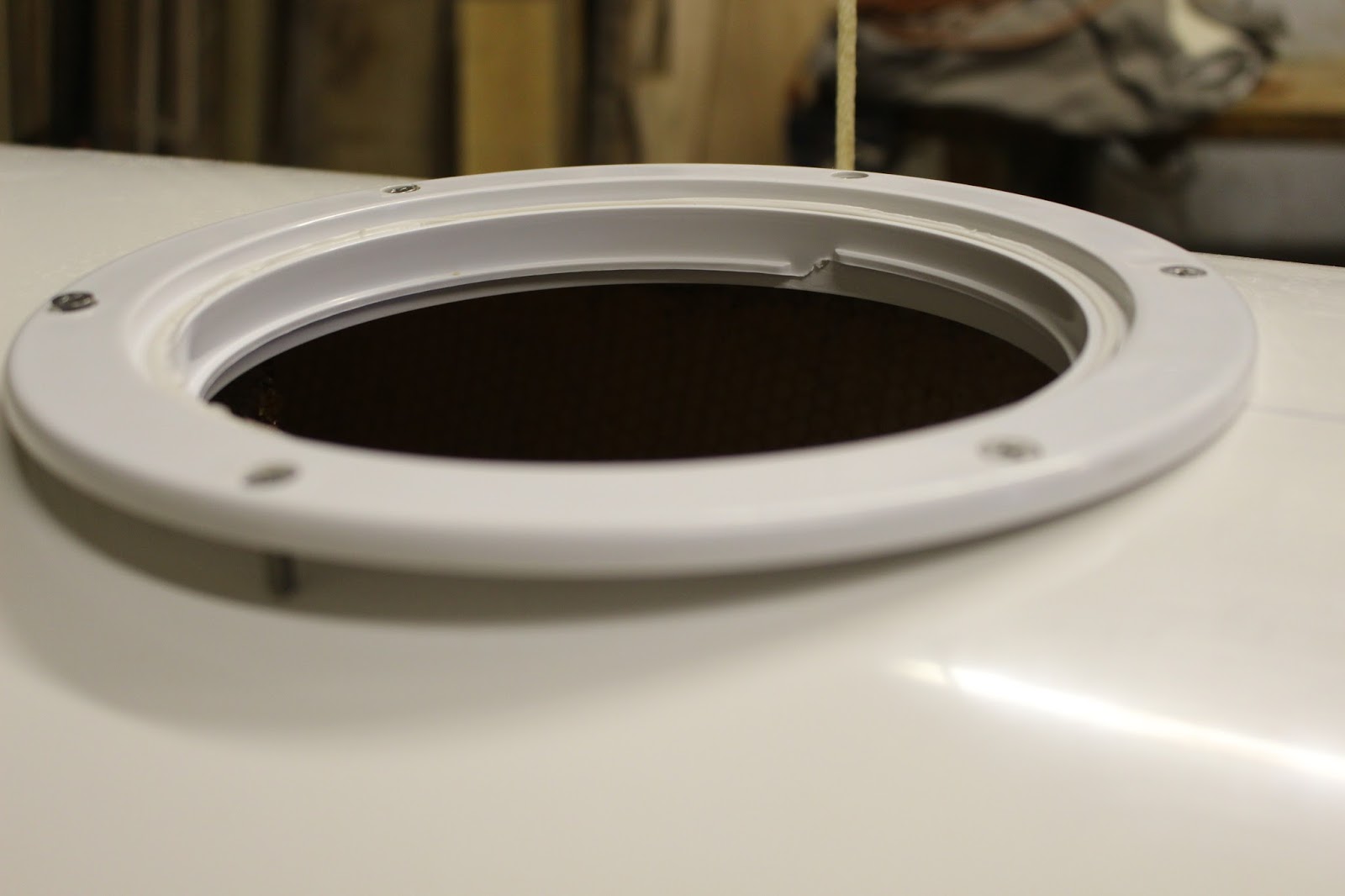
Happily, there's a nice neat solution: a screw-in marine "inspection" hatch.  Here's an 8-incher I found online:


I ordered this one from an Ebay seller, but I expect you can find one at a typical marine supply store, too.  I'd cut my hole so the rim would drop right in, so all I had to do after that was attach it with stainless machine screws and an adhesive sealant.

One little problem is that the deck has some curvature to it, so the hatch rim wouldn't contact it all the way around:


To some extent I could tighten the screws and pull the rim flat against the deck, but I didn't want to be too aggressive with that because if the rim took on the deck's curve the lid wouldn't screw in properly, and it might put undue stress on the deck.  So for the most part I chose to let the hatch and the deck keep their respective shapes and fill in the gaps.

First, I applied G-flex epoxy to the twelve o'clock and six o'clock areas of the rim's underside, put the hatch in place, and tightened the screws at eleven o'clock, one o'clock, five o'clock, and seven o'clock:


Note that I screwed in the lid to keep the rim from taking on too much of a curve.  Also, I'd sanded all the mating surfaces so the G-flex would stick well.

Next, I filled in the gaps where the deck curves away from the hatch.  For this job I used a thickened version of G-flex epoxy (also available from Sweet Composites).  This version has the consistency of toothpaste, and fittingly enough, it comes in tubes:


Both kinds of G-flex mix up in a 1:1 ratio, so you just squeeze out equal amounts of resin and hardener (or as close as you can get, at least; there does seem to be some margin for error).

I performed this task in a couple of steps, stuffing a bit of thickened G-flex into the gap, letting it harden up a bit, and then stuffing in some more G-flex until the gap was filled:


I filled the right gap first, and then the left gap.  Each time I had the boat rolled up on its side so I'd get as much help from gravity as possible.

And so, that hole is now sealed up, but I can open it anytime I want.  After the G-flex cured I trimmed and sanded off as much of the messy excess as I could from the deck.  The hatch almost looks like a little turret:


I suppose if I wanted to be cute I could stick a little machine-gunner doll back there.  Or, if I had an infant child, I could install a baby seat.  Maybe some future owner of this boat can do that.

Saturday, September 24, 2016

Affixing the rudder-line tubes

Still to be done in this boat repair project are cementing those rudder-line tubes in place and doing something about that hole I cut in the boat.  For these jobs I will be delving into the world of fiber-reinforced plastics (FRP).

I do not for a minute claim to be a great expert in FRP.  I know a number of people who are experts, or at least highly-accomplished amateurs; the ones I can think of off the top of my head include John Kazimierczyk in New Hampshire, Bill Hearn in Massachusetts, Doug Bushnell in New York, John Brennan in Colorado, and Brad Rex in Louisiana.  Every time I have a problem with a boat I wish I had one of these people around to hold my hand while I fix it.  But I don't, and as a result I'm a veteran of years of trial and error and I've managed to learn a thing or two in the process.  And frankly, I believe that any canoe and kayak racer worth his salt has at least a modicum of skill in FRP repair.  As I mentioned in a previous post, our sport doesn't have the abundance of tech support personnel that sports like golf and tennis and bike racing and auto racing have, so if there's a problem with your boat you should be ready to fix it yourself.

The first thing I did was affix the rudder-line tubes to the inside of the hull amidships so they won't just be flopping around freely in there.  The boat actually does have existing eyelets that the old tubing passed through, but my new British-unit-sized tubing is a hair bigger than the old metric-unit-sized tubing, and it doesn't fit through them.  Also, I can't reach most of these existing eyelets from the hole I cut.  So I had to do something else.  For this job, I used this product:


The two-part West System epoxy resin and hardener can be purchased from various retailers; I get mine from Sweet Composites, owned by my old slalom-racing friends Jennifer and Davey Hearn.  The yellow pumps are calibrated to dispense the resin and hardener in the correct ratio.  The plastic tub contains fine wood dust saved from my electric sanding tools (for those who don't know, I build wood furniture in my out-of-the-boat life).  Fine wood dust makes a good thickener.

I mixed up the resin and hardener in the clear plastic cup.  Then I added it to a pile of wood dust in the black jar lid.  I added wood dust a little at a time until I had a paste with a consistency similar to peanut butter:


I then used little globs of this paste to glue the tubing to the inside of the boat in as many places as I could reach.  This is about the best camera angle I could get:


The spring clamps are there to hold the tubing flat against the hull surface.  I should note that I had sanded the hull surface ahead of time so the epoxy paste would form a good mechanical bond with it. Epoxy is unlikely to bond with the smooth glossy plastic of the tubing, so I tried to pile the paste up and over the tubing to create a crude "eyelet" that the tubing passes through.

Once the paste had had a few hours to get good and hard, I turned my attention to the ends of the tubes where they poke out of the boat at the stern and in the cockpit.  To secure the tubes in these spots, I turned to another West System product (also available from Sweet Composites):


G-flex epoxy is supposed to better than traditional epoxy at sticking to common consumer-grade plastics like that of the tubing, and it's good for bonding dissimilar materials, so my hope is that it will keep the ends of the tubes where they belong.  Hoping to create the best possible bond, I roughed up the tubing surface by sanding it lightly with coarse paper.  Then I mixed up some G-flex and applied it where the tubing emerges in the cockpit:


...and where it emerges at the stern:


In both places, I'd pulled the tubing taut ahead of time.  You can see the postal tape I used to keep it in place in the cockpit; at the stern, the left-hand tube was wanting to slide back into the boat, so I used the piece of wire to hold it where I wanted it.  (Yes, the excess tubing will get trimmed off later.)


Coming up next: I'll do something about that hole I had to cut in the boat.

Friday, September 23, 2016

Putting in some new rudder-line tubes

Using some ropes suspended from the ceiling, I've positioned my boat at a comfortable work height:


The old lines had some useful information printed on them:


(O.D. stands for "outer diameter," and I.D. stands for "inner diameter.")

I googled Sun-Rise Polyurethane Tube and learned that it is a Taiwanese company.  That makes sense, considering that this boat was manufactured in China.  I browsed the Internet for a similar product manufactured domestically, and found tubing for sale at Grainger that was manufactured by Saint-Gobain Performance Plastics of Akron, Ohio.  I ordered some tygothane tubing in the closest British-unit size to the old tubing that they had: 1/4 inch O.D., 3/16 inch I.D.:


100 feet was the smallest quantity of this tubing I could buy.  That means I'll have plenty left over after I cut the two rudder-line tubes, each of which will be around 10 feet long.  If anybody would like some of this tubing, let me know in the Comments section and we'll talk.


I cut two lengths of tubing with a few extra inches so I'd have some excess to work with at each end.  I used a long piece of wire as a "needle" to pull the tubing into place.  I did so in two stages--from the cockpit to the hole I cut:


...and from the hole I cut to the rudder hatch at the stern:


I'd drilled a little hole through the end of the tubing through which I could insert the wire.


Now that the two pieces of tubing are in in position, it's time to cement them in place.  That'll be the topic of my next post.

Let's have a look inside that boat

As I've mentioned in recent posts, I was unable to thread new rudder lines in my six-year-old Epic V12 surf ski because, I believed, the tubes that house the lines were broken inside the boat.  Having tried every trick I could think of to avoid it, I decided some major surgery was in order.

I hated to do it, but I sucked it up and did it: I cut a hole in the deck of my beautiful boat, some 14.5 inches (37 cm) aft of the seat bucket:


Right away I learned something new: the boat has a reinforcing wall running the length of its stern half (and maybe its bow half too, but with any luck I'll never have to lay eyes on it):


So I had to cut a little section of that out to complete the hole.


A look inside confirmed my suspicion that the rudder-line tubes were broken:


In fact, the tubes turned out to broken into may pieces:


How this happened, I'm not sure: the degradation of any plastic product typically involves exposure to ultraviolet radiation, and you wouldn't expect that with tubes sealed inside a boat like this.  My best guess is that the fluctuating temperature is responsible.  I keep my boat down at the marina where it endures the hottest temperatures of summer and the coldest temperatures of winter.  The tubes do get moisture inside them and I can believe the freezing and thawing of that moisture in the wintertime takes its toll on the tubes over a period of years.

Obviously, I could avoid this problem by keeping my boat stored in my garage at home instead of down at the marina.  But I love the convenience of having my boat waiting for me down on the riverfront, where I can just take it off the rack and put it right into the water.  A little extra wear and tear on my boat is a price I'm willing to pay not to have to load the boat on and off my car every time I want to paddle.  The boat, after all, is simply a thing that enables me to engage in paddling, and the paddling is what is important.

So... anyway.  Now that the demolition is done, how will I rebuild?  That'll be the topic of my next post.

Wednesday, September 21, 2016

Post-race thoughts and post-season thoughts

On Sunday I felt remarkably good for the day after a race, with no soreness to speak of.  I gave myself a couple of days off before making it back down to the riverfront yesterday.  I had absolutely no agenda for yesterday's paddle other than to get in the boat and put some strokes together.  When I got to the mouth of the harbor I saw a barge rig moving upriver, so I decided to avail myself of some surfing.  I ended up with a pretty vigorous workout: the rig was already a hundred meters or so upstream of the harbor's mouth, so I had to paddle hard up along the Tennessee bank to gain enough that I could ferry out to where the biggest waves were.  That was ten minutes or so of high-aerobic-zone effort.  Then, catching each wave required a quick, hard sprint.

I hope to make it down to paddle at least once a week for the next little while, but I'm ready for a break from training and racing.  As I mentioned a couple of posts back, there are some things going on in my out-of-the-boat life that demand my attention.  And I'm just weary and ready for some rest.

Soon I want to start up a strength routine again.  I haven't done any strength work at all since I left on my trip to New England last month, and I expect I've gotten a bit weak in that area.

I also still need to do something about my old V12 surf ski that has the rudder-line problem.  I'll try to share some photos and commentary when I get around to that repair project.

In the meantime, now that the 2016 season is complete, how's about some reflection and introspection:

I participated in seven races this year, and I was not the overall winner in a single one of them.  This is the first year in about as long as I can remember that I didn't manage to finish first in some event somewhere.

Several races that used to be easy wins for me have become quite competitive.  Is this a sign that I'm not as good as I was three or five or ten years ago?  Maybe.  I'm certainly no more immune to the advancement of age than anybody else.  But I also think that the quality of racing is going up here in my part of the country, and I'd rather focus on that because the issue is near and dear to my heart.

The greater Tennessee-Arkansas-Mississippi region is rarely seen as a national leader in health-and-fitness-oriented activities.  More often we seem to make news for high rates of obesity and diabetes and heart disease and stuff like that.  Our region has also never really been foremost in people's minds when they think of excellence in canoeing and kayaking.  In one paddling discipline or another you'll find hotbeds in coastal regions and mountainous regions and a few of the trendier inland cities, but I'm used to getting looks of disbelief when I travel to one of those places and tell people I'm from Memphis, especially if I've just done well in a race.

I don't really care that much what outsiders think of my city and my region; oddly enough, I think we enjoy a certain quality of life as a result of not being a place that everybody else wants to move to.  But there's definitely room for improvement to that quality of life, and for my money nothing enhances quality of life better than good opportunities for canoe and kayak paddling, training, and racing.

I'd be remiss if I didn't recognize my friend Joe Royer, who through his company Outdoors, Inc., has driven the outdoor sports scene in Memphis and the Mid South, sometimes singlehandedly.  He founded the Outdoors, Inc., Canoe and Kayak Race in 1982--long before such events were considered cool.  Three and a half decades later that event continues to be as good as any I have ever participated in.

I'm not the same kind of leader that Joe is.  I don't have his energy or his business savvy or his gregarious charm.  But I can lead in other ways, and in general I try to set a good example in my approach to racing here in the Mid South.  In particular, I want to convey the message that the races I go to are indeed athletic events, and that being an athlete is a good thing, a perfectly normal thing for a person of any age and any walk of life... that you don't have to be an aspiring Olympian or a member of a pro sports team to have a training plan and set athletic goals.  I'd like to convince people that paddling hard and seeing how fast you can go is actually fun even though it's physically demanding at times.

Little by little, people are starting to show up who make it harder for me to win these races that I once could almost count on winning.  There are some young people like Carson and Conrad and Peyton Pellerin, and there are some older guys like Shane Kleynhans and Rick Carter.  I don't presume to deserve all the credit for their emergence, but I'd like to believe that at least a small part of their motivation comes from being tired of that Elmore guy winning all the races.

Mind you, I'm still a competitor and I don't exactly like getting beat.  I'll be spending this offseason pondering some ideas of what I might do to regain a title or two in 2017.  But it's a lot more fun to be part of a pack of people fighting it out up front that to be all alone in the lead.  I don't expect the Mid South will ever become the ultimate paddling mecca, but that's okay.  I'm just glad to see a few more people recognizing its potential for some exciting canoe and kayak racing.

I appreciate everybody who reads this blog and I hope you've enjoyed the vicarious experience of my race season.  After a little time off I guess I'll start the process all over again.  Because... why not?

Monday, September 19, 2016

Movin' pictures

Here's a video clip of Saturday's race shot by Tom Taylor.  He was posted along the course some 2000 meters from the finish.  The K3 in the foreground has Conrad Pellerin manning the bow, Carson Pellerin paddling stern and controlling the rudder, and Peyton Pellerin paddling amidships.  That's me sitting on their starboard wake.  Shane Kleynhans hangs out a couple of boatlengths back.


Monday photo feature


At about this time two years ago I took my trusty whitewater boat down to the harbor for a couple of weeks of intense practice.  My race season had concluded for the year, and I was about to drive up to Deep Creek, Maryland, to watch the world championships of whitewater slalom racing, after which I would spend several days on the Gauley River near Summersville, West Virginia.  I hadn't been in the whitewater boat in a long time, so I figured some stroke drills and roll practice here on my home water were in order.

This is the same boat that got stolen this past April.  It was a good boat and I sure wish it would turn up, but that seems less and less likely with each passing day.

Sunday, September 18, 2016

Good competition in the Deep South

Racers gathered yesterday morning on the Pelahatchie Bay portion of Barnett Reservoir for the annual Gator Bait Race.  This weekend the eyes of most North American surf ski enthusiasts might have been on a couple of higher-profile events including the East Coast Championships up in Connecticut, but I consider this race in central Mississippi one of the more underrated events of the entire year.  It's not a splashy day-long event with a big post-race party full of live music and adult beverages and so on, but the race itself--the part that counts, after all--is meticulously organized and I have never been disappointed with the level of competition.

Starting and finishing at Pelahatchie Shore Park, the course makes a big loop around Pelahatchie Bay that takes paddlers across a couple of open-water expanses and through a narrow lily-pad-ridden channel behind a couple of islands.  The course is advertised as 5.5 miles (about 8800 meters), but modifications to avoid some problematic shallow sections made it quite a bit shorter than that yesterday.  The absence of the usual turning buoy at the beginning of the home stretch made it perhaps a full mile shorter.  One of my fellow racers measured it at around 4.5 miles (7 km or so) on his G.P.S. device.

The race always starts right on time, so we got in our boats and warmed up and settled onto the starting line.  At the gun I sprinted hard to establish good position, and the boats who matched my speed were exactly the ones I'd counted on.  On my left were the 15-year-old Pellerin triplets from Breaux Bridge, Louisiana.  Carson and Conrad and Peyton Pellerin were paddling their Spencer "Patriot" boat as a K3, and as such they had already beaten me twice this season, but I was hoping to repeat last year's narrow Gator Bait victory and provide a benevolent reminder that they haven't quite seen the last of me.  Over to the right, meanwhile, was Shane Kleynhans of nearby Brandon, Mississippi, a newcomer to the sport who has made significant improvement in the last year.

I hopped on the Pellerins' stern wake, but they were moving so fast in that first kilometer that I couldn't hold it.  It seemed, at that moment, that their teenage bodies had matured right out of my league.  So I moved over and tried my luck on Shane's wake, but he was sprinting so hard in pursuit of the triplets that I had trouble holding that, too, and I feared that September 17, 2016, might be the day that I ceased to be relevant in the top ranks of canoe and kayak racing in the greater Mid South and Gulf South region.

Mercifully, this blistering starting pace didn't last.  As they approached the entrance to the "back stretch" channel the Pellerins had to back off a bit as they sought the clearest path through the lily pads.  Shane slowed down quite a bit as well, and I found an opportunity to sneak up into second place.  As we advanced into the narrow channel I found the pace much more manageable and I began to think there just might be hope for me yet.

Work crews had made a valiant effort at lily pad removal, but we had to pick our path carefully nevertheless.  A couple of times I thought I had snagged a hunk of vegetation on my rudder, but in the end my weed deflector proved equal to the challenge.  The Pellerins and I and Shane stayed single-file throughout this part of the course to avoid any race-ruining mishap.

As the course began to open back up I sensed that Shane was falling off the pace a bit, and to press the advantage I sprinted up onto the triplets' right-side wake.  That created a small gap and the pace began to nudge upward.  We might have opened up the pace even more if we hadn't been searching for the buoy that, as I mentioned above, wasn't there this time.

We finally realized what the situation was when we saw race official Tom Taylor directing traffic from his position on a motorboat.  We went left of a couple of islands and entered the final 2000 meters, and from this point on the race was remarkably similar to last year's in the way it played out.  I held my position on the triplets' side wake, occasionally throwing in a surge to see how they would respond.  Meanwhile Shane was hanging in there just a couple of boatlengths back and I knew better than to count him out.

With some 400 meters left I sprinted for the lead, but the Pellerins responded with a withering sprint of their own and I knew they had the upper hand this time around.  I dropped back on their stern wake and tried my hardest to stay there.  As the course veered left toward the finish line I made one last attempt to cut inside and slip by them there, but to no avail.  Clearly the triplets have developed a top speed I can't match and they reached the line seven seconds ahead of me.  Shane held on for third place, and a little while later Nick Kinderman of Ocean Springs, Mississippi, used a strong finish to claim fourth place overall and third in the men's single race boat class over David Dupree of Rayville, Louisiana.

The full results are posted here.  Conrad Pellerin and Carson Pellerin are listed in first and second place, but they were in fact in the same boat along with their brother Peyton.  So I was second, Shane was third, Nick was fourth, and so on.  Camille Richards of Madison, Mississippi, was 20th overall and the top female finisher.

After a good hard-fought 40 minutes or so of racing we were happy to unwind and start the rest of our day with a nice catered lunch in the Pelahatchie Shore Park pavilion.  Some rain moved in as the last finishers were completing the course, but there was no lightning and I would say the weather was nearly ideal overall.  I expect the 2017 Gator Bait race will be about this same weekend and I hope more racers will consider attending this fine event.

Friday, September 16, 2016

Racing to escape stress

I'm spending tonight in Jackson, Mississippi, ahead of the Gator Bait Race on Barnett Reservoir tomorrow morning.  I've just been to the race check-in place where I filled up on some sponsored food.  I expect there will be some good competition tomorrow so I'm hoping for a good night's sleep.

I've had a rather stressful week at home and I'm glad to be away from that for a few hours.  I'm having some major renovation work done on a rental property I own and I've been dealing with some important decisions and some sizable bills.  I've always been prone to anxiety and I will be glad when this is all behind me.  It'll probably last another month or so.

I've been down to the river four times this week.  Each time I did the stuff I typically do to get race ready: some relaxed stretching and visualization; a good long warmup; and some short sprints at maximum intensity with full recovery in between.  By the end of each session I felt as upbeat and relaxed as I've felt this whole week.  Exercise supposedly releases endorphins, and I think that was working for me.