Friday, July 8, 2016

"A healthy life is a good life"

These days the Internet and other mass media are bursting at the seams with "healthy living" advice, and as an athlete I'm tempted to dismiss it all as irrelevant to me, as intended for a more sedentary audience.  But every now and then something does get my attention.  Every Wednesday my local public radio station runs a brief "healthy living" segment with Sheila Harrell of the Church Health Center, and this week she presented us with a list of statements that each of us is supposed to evaluate with "Strongly agree/Agree/Not sure/Disagree/Strongly disagree."

  • I don’t usually rush from one commitment to another.
  • I take care of myself as well as others.
  • I nourish myself with a well balanced diet.
  • My home and workspace are organized.
  • I feel positive most of the time.
  • I spend more time doing what I want than what I should.
  • I use my annual vacation time.
  • I get adequate sleep.
  • I have at least one strong relationship with someone who supports me.
  • I don’t smoke, drink to excess, or have any other addictive behaviors.
  • I take at least 15 minutes daily to do something I enjoy.
  • I have a hobby.
I can "strongly agree" with the majority of these statements--after all, I'm an athlete and keeping myself healthy is more than just a casual endeavor--but there are a couple that I could do better on, and that's why this particular radio segment got my attention.

Tuesday, July 5, 2016

Unexpected variety on the riverfront

The weather report on the radio yesterday morning made it sound like a typical July day--hot and humid--but it wasn't until I got down to the river that I realized how windy it was.  I'd planned to do a two-hour paddle and was counting on a long grind, but instead I spent the first hour enjoying some Memphis-style downwind action out on the Mississippi between the mouth of the harbor and the Hernando DeSoto Bridge.  I wasn't getting any long, sweet rides, but I had fun catching all kinds of bumps for a few seconds at a time.  I got plenty wet, with waves crashing into my bucket and footwell, and along with the south breeze that kept me cool.  There aren't but a couple of months each year when I actually enjoy getting drenched while paddling, and that time has arrived.

At the end of the first hour I went back into the harbor and paddled steady to the north end and then back down to the dock.  This was more the "grind" I'd been expecting.  I was tired from the downwind stuff, and also from the strength exercises I'd done on the dock before getting in the boat.  I did two sets of pushups and two sets of the core exercise I'd learned from the Lèa Jamelot video on Face Book--in other words, I did the two exercises from this month's strength routine that require no equipment.

When I'm paddling tired like that, I focus hard on maintaining good stroke form.  The hope is that in the late stages of a race when fatigue has set in, I'll still be taking good strokes.

After yesterday's endeavors I was tired in the boat today.  Joe and I paddled an easy-to-medium pace in the harbor for 80 minutes.

Monday, July 4, 2016

Monday photo feature


Five years ago I joined a bunch of gulls on the water along the Outer Banks of North Carolina.

Sunday, July 3, 2016

Weekend exercise

Those comfortable days we had in the middle of last week are over, and the humidity is creeping on back up there.  But it's still not as bad as it was last weekend, and it definitely isn't as bad as those couple of days right before the OICK race.

Yesterday I paddled for 70 minutes out on the Mississippi, pushing the pace pretty hard now and then.  Considering the hurt I'd put on myself on Thursday, I felt pretty good in the boat.

Under normal circumstances I'd have paddled today, but I had to make a two-hours-one-way trip over into Arkansas to pick up some white oak logs to use in my woodworking business.  Right now my pickup truck isn't rigged to carry a boat, or else I'd have taken one and paddled it on the Spring River near where the logs were.  Instead I took a swim in the Spring, and it felt great after getting very sweaty and dirty dealing with those logs.

I'll make up for the missed paddling tomorrow.

Friday, July 1, 2016

Summer pace work

We've gotten a break in the weather this week: since Tuesday the Fahrenheit highs have been in the high 80s or low 90s, and the humidity is down.  It's significantly more comfortable than it was last weekend.

Not sure how much longer the nice conditions would last, I made sure to get in a good workout in the boat yesterday.  I warmed up for ten minutes and did three of my backpaddling-then-forward-paddling power drills.  Then I paddled up the Mississippi to the mouth of the Wolf River.

I started my G.P.S. and did a one-mile piece up the Wolf, trying to maintain 7 miles per hour.  At yesterday's Mississippi level (12.7 feet on the Memphis gauge) I expected to have flatwater for at least a mile up the Wolf, but I suspect I might have been fighting a slight current in the second half of my piece.  I finished the piece in 8:42.  I recovered by paddling back toward the mouth of the Wolf, and the ease with which I moved around 6.7 mph supported my belief that there was a bit of current flowing.

I started my next one-mile piece at the power lines that mark the OICK race start and headed out down the Mississippi, where I definitely had some current flowing.  Because of that I wasn't really paddling a true mile, but I tried to keep the intensity the same.  I maintained about 11.4 mph on the G.P.S.--on flatwater that would be around 7 mph since the Mississippi River flows at 4-ish mph.  My elapsed time for this mile was 6:43.

I finished the piece and paddled/drifted downriver in recovery.  I was quite tired by the time I reached the mouth of the harbor and gathered my courage for one last piece on what I knew would be dead flatwater.  Once again 7 mph was the target pace.  I was feeling it bad as I gazed longingly at the landmark where I knew my mile would end, and I attempted to comfort myself with reminders that it wasn't as god-awful hot as it was last weekend.  At last I completed the piece 8 minutes and 32 seconds after I'd started, and it felt good to know that I'd pushed through the pain with an effort consistent with the previous two pieces.

I arrived back at the dock with a total in-the-boat time of 100 minutes.  If I can get this kind of workout in at least once a week through the heart of summer, I'll have accomplished something.

Tuesday, June 28, 2016

Another strength routine

I've started up a new strength routine to run to the middle of July.  I've actually been doing it since the beginning of last week.

I'm pretty sure I've mentioned here before that strength work is my least favorite part of training.  The only reason I do it at all is that I do think it's beneficial.  But I try to keep my routines pretty simple and brief.  The less pleasant something is, the more tempted I'll be to skip it.

This new routine mostly works my core: two exercises use the stability ball, and another one is an exercise I learned watching a video posted on Face Book by a French flatwater racer named Lèa Jamelot.  (Thanks to slalom racing friend Billy Hearn for sharing it).  Jamelot does a number of neat exercises in the video and I'll probably work them into future strength routines.

The routine goes like this:

1.  Kneeling atop the stability ball
2.  Pushups
3.  Stability ball exercise demonstrated by Chinese slalom kayaker Jing Jing Li at 2:56 of this video
4.  Lèa Jamelot's exercise: involves standing on one hand and same-side foot, and touching the other-side elbow to the knee


I would love to share the entire Lèa Jamelot video here, but it's posted on Face Book (not You Tube or Vimeo or something like that) and there doesn't seem to be a way to embed it in a blog post.

Monday, June 27, 2016

Monday photo feature


We had a long, lovely spring here in the Mid South so I can't really complain about it, but it does seem that the dog days have settled in here before July has even begun.  Down at the dock that means a bath under the hose after paddling.  Paddling on a stifling hot day, I typically spend the last half-hour or so longing for this moment, and I doubt showering on granite slabs overlooking the Mediterranean Sea could feel any more luxurious.

I don't care for temperatures at either extreme, but I especially dislike hot weather, and when a spell like this one sets in I try to relish every little positive thing I can.

The dish-soap bottle contains Dr. Bronner's soap.

Sunday, June 26, 2016

Reloading

Anybody who knows me or who has read this blog for a long time knows that I crave a comfortable routine.  And it feels like I've lacked one for at least the last month, with the pain in my hip and the resulting down time followed by a hurried attempt to get back into decent racing form for last weekend's OICK race.

Now, with six weeks to go before I race again, I'm trying to settle back in for a while and put together some days and weeks I can feel good about.  This past week I did a 70-minute paddle with Joe in the harbor on Tuesday, four 500-meter sprints with a group out on Walnut Grove Lake Thursday, a 90-minute paddle out on the Mississippi yesterday, and a 60-minute paddle on the riverfront today.

The sprint session on Thursday was an exhausting but overall good workout.  We've got close to a dozen or so paddlers interested in racing here in the Memphis area, but we're sort of spread out all over town and paddle in different places and we don't see one another that often.  These weekly sessions on Walnut Grove Lake (and eventually Patriot Lake, once it reopens) are a good remedy for that and I'm hoping to get out there maybe every other Thursday this summer.

This past Thursday Kata Dismukes's husband Ralph remarked that it looked like I wasn't getting my paddle blades fully submerged, so when I paddled today I shot some video of myself with my Go Pro camera mounted on my stern to see what was going on.  I tried my best to paddle like I normally do and not do any faking for the camera.  The footage revealed that on maybe every fifth stroke my right blade wasn't going all the way in.  It's not the first time I've spotted that in videos of myself, but I thought I was doing better these days.  So there's something for me to work on.

We're having a run of hot weather here, and I took my camel back full of icewater with me on yesterday's longer paddle.  I drank up the whole thing, and I don't often do that.

Tuesday, June 21, 2016

Until next year...

Here's a final observation about the Outdoors, Inc., Canoe and Kayak Race before I move on to other things.

My opinion is not unbiased, of course, but I simply can't imagine a better event for the city of Memphis.

When it comes to things like tourism and entertainment and culture and so on, it seems that our city too often tries to swing for the fences.  In the downtown area alone in the last fifteen years, the city, which does not have a particularly wealthy tax base, has built an arena to lure a pro sports team, given millions in tax breaks and subsidies to persuade a large retailer to convert the old arena to a destination store, and financed an incompetently-managed, colossally over-budget construction project on the riverfront to serve large passenger riverboats.

I'm not here to make provocative political statements, and I'm willing to say yes, pro sports teams and destination retail stores and big capital projects can be good for a city.  But the point I'd like to make here is that all the millions of dollars in the world cannot create the sort of community spirit I saw down on the riverfront on Saturday.

No event happens for free, and a good bit of money got spent to make the OICK race happen (no small portion of it on fees levied by the city bureaucracy).  But it was the people, not the amenities, that made the event.  And those people were participants in a joyfully healthy endeavor: propelling human-powered craft down the city's greatest natural resource, the grandest river in North America.

The event brings together subsets of the canoe and kayak racing population who don't often see one another.  Surf ski racers tend to gravitate toward open-water venues near the coast.  Marathon canoeists have their own races on small, mostly flat rivers.  Wildwater racers prefer... wild water (i.e., whitewater on mountain streams).  But the OICK race has hosted all these types of racers, and more.

And all these racers get to mingle with a slice of the Memphis population that doesn't even race except this one time each year, when they drag their canoes out of their backyards to spend a beautiful June morning paddling, socializing, cheering, and laughing down on the riverfront.

I'm not suggesting that the city should bankroll events like the OICK race; on the contrary, I think that would diminish their grassroots spirit.  But it would be nice if our leaders would show a bit more appreciation of their value, and perhaps remove a few of the hoops that organizers have to jump through to put them on.  To put it another way, I'd like to see the city and its business elites trust us to entertain ourselves.  We sure had a blast doing it last Saturday.

Here's a look at this year's race tee shirt:


At least in my opinion, it's delightfully un-fancy.  Very basic.  As my friend Joe, who happened to be the race director last weekend, put it, "The tee shirt doesn't make the event.  The event makes the tee shirt."  I'll be wearing mine proudly not because of its pizazz but because of the quality event it represents.

As a general rule, the OICK race takes place the day before Father's Day each year.  That means you can at least pencil it in for June 17, 2017.

Monday, June 20, 2016

Monday photo feature


Eric Mims (in the blue hat, with his back to the camera) was part of the winning boat in Saturday's Outdoors, Inc., Canoe and Kayak Race, but he was also on the job as a representative of Epic Kayaks.  After the race Eric manned a booth with his company's boats on display, and on Sunday he worked the annual post-race boat demo, helping dozens of potential customers try the boats out on a lake at Shelby Farms.

In the photo, taken after the race on Saturday, Peyton and Conrad and Carson Pellerin try not to look too bored as their father Andre talks boats with his friendly Epic rep.

Sunday, June 19, 2016

Giving it my best in the 35th OICK race

As the 10:15 AM start time for yesterday's Outdoors, Inc., Canoe and Kayak Race approached, it appeared we had lucked out with the weather: even though the Fahrenheit temperature was climbing toward the 90s, the humidity wasn't nearly as bad as it had been Thursday and Friday, and a pleasant northwest breeze caressed us as we warmed up and took our positions on the starting line.  The river was a bit low--7.6 feet on the Memphis gauge--but somehow we found enough room for two-hundred-plus boats in the mouth of the Wolf River up at the north end of Mud Island.

I was feeling about as good as I could ever hope for: I was rested, my strokes seemed to have a nice "pop" to them, and my left hip was virtually pain-free thanks in part to the adrenaline flow.  I think a part of my psyche was still smarting from my struggles of a week earlier, but in general I felt ready to get out there and mix it up with what I knew would be a competitive field.

The gun went off, and I got off the line as well as I have in a long time.  In the first 50 meters the only boats in my peripheral vision were the single surf ski paddled by Mike Herbert over to my left and the tandem surf ski paddled by Eric Mims and Waylon Willis on my immediate right.  Those two boats were the pre-race favorites and I wasn't at all surprised as they quickly moved out ahead of the rest of us.

As we navigated the squirrelly water where the Wolf gives way to the Mississippi, things got a bit crazy as the boats I was counting on for my main competition began to assert themselves.  The Pellerin triplets--Carson, Conrad, and Peyton--propelled their K3 out onto the main river with a confidence beyond their 14 and a half years.  Rick Carter was close behind, trying with all his might to take control of the "second pack."  Kata Dismukes nudged in from my left and I briefly got my bow hung up on her stern while trying to stay on her wake.  To my right, the rapidly-improving Shane Kleynhans surged ahead of me.

It all happened so fast that I can't even begin to pinpoint the critical moment, but I found myself a couple of boat lengths behind this four-boat pack and I would spend the rest of the race sprinting in vain to get up on their stern wakes.

Up front, Mims and Willis pursued their bid to take down the defending-champion Herbert.  Herbert sat on their left-side wake, and bow paddler Mims waited for an opportunity to break away.  Finally, between the Hernando DeSoto Bridge and the southern tip of Mud Island, it came: the Mississippi's swirling currents kicked the tandem ski far enough to the right to leave Herbert teetering on the fragile outskirts of the wake, and Mims threw down a ferocious flurry of strokes.  Willis followed Mims's lead, and the pair began to pull away as they headed up into the harbor.

Meanwhile, the Pellerins continued to lead the second pack with Rick Carter, Kata Dismukes, and Shane Kleynhans in tow.  I attempted sprint after sprint after sprint, but simply couldn't attain Kleynhans's wake.  I finally saw an opportunity to close the distance when the four boats ahead of me went wide around the tip of Mud Island.  Knowing just how tight I could make the turn without scraping the muddy bottom, I moved within a boat length of Shane's stern as the finish line came into view some five hundred meters away.

Fully aware that they were dealing with a three-time Olympian, a winner of three world championships medals, a Pan American Games champion, and an almost-winner of an Olympic bronze medal--all in the person of one Mike Herbert--Mims and Willis kept the pressure on all the way to the finish line, winning the overall title by 24 seconds.  After Herbert clocked in, more than a minute would pass before the chase pack would sort itself out.  Rick Carter swung to the right of the Pellerins confident that he could outsprint them in the closing meters, but the triplets refused to give an inch and finished three seconds ahead.

Exhausted from all my surge attempts out on the river, I figured Carter and the triplets were beyond my reach in the harbor and I focused my attention on making a run at Kata and Shane.  Each of them was bent on beating the other, however, and even my most valiant efforts couldn't prevent them from pulling away.  Shane sprinted furiously in the final 50 meters to overtake Kata right at the line, clocking in less than a full second ahead of her.  Mercifully, my own race came to an end thirteen seconds later.

Mims and Willis both live in the Charleston, South Carolina, area, where they work for Epic Kayaks. Herbert calls Rogers, Arkansas, home.  The Pellerin brothers hail from Breaux Bridge, Louisiana, while Carter lives in Eutawville, South Carolina.  Kleynhans is a native South African now living in Brandon, Mississippi.  Kata Dismukes grew up in Hungary, but just this past week she was awarded her United States citizenship; she lives in an eastern suburb of Memphis.

Paddlers competed in dozens of boat classes Saturday, and many outstanding performances were put forth on our majestic river.  Dale Burris (Russellville, Arkansas) and Don Walls (Dover, Arkansas) were the fastest overall canoe.  Bill Cains (Altus, Arkansas) and his daughter Amanda (Dallas, Texas) won the tandem kayak (sit-inside) class.  Phil Capel of Sherwood, Arkansas, was the top finisher in a non-race-boat kayak.  The complete results are posted here.  (Note: "Murray Ortega" is in fact Rick Carter.)

This morning I went out to Shelby Farms for the annual post-race boat demo, where I tried out a couple of the other surf skis on the market.  I had a chance to talk to Kata Dismukes out there, and she told me she doesn't feel like she's racing particularly well so far this year.  That's not what I wanted to hear from her, seeing as how she had just beaten me for the first time ever, but it's a worthwhile topic of discussion because I'm not feeling in very good form either right now.

The fact is that it's very difficult, if not impossible, for an athlete to be at the top of his game year in and year out no matter how hard or how wisely he trains.  I've met many Olympic hopefuls over the years, and many of them have told me that in a given quadrennium it's not a bad idea to back off from the sport a bit for a season--you can still race, but you should take it easier in training and not have such high expectations every single season.  That sort of makes sense to me because it seems that my body chooses to have "up" years and "down" years even if my brain doesn't want to make that choice.

Thursday, June 16, 2016

Pre-race stuff

It's been a week of rest, short sprints, and mojo repair.  Now, some 38 hours before the start of the Outdoors, Inc., Canoe and Kayak Race, I'm feeling reasonably rested and ready.  There's still some soreness in my hip area, but I don't feel nearly as beat-up as I felt last weekend.

The weather has been more and more humid in the last week or so, and today was easily the least-pleasant day of the year so far.  The temperature reached about 98 degrees Fahrenheit with the heat index exceeding 110 degrees.  It was already quite oppressive when I got down to the river around 10:30 this morning.  I hope Saturday won't be as bad as today, but I'm counting on a hot one.

Paddling this week has been mostly easy with a few sprints each day.  On Tuesday Joe and I paddled together for about 70 minutes and I did eight 12-stroke sprints with plenty of recovery time in between.  Yesterday and today I was down at the river by myself, and did nice long full-body stretching sessions before getting in the boat each day.  I paddled 40 minutes both yesterday and today, doing six 12-stroke sprints yesterday and four 12-stroke sprints today.

I was discussing the race with a friend recently and she asked me if I do any particular mental preparation.  I haven't talked much about that here lately, but the answer is yes, and I try to do a lot of visualization before a big race.  Pre-race visualization was a very important part of the slalom racing I did back in the 1990s and I find it useful for the racing I do these days as well.

For good visualization, get off by yourself in a quiet place, and relax your body as completely as you can.  Then go through the race in your mind, from your own point of view as you're sitting in your boat.  I always visualize the situation at the starting line and the things I need to do to have a good start.  As for the rest of the race, I visualize things unfolding exactly as I'd like them to, and I also visualize possible unexpected developments and how I might deal with them.  I visualize myself settling into a good mid-race tempo and also those moments when it's time to "put the hammer down."

I even try to visualize the things I want to be doing before I'm in the boat: going by the check-in booth, getting all my gear together, stretching, drinking water, putting on sunscreen... visualization is a good time to get all these details organized in your head, and that way they just sort of "happen" the morning of the race.

So... we'll see how it goes.  There are some good racers registered and I think it'll be an exciting contest.

Video from Batesville

There was one of those drones buzzing around the start of the race last Saturday, and we can now view the resulting footage:


I'd forgotten the actual name of this event: the "Spring Time Sprint."  I'd been calling it the Batesville Canoe and Kayak Race here.  Thanks to Robert Latus for the video.

Monday, June 13, 2016

Monday photo & video feature


At the end of my race on Saturday I saw a part of the town of Batesville I'd never seen before: the old White River Stadium.  A river stadium... how cool is that?

The now-forested piece of land that separates this narrow channel from the main river is manmade; before it was built a person could sit here and view the whole expanse of the White.  The venue hosted boating and water-skiing events that were probably similar to the ones that took place on McKellar Lake here at Memphis.  The townspeople even crowned a White River Queen on the stage surface in this photo.

What a shame that such events have fallen by the wayside in this part of the country.  I'd be in favor of bringing them back--provided, of course, that they include lots of canoe and kayak racing.

Here at Memphis today we might not have a river stadium, but we do have an event that's worthy of a legion or two of fans.  The 35th Outdoors, Inc., Canoe and Kayak Race is coming up this Saturday.  Here's some footage from the race in 2012:


My favorite part of this video happens around the 30-second mark, when a bunch of surf skis leads the parade down the Wolf River toward its confluence with the mighty Mississippi.

Right now it looks like the Mississippi will be between 7 and 8 feet on the Memphis gauge Saturday. That's some nine vertical feet more water than what you see in this video.

Sunday, June 12, 2016

Racing out of the Ozark foothills

I made the trip over to Batesville, Arkansas, yesterday, and not only am I still struggling in the downriver boat, but also I think it might not be a good idea to be paddling it with the hip troubles I've had.  My injured spot was hurting badly during the last several miles yesterday.  I may have to abort my trip down to the Chickasawhay River race.

We lined up below Lock & Dam No. 2 some seven and a half miles (11 kilometers) upstream of town, and off we went.  Phil Capel of Sherwood, Arkansas, led me by 30 or 40 meters in the early going, and I worked hard to try to pull even with him.  I was trying to avoid his wake so it wouldn't mess with my rudderless boat, but on the meandering White River I had to cross it several times.  With several hard sprints I finally managed to get up on his stern, and then I took the lead with a strong surge.  I knew I was working hard, but I thought maybe I could pull this one off.

My lead didn't last long, however.  Phil took a better line than I did around the next bend, and with a strong surge of his own he shot back into the lead.  In the blink of an eye he had a hundred meters on me, and the wind was gone from my sails.  By this time the pain and fatigue were taking their toll and I limped to the finish line in total survival mode.

This morning I'm feeling a bit stiff but not too bad overall.  I plan to go downtown for a short easy paddle in the surf ski just to loosen up and help my muscles recover.  I think my greater challenge for the coming week is to get some confidence back.  Less than a decade ago I was racing quite well in my downriver boat in events like the USCA Nationals and the Hatchie River Race, and to be struggling so now has dampened my mojo.  It's a clash between my traditional attitude--a somewhat brash and not entirely rational belief that I can hop in any race boat and be one of the better racers in this part of the country--and several realities, such as my lack of practice in that boat in recent years and my less-than-sound skeletomuscular health.  And, yes, my slow but inexorable age advancement.  I never like to admit it to myself, but maybe there are some things I just don't do as well as I used to.

I'd be lying if I said I didn't wallow in some self-pity in that last mile or so yesterday, but I refuse to look back on the weekend that way.  In fact, I had a pleasant drive across the Arkansas Delta, saw some good friends on the water, and paddled a lovely section of the White River.  And with my favorite event of the year, the Outdoors, Inc., Canoe and Kayak Race, just six days away, I have a chance to get myself back on track athletically.

Friday, June 10, 2016

I should've thought about this sooner

Last night I joined a half-dozen or so other local paddlers for a few sprints on Walnut Grove Lake on the east side of Memphis.


I paddled my old Apple Turnover boat (shown above in a file photo) for the first time in a long time.  It was my main race boat back in the late 1990s and early 2000s before I got my first surf ski.  After I got the surf ski I continued to use this boat at least once a year in the Hatchie River Canoe and Kayak Race over near Bolivar, Tennessee.  Since that race folded, I have paddled it only very occasionally.

This season I have a couple of races I want to use it in--the one on the Chickasawhay River in eastern Mississippi a couple of weeks from now, and the USCA Downriver Kayak Championships (for which this boat was originally designed) at the end of July.

But until last night I'd failed to realize just how out of practice I am in paddling such a boat.  The boat has no rudder--it's basically a wildwater boat designed for Class I-II water--and so the paddler must lean it right or left to steer it.  Once upon a time I totally had the hang of this skill, but by last night the relevant muscle groups hadn't done such duty in a long, long time.  "Awkward" was the word for how I felt as we went out and did five 500-meter sprints.  I didn't even bother looking at my times because I knew they were slow.

Tomorrow I will give this boat another outing on the White River at Batesville, Arkansas.  Then I'll be back in my surf ski all next week doing my final tuning for the Outdoors, Inc., Canoe and Kayak Race on the 18th.  After that I'll worry about how quickly I can be ready for that Chickasawhay River race.

Thursday, June 9, 2016

Turning up the heat in more ways than one

Our long, pleasant spring is giving way to summer here in the Mid South.  The last few days have been sort of a transitional period--hotter but not so humid, sort of like in the desert Southwest, where it's tough out in the sun but delightful in the shade.  But now the humidity is beginning to creep upward, and soon we'll be in the middle of another sweltering summer.

I think the best way to cope with a hot summer (or a cold winter) is just immerse yourself.  Those days when you have to grit your teeth as you step out of your comfortable home are actually not so bad once you're out and moving, assuming you're properly dressed in the winter and adequately hydrated in the summer.  I honestly think that my climate-controlled house feels much lovelier on those days when I've been outside working hard for part of the day.

This week I'm doing the last couple of workouts that my body will be able to process by the 18th of June, when the Outdoors, Inc., Canoe and Kayak Race takes place.  On Monday I did a set of eight pieces of "45 seconds on, 30 seconds off," doing each "on" piece at sub-maximum intensity.  It was a very tough workout, but it was over quickly.

On Tuesday I paddled easier in the harbor for 80 minutes.  My left hip felt quite sore from the stress of Monday's workout.  I knew I needed to give it a break yesterday.

I did the May-June strength routine both Monday and yesterday, and will do it tomorrow for the last time before the big Memphis race.

This evening I plan to join a few other paddlers in this area who have started a "Thursday night sprint" series.  We'll do a few 500-meter sprints out at Walnut Grove Lake.  I'll paddle just a little bit tomorrow, and then I'll do my "rehab assignment" on the White River at Batesville, Arkansas, on Saturday.

So, there's plenty going on.  I haven't raced since the 30th of April, and I'm looking forward to getting back at it and seeing some friends along the way.

Monday, June 6, 2016

Nice article on the U.S. Olympic slalom C2

“I’m not sure it was my dad’s Olympic history per se that inspired me to compete, but rather his abiding and contagious love for the sport,” Devin McEwan said. “So much so that his success in international competition seemed almost incidental.”
The full article is here.


Monday photo feature


Eric Mims of Isle of Palms, South Carolina, competes in the Paddle Bender race at Prosperity, South Carolina, this past Saturday.  In less than two weeks, Eric will be making the trip to Memphis to participate in the 35th Outdoors, Inc., Canoe and Kayak Race.  Photo by Elizabeth Poacher.

Sunday, June 5, 2016

Race schedule update

When a major-league baseball player is working his way back from an injury, he typically plays a few games at the minor-league level before returning to big-league play.  In baseball lingo this is called a "rehab assignment," and it gives the player a chance to work on his swing against live pitching and get his timing back and stuff like that before going back to the high-stakes world of the big leagues.

I've got my own "rehab assignment" coming up this Saturday: a race on the White River at Batesville, Arkansas.  I hope to get my body used to the idea of racing again before I face some tough competition here at Memphis the following Saturday.

At this moment, my race schedule for the remainder of this year looks like this:


June 11: Batesville Canoe and Kayak Race.  White River, Batesville, Arkansas.  A race of about 7 or 8 miles downriver from Lock 2 to the U.S. 167 bridge at Batesville.

June 18: 35th Outdoors, Inc., Canoe and Kayak Race.  Mississippi River, Memphis, Tennessee.  A wonderful event here in my hometown.  5000 meters down the Mississippi, starting at the mouth of the Wolf River and finishing in Wolf River Harbor at Mississippi River Park.

June 25: The Great Chickasawhay Race.  Chickasawhay River from Shubuta, Mississippi, to Waynesboro, Mississippi.  21 miles downriver.  The name of the river is pronounced chick-uh-suh-HAY.

July 31: USCA Downriver Kayak National Championships.  White River, Batesville, Arkansas.  The national championships for kayaks that meet ICF wildwater specifications.  Held in conjunction with the USCA Stock Aluminum Canoe National Championships.  The course will run upriver and downriver, starting and finishing at the U.S. 167 bridge at Batesville.

August 6: The Paddle Grapple.  Fontana Reservoir, Bryson City, North Carolina.  A 10-kilometer flatwater race.

August 12: USCA Marathon National Championships.  Connecticut River, Northfield, Massachussetts.  13 miles both upriver and downriver.  I will be competing in the K1 Unlimited class in my surf ski.

September 17: Gator Bait Canoe and Kayak Race.  Barnett Reservoir, Brandon, Mississippi.  A 9-kilometer flatwater race.

Mending (cont'd)

My injured area is doing better each day.  Yesterday I paddled for 50 minutes and felt no pain at all for the first ten or fifteen minutes.  Some soreness developed after that, but nothing too bad.  Considering how hard I paddled on Friday, I find that very encouraging.

I paddled at easy-to-medium intensity yesterday.  I'm taking today completely off, and tomorrow I plan to do another strength routine on the dock followed by a workout in the boat.

Friday, June 3, 2016

All told, a strong week

I knew I needed some good recovery time from Monday's more intense workout, so I paddled easy on Tuesday and yesterday, and on Wednesday I did the May-June strength routine but didn't paddle.  My injured area has responded in encouraging fashion.  There's still a bit of soreness there, but it's seemed less and less like something to worry about each time out.

This morning I went down to the marina and found another dead-calm scene in the harbor.  I did the May-June strength routine on the dock and then got in the boat.  I ran into Joe down there and he accompanied me on a good long warmup paddle down to the mouth of the harbor and back to the marina.  Then I commenced my workout: it was the same as Monday's--six two-minute pieces with two minutes recovery in between--but this time I nudged the pace up from 7 miles per hour to 7.5 mph.

Today's workout felt much harder than Monday's.  On Monday I felt taxed but never doubted I would finish it out strongly and smoothly; today, with two pieces to go, I wondered whether I could maintain that 7.5 mph pace and even considered dialing it back to 7.  But I bore down and got it done as planned, and I hope that will pay psychological dividends in a race soon.

I was feeling it the most in my legs, especially my thighs.  At the end of each piece my thighs throbbed and felt rubbery.  Granted, I'd just done Hindu squats as part of my strength routine on the dock.  In any case, I hadn't entirely intended today's workout to be an all-out affair, but it sort of turned out that way.  I'm still learning just how big a difference a half-mile per hour can make.  The hip held up fine... I guess I'm back.

Monday, May 30, 2016

Monday photo feature


The house we rented at Dauphin Island last week was very nice, but my one complaint is its lack of good water access for canoes and kayaks.  This photo shows some of the other houses in our little cul-de-sac off Mississippi Sound: many hundreds of thousands of dollars spent on dwellings, docks, boat lifts, and so on, and yet not a single low dock for canoe and kayak launching.  The anthropologist in me is dying to know: what on Earth is wrong with these people?

I came up with a decent solution at our house:


The boat lift was vacant, so I put the kayaks on it like so, and lowered it until the steel beams were just far enough underwater for the boats to be fully afloat with paddlers sitting in them.  That way you could stand on the beams when getting in and out of the boat.

Once again, Holmes Ingenuity™ saved the day.

Cautiously nudging up the intensity

In each of my last several times in the boat, my hip has been pain free for the first ten minutes or so but has become sore later in the session.  My approach has been to put a bit more stress on it each time out--without overdoing it--and then giving it time to recover before the next time in the boat.  I'm hoping that it will be a bit more solid each time.

On Saturday I paddled for 40 minutes in the harbor and a little bit out on the river, throwing in occasional short surges to see what the hip muscle could handle.  It was sore by the end of the session like I said, but didn't seem any worse when I woke up yesterday morning.

I gave myself all of yesterday off.  This morning I went down to the dock and did two rounds of my May-June strength routine, and then got in the boat for 50 minutes of paddling.  I warmed up for ten minutes, and needed all of that time to work out the fatigue from the strength exercises.  Then I did six two minute pieces with two minutes recovery in between.  The weather was calm, so it was a good day to use the GPS; I shot for 7 mph on each piece.  Once again the soreness in my hip increased as time went on, but I was careful not to red-line it and I think it will recover okay.

Saturday, May 28, 2016

Relaxing and healing (I hope) at the beach

I got home last night after enjoying three full days at Dauphin Island.  Each morning I paddled some in Mississippi Sound, usually accompanied by a niece or nephew in the fat plastic boat I took down there.  Each of the kids went out with me at one time or another, but my 12-year-old niece Rachel was my most enthusiastic paddling partner:


The intensity was low; I think my longest session was an hour or so.  Basically, it was terrible training to be doing less than four weeks before the five-kilometer Outdoors, Inc., Canoe and Kayak Race.  But I was in rehab mode, trying to get healed enough to do a faster workout or two before race day.  My hip is still sore, but I would say, with caution, that it's been a little bit better each day.

Each afternoon I walked across the island to the beach and swam, giving myself over to the healing power of the Gulf of Mexico.

Thursday, May 26, 2016

New strength routine

The weather here at Dauphin Island has been awfully close to perfect this week: mostly-sunny skies, Fahrenheit temperatures in the low 80s, a pleasant breeze.

I have started a new strength routine to go from now until my next race on June 18.  Since I'm on the road right now, I've drawn up a routine whose exercises rely on either body weight or easily-transportable rubber bands.  It goes like this:

1.  Dips
2.  Hindu squats
3.  Standing flies using rubber bands
4.  Four-way abdominal crunches
5.  Front and lat raises using rubber bands

I did the routine for the first time on Tuesday and then again today.  I'm still a bit sore from Tuesday's work but that just means the muscles are responding to a new stress.

Wednesday, May 25, 2016

U.S. Olympic Team: how many flatties?

I've been waiting to say anything more about the U.S. Olympic selection in flatwater because it's been hard to find much information online.  But the USA Canoe-Kayak website has finally posted a good explanation of what the situation is in the aftermath of the Pan American Championships at Lake Lanier last weekend.

Right now the U.S. has one guaranteed Olympian in flatwater sprint: Maggie Hogan of Huntington Beach, California, will compete in 500-meter single kayak in Rio.  She took second in this event behind a Canadian this past Friday, and since Canada had already qualified a female 500-meter kayaker for the Olympics, Hogan got a berth for herself.

2012 Olympian Tim Hornsby of Atlanta failed to place high enough in the 200-meter single kayak to guarantee his trip to Rio, but stands a decent chance of being named to the team later once other Pan Am nations announce their Olympic teams and the ICF reallocates any unused slots.  1000-meter canoeist Ian Ross of Gainesville, Georgia, also has a fair chance of ending up in Rio.

In both 2008 and 2012, the U.S. managed to send only two flatwater sprint racers to the Olympics.  Part of the reason is simply that U.S. athletes haven't been that successful at the international level so far in the 21st century.  Another part of the reason is the IOC's constraints on the number of canoe and kayak athletes in the Games, and its determination to allocate more of those berths to parts of the world that traditionally have not been as strong in canoe and kayak racing.

In any case, I'm hoping for the best.  I yearn for "the old days" when the U.S. sent a full contingent of flatwater racers--K2s, C2s, K4s, the whole bit--to the Olympics.  If it could get more than just the two berths it got in '08 and '12, that would be a shot in the arm.

Tuesday, May 24, 2016

Good place to train, if I could

I'm down at Dauphin Island until Friday.  The weather is gorgeous and I'm enjoying doing a whole lot of nothing this afternoon.

This morning I did some brief, easy paddling with my 12-year-old niece and my 13-year-old nephew. I wasn't sure how enthusiastic to paddle they'd be and I even considered not bringing a boat down for them, but as it turned out they were eager to go, especially my niece, so I'm glad I threw it on the car. They probably could have paddled all around the island if it weren't for my own physical limitation.

My hip didn't feel any worse than it felt when I paddled Saturday, but it didn't feel any better, either.  It's hard not to wonder whether I'll really be ready to race three weeks from Saturday.  The discomfort is such that I felt I could rev my engine if I needed to,  but right now I'm still nervous about making it worse.

Monday, May 23, 2016

Monday photo feature


I shot this photo of Peter White navigating a rocky stretch of water on the Pigeon River in 1993.

Sunday, May 22, 2016

Rehab assignment

Yesterday afternoon I got in the boat for the first time in nine days and paddled for 30 minutes.  I paddled from the marina to the mouth of the harbor and back, keeping the intensity as low as I could stand.

My hip felt sore the whole time, but there wasn't the sort of stabbing pain on each stroke that I'd felt the last time I'd paddled.  I hope that's a good sign--that perhaps the muscle tear has mended but the muscle hasn't yet regained its flexibility.  Not being a doctor or anything other than a guy who's lived in his body for almost a half-century, I hope that's what's going on.  The most encouraging thing is that the area didn't feel any worse when I woke up this morning.

I guess I'll take my boat down to Dauphin Island and just paddle easy while I'm down there, building up little by little.  I won't lie: this is very frustrating.  I've basically been out of the boat for two weeks now, with at least another week of very light paddling to come.  Assuming everything goes well and I don't do anything to aggravate the injury, that will leave me with about two weeks to do any meaningful training for the Outdoors, Inc., Canoe and Kayak Race on June 18.

I do, fortunately, have a good training base under me this season, and my fitness level should be up to the challenge.  My biggest concern is the intensity level required for a five-kilometer race, and whether I'll be able to heal enough to train all-out a time or two before race day.

We'll see.  There's a lot of season left after June 18, so I'll do my best to be ready for that date without hurting myself any worse.

Friday, May 20, 2016

U.S. Olympic Team update

I learned this morning that the ICF has made its decision, and the U.S. will indeed be allowed to enter boats in all four whitewater slalom classes at the Olympic Games this summer.  And so the U.S. Olympic Team is now set in this discipline.  Here are the U.S. athletes you'll see paddling whitewater on TV this August:

Women's kayak: Ashley Nee, Darnestown, Maryland
Men's kayak: Michal Smolen, Gastonia, North Carolina
Men's single canoe: Casey Eichfeld, Drums, Pennsylvania
Men's double canoe: Casey Eichfeld, Drums, Pennsylvania, and Devin McEwan, Lakeville, Connecticut

I've also recently learned that Michal Smolen's first name is pronounced "mee-how."  I'd just assumed it was pronounced just like "Michael."

Meanwhile, the Pan American Championships for flatwater sprint are taking place right now on Lake Lanier at Gainesville, Georgia.  This event will determine the boat classes in which each nation of the Americas will be allowed to enter athletes.  I'll share the results when I know them.

Wednesday, May 18, 2016

Strength routines

My hip is not pain-free, but I believe it is improving.  I'm trying to be patient and not rush back into the boat too soon.  Like I said, I'm trying to stay active doing stuff that doesn't affect the injured area, and I'm also doing my strength routine more frequently since I have more time on my hands.

After the race at Vicksburg back on April 30, I looked at the calendar and saw I had seven weeks before the Outdoors, Inc., Canoe and Kayak Race here at Memphis.  I decided to do one strength routine for about the first half of that period and then another for the second half.  Right now I'm still on the "first half" routine, and it goes like this:

1.  Military press with dumbbells
2.  Dead lift and then military press with a barbell
3.  Pullups
4.  Stability ball core exercise

Before my injury, I was doing this routine twice a week (Wednesdays and Fridays), going through the routine twice each time.  At the end of last week, when I realized that I'd have to stop paddling for a while, I went to an every-other-day schedule: I did the routine Friday, Sunday, and yesterday, and I'll do it again tomorrow and Saturday.

I'm leaving town next Monday for my annual trip with my mother and my sister's family to Dauphin Island on the Alabama Gulf Coast.  I'll be down there until Friday.  I figure this will be a good time to switch to the "second half" routine.  I haven't settled on the exact routine yet, but since I'll be on the road it'll consist of more "portable" exercises that require little or no equipment.

Tuesday, May 17, 2016

Deep thoughts

One of the things I find fascinating about this sport is the things that go through a racer's mind during competition.  I can assure you all kinds of things go through my mind, and I always wonder (and sometimes try to guess) what's going through the minds of my adversaries.

Craig Impens of Toms River, New Jersey, attended a Philadelphia Canoe Club race on the Schuylkill River this past weekend, and finished second to one of this country's better racers, Jesse Lischuk.  Today he posted the video from his Go Pro camera after adding some annotation to the footage.  Watch the nearly ten-minute video and learn what Craig was thinking about for almost an hour in the boat:


Monday, May 16, 2016

Monday photo feature


Litter in our waterways is a problem paddlers all over the world put up with.  When I paddle on the Memphis riverfront, there are days when there's no litter in sight and there's no place more beautiful, but there are other days, typically after a period of heavy rain, when the mostly polymer-based flotsam is so thick I have to think about where I put my blade in the water.

From time to time I actually pluck pieces of litter from the water and toss them in the front part of my surf ski's footwell so I can dispose of them properly after I'm done paddling.  Other times the problem seems so impossible for a lone little guy like me to solve that I just throw up my hands and don't bother.

Indeed, I believe the problem won't truly be solved until everybody pitches in.  By "everybody" I do mean everybody--every single citizen of our society.  And by "pitching in" I mean not just putting refuse in the trash can, but ceasing to purchase in the first place all the cheap plastic junk that's being manufactured in this world, as well as all the pseudo-food that comes in low-grade plastic packaging.

During the awards ceremony at Vicksburg a couple of weeks ago, a special award, the "Trash Line Award," was bestowed upon Mr. Kelly McGinnis of suburban Jackson, Mississippi.  I wasn't really in the loop on the exact reason Kelly was selected for this award, but I think it had something to do with his unwavering commitment to the removal of litter from all our waterways.  Photo by Paul Ingram.

Presiding over the ceremony are Laura Callaway and Cliff Geter.  I believe the "M" on Cliff's ball cap stands for "Moratorium," as in "Let's declare a moratorium on the production and purchase of all plastic products that serve mankind in no meaningful way whatsoever and simply wind up polluting the lakes, rivers, and oceans where we paddle."  Once that's happened, and we realize we don't need so much money to buy useless stuff or to pay our medical bills for the maladies caused by consumption of junk food that came in plastic packaging as well as the air pollution that results from polymer manufacturing processes, we can stop working so many hours at jobs we don't like and spend more of our precious lives paddling our boats on our beautiful litter-free waterways.

Sunday, May 15, 2016

"Tearin' it up," but not the way I intended

I went to the doctor Friday afternoon.  An x-ray of my pelvis showed nothing wrong, and the doctor said I probably have a muscle tear in my left hip area.  That sounds plausible to me.  I do a lot of rotating at the hip--in the boat, of course, and also in my stretching and warmup routines--and it's entirely possible that I cranked it too hard at some point and tore something.  And I think I made it worse once I discovered something was wrong.  When something hurts, I tend to want to stretch the area in an attempt to alleviate it, and in this case that was the wrong thing to do because it probably exacerbated the tear.

There's not much you can do for a muscle tear except rest and let it heal.  So that's what I'm doing.  My current strength routine (which I'll talk more about when I get a chance) doesn't affect that area, so I'll do that a bit more frequently this coming week since I'll be out of the boat.  I also plan to stay generally active, riding my bike and doing whatever else I might think of that won't aggravate the injury.  And I never have any trouble finding things to do in my non-athletic life.

The doctor thought a week or so out of the boat would be enough time for the muscle to mend.  After that, I need to ease back into paddling for another week or two.  With the Outdoors, Inc., Canoe and Kayak Race five weeks away, it's not an ideal situation, but as long as I don't rush things I think I'll have time to recover and be decently ready to go by the 18th of June.

Friday, May 13, 2016

Today's inspiration

Here's an inspiring little video put together by the Nantahala Outdoor Center:


Basically, it celebrates everything that is good about competition, and how a beautiful river and a joyous sport like canoeing and kayaking can bring out all those good things.  Several of my favorite quotes:

"I love racing, and I love the fact that it made me better and more valuable in every role that I had at NOC... to do it right, a little bit better each time, matters."  --Gordon Grant

"Guests want to be surrounded by people who are really at the top of their game--people who are pushing the envelope, doing it gracefully..."  --John Burton

"Once you're been there, it's with you.  Once you've put your toe in the Nantahala River, it's with you forever."  --Lecky Haller


Paddlesports are not immune to the uglier aspects of competition.  Over the years I've encountered a few bloated egos, some behind-the-scenes backbiting, even some underhanded in-race tactics once or twice.  But in general I think the shared love for the beautiful environs promotes unity rather than discord among canoe and kayak racers.

The rivers around the North Carolina summer camp I attended, including the Nantahala, were where I first learned to love paddling.  Like Lecky said, it's with me forever.  As I've gotten older and visited an ever-growing list of rivers, I've learned to see that beauty in them as well, including, significantly, my river here at home, the Mississippi.

Paddles and baseball bats

I've managed to get an appointment with the orthopedist for this afternoon.  My left hip is hurting as much as ever this morning, and I hope I can find out what's going on and get myself on the road to a speedy recovery.

During baseball season I like to listen to Saint Louis Cardinals games on the radio  This week they played a series in Anaheim with the California Angels, whose roster includes former Cardinal Albert Pujols.  In eleven seasons with the Cardinals,  Pujols was their superstar and one of the undisputed stars in all of baseball.  Once his career is over, he should be a lock for induction into the baseball Hall of Fame on the basis of his performance during those years.

Sadly, Pujols has struggled with foot and leg injuries since signing as a free agent with the Angels after the 2011 season.  So far this season his batting average has languished below .200.  As he took an at-bat the other night, Cardinals radio announcers John Rooney and Rick Horton discussed his lower-body ailments and the damper they have put on his swing.  A powerful swing, they explained, is not simply a motion of the arms; it starts in the hips and torso, which in turn are dependent on legs and feet that are firmly planted on the ground.

Much the same is true of an effective paddle stroke.  A kayaker's feet are planted against the footboard, and leg drive generates rotation at the hips.  Most readers of this blog probably know this, but I do encounter people fairly often who are surprised that pain in the hips could have an impact on paddling a boat.  I always enjoy learning examples of similar issues in other sports.

Thursday, May 12, 2016

Some racing advice from Mr. Barton

Since I won't be racing myself this weekend, I'll share this bit of racing advice that Greg Barton posted on his Face Book athlete page last week:

Wake Jumping 
One km into today’s Lake Whatcom Classic, I found myself on the stern wake of Brandon & Heather Nelson in a double ski, who were on the stern wake of a 4+ rowing shell. Off to our left was DJ Jacobsen & Kevin Olney drafting a 4x scull.
About 4 km into the race, the 4+ shell starting making a right turn, indicating they were doing the short course while the rest of us were doing the long course. That left the Nelsons and me without our “ride”. By that point, the 4x scull had pulled 60-80m ahead of us.
This brings up a major decision in a distance race – do I attempt to catch the lead pack, team up with the Nelson double ski, or paddle solo? If you are capable of staying with a faster boat or pack, it will give you a noticeably faster time for the race – provided you don’t tire yourself out so much that you completely die off towards the end. Even then, it may be worth it if you can stay with the faster boat for a significant time before falling off.
I opted to chase down the lead pack. There are 2 ways to go about this – 1) Climb up and over a series of wakes from directly behind the leader(s), or move out to the side into clear water and angle up to them just outside of the wakes. Since I was already within the vee of the lead wake at the point, I opted to paddle up the center. Even 80 meters back, there are still wakes – especially if they are from teamboats (which are heavier) or multiple craft.
The strategy is to surf the small wake for a period of time, then put in a hard sprint to move up and over the next wake. Rest for a short period, then sprint again to move another wake closer. The timing and effort is important. You need to sprint hard enough to climb over the next wake in 15-20 seconds. If instead you push forward with a steady grind, you’ll likely tire out before gaining enough speed to jump the wake. Then you need to chose your rest period – not enough rest before jumping the next wave and you’ll be too tired to make it. But resting too long decreases your chance of ever catching the leaders – especially if they are moving faster than you can paddle on your own. A series of sprints and high intensity paddling can only be maintained for a certain period of time. More than 5-10 minutes and you will likely tire before catching the pack.
My sequence was to jump a wake, recover for 30-60 seconds until I felt capable of going again and sprinting over the next wake. This was not a full recovery – I was still tired from the previous sprint before going again. But I knew I had to catch them before my limited energy reserves would be completely depleted. The good news is that each progressive wake becomes slightly larger and an easier ride, until you finally reach the stern wake of the last boat on the pack.
I was dead tired when finally catching up, but then tried to paddle as conservatively as possible while maintaining a position on the stern wake of the double ski. I kept this position until about 1.5 km from the finish. First I moved up to the side wake of the double ski, rested briefly and then pulled up alongside the 4x scull to challenge for the lead – eventually pulling ahead.
Jacobsen & Olney followed me up on my side wake. Then they took the lead for a period while I rode their side wake. I managed to pull ahead for a final time and held them off in a sprint to the finish.
It was an exciting race. Experience definitely pays off. The more times you put yourself in these situations and try different strategies, the more you’ll learn what does and doesn’t work for you!
Here’s the results.


One of the things I've always admired about Greg is his desire to master every aspect of canoe and kayak racing.  Whether it's "wake-jumping," or starts, or buoy turns, or any other skill, Greg seeks to find the methods that work best for him and be a truly complete racer.  I also like his problem-solving approach to dealing with issues he encounters on the water: I remember reading something he wrote once about arriving at a race in the Pacific Northwest and finding the conditions much colder than he'd expected, and fashioning a makeshift pair of pogies from a couple of plastic bags.

Any time you read something on this blog that you find particularly wise or enlightening, you can be sure that it is full of stuff I learned from Greg and similarly accomplished athletes.

Sigh.

Well, there will be no race for me this weekend.

The plan had been to drive up to the Osage River east of Jefferson City, Missouri, to participate in the Osage Spring 12 race on Saturday.

But on Tuesday I woke up with a sharp pain in my left hip area.  I thought maybe I'd slept on it wrong, or that maybe I'd done something Monday to tweak my back in that area, and that it would hurt for a couple of days but work itself out eventually.  I've had my share of little episodes like that where something is just a little out of joint and putting pressure on a nerve or something like that.

Now here I am two and a half days later and the area hurts as much as ever.  I went downtown this morning and attempted to paddle, but even paddling easy I could manage only 20 painful minutes.  The worst moments were the strokes on my right: as I pulled lightly on the foot strap with my left foot to drive my torso rotation, the pain in my left hip made me wince each time.

So, I'm afraid racing this weekend is out of the question.  Sure, Saturday is still a couple of days off, and if this were a local race I might at least go down there and warm up and see how it feels; but the Osage River is a five- or six-hour drive from here, and I just can't justify going all the way there just to have to withdraw at the last minute.

I'd planned to go to this same race last year, but my shoulder was bothering me and I ended up staying home.  Some higher authority must not want me to paddle on the Osage River.

As for what I'm going to do about this injury, I'm not sure yet.  Typically I give it a few days to see if there's any sign of it healing on its own.  But if I'm going to end up seeing a doctor, I need to do it soon because I have a trip to the beach with my mom and my sister's family planned for week after next, and I want to have any treatments underway by then.  The Outdoors, Inc., Canoe and Kayak Race is just three weeks or so after I get back from that trip.

Monday, May 9, 2016

Monday photo feature


We had gorgeous weather here in the greater Memphis area this past weekend.  And in fact, we've had a long run of pleasant weather this spring.  There's been quite a bit of rain and quite a bit of wind, but temperatures have been in mostly a very comfortable range for weeks.  In many years we go from chilly to hot very abruptly, but that hasn't been the case this year.

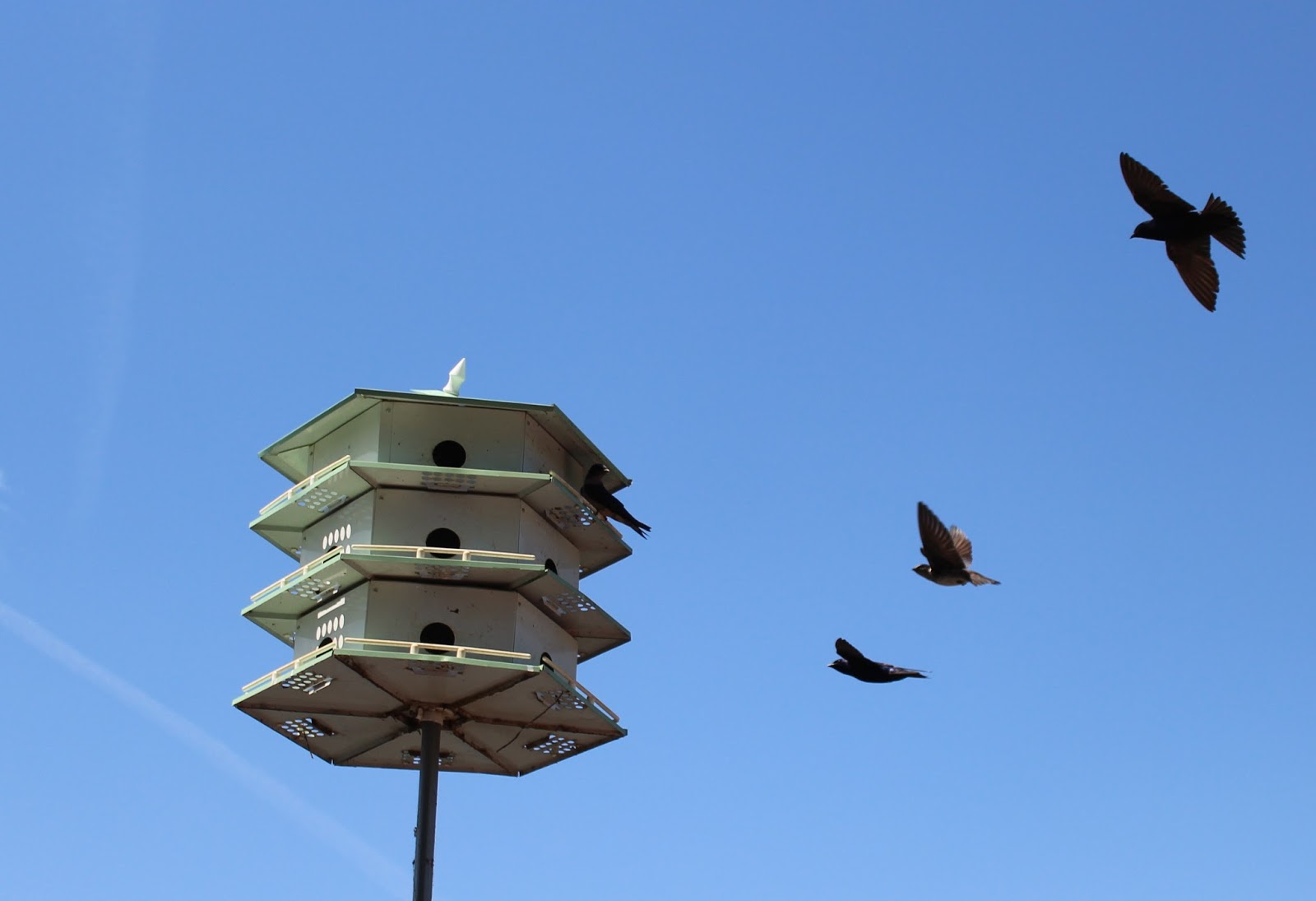
Purple martins take up residence all up and down the Memphis riverfront at this time of year.  We've got an active family at the marina where I keep my boat.  I've enjoyed their company while stretching on the dock and readying my boat and gear for paddling.

Good paddling weekend

I have a race up in Missouri this Saturday, and I'd like to do well in that.  But there's a lot of season to come after that, and I'm moving ahead with my eye toward the future as well.  A big date on the calendar is June 18, when the 35th Outdoors, Inc., Canoe and Kayak Race takes place.  It's my hometown race, and that's reason enough to want to do well, but it's also a very competitive race.  In some years there are as many as a half dozen guys right around my ability level, and we're all fighting it out to finish in the medals.  And it's a short race--5000 meters--so I've got to start working on speed and lactic endurance more.  So that will be a theme of the next month or so of training.

On Saturday I paddled for 60 minutes.  After warming up and doing three 8-stroke sprints, I did a set of eight one-minute pieces with two minutes recovery.  I had my GPS with me and was shooting for 8 miles per hour during each piece.  When I went too fast--at times I hit as high as 8.7 or 8.8 mph--I tried to back off the intensity ever so slightly while maintaining good solid stroke form.

Yesterday I did a longer session (100 minutes) at a strong tempo.  It was a beautiful day and I paddled up the Mississippi above the Hernando DeSoto Bridge and ferried across to paddle several kilometers up the Loosahatchie Chute, much like Ted Burnell and I had done last Monday.  This is one of my favorite outdoor places in the Memphis area; when you're paddling up there with your back to the city, all you see is wilderness populated by birds and fish and turtles and beavers.  Ted likened it to paddling up the Zambezi.  Then when you come back downriver you have arguably the best view of the Memphis skyline there is.

I didn't see any jumping Asian carp yesterday, but the fish sure were active underwater.  Three or four times I hit one with my paddle.  They were probably catfish, though they could have been alligator gar or sea monsters or who knows what.

Sunday, May 8, 2016

U.S. Olympic paddling update

There was a U.S. Olympic Team selection event for flatwater sprint paddlers last weekend on Lake Lanier at Gainesville, Georgia.  This weekend the slalom racers were on the water at Oklahoma City's new artificial whitewater venue for the second of their two selection events.

The International Olympic Committee has a pre-set number of athletes it will allow to compete in canoe and kayak events at Rio this summer.  How those berths are distributed among nations is determined by how each nation performs in the previous year's world championships and in the championships for its continent or global region (i.e., Asia, Europe, Africa, Oceania, the Americas).

In flatwater, the U.S. athletes did not perform well enough at the 2015 world championships to secure any berths in the Rio Olympics.  That means that any Olympic berths the U.S. gets will be determined at the Pan American Championships on May 19-20 at Lake Lanier.  And so last weekend's trials on Lanier were a competition for the right to race in the Pan Ams.  The following athletes won their classes last weekend and will now attempt to qualify for spots in the Olympics later this month:

Men's 1000-meter single canoe: Ian Ross, Bethesda, Maryland
Men's 1000-meter double canoe: Ian Ross, Bethesda, Maryland, and Gavin Ross, Bethesda, Maryland
Men's 200-meter single canoe: Ben Hefner, Gainesville, Georgia
Women's 500-meter double canoe (non-Olympic event): Lydia Keefe Sampson, Seattle, Washington, and Azusa Murphy, Seattle, Washington
Women's 500-meter double kayak: Farran Smith and Samantha Barlow, San Diego, California
Women's 500-meter single kayak: Maggie Hogan, Huntington Beach, California
Men's 1000-meter single kayak: Chris Miller, Gainesville, Georgia
Men's 1000-meter double kayak: Chris Miller, Gainesville, Georgia, and Stanton Collins, Gainesville, Georgia
Men's 200-meter double kayak: Chris Miller, Gainesville, Georgia, and Stanton Collins, Gainesville, Georgia
Women's 500-meter single canoe (non-Olympic event): Lydia Keefe Sampson, Seattle, Washington
Women's 200-meter single para-kayak: Anja Pierce, Pittsford, New York
Men's 200-meter single para-kayak: Nik Miller, Virginia Beach, Virginia
Men's 200-meter single kayak: Tim Hornsby, Atlanta, Georgia
Women's 200-meter single kayak: Emily Wright, Fairport, New York

Tim Hornsby, who competed in 200-meter single kayak at the 2012 London Games, is the only member of this group who has previous Olympic experience.

In slalom, meanwhile, the U.S. Olympic Team is now complete.  Well, almost.

The U.S. secured Olympic berths in men's kayak and men's single canoe at the 2015 world championships, by virtue of Michal Smolen's third-place finish in K1 and Casey Eichfeld's fourth-place finish in C1.  Smolen and Eichfeld did not actually win the right to fill those berths in Rio at last year's worlds, but they did earn a points advantage over other U.S. athletes, and they closed the deal at the selection event at Charlotte last month.

In the other two slalom classes, women's kayak and men's double canoe, no athletes finished racing at Charlotte with an insurmountable point total for Olympic selection, and so competition continued in those classes this weekend at Oklahoma City.

Ashley Nee of Darnestown, Maryland, who had earned a K1W Olympic berth for the U.S. at the Pan American Championships at Minden, Ontario, last summer, won at Charlotte for an edge in points coming into Oklahoma City.  Dana Mann took the win this weekend, pulling into a tie with Nee in points, but Nee has been named to the Olympic Team because she was the one who qualified the spot at the Pan Ams.

In men's double canoe, the team of Casey Eichfeld and Devin McEwan beat out Michal Smolen and Zach Lokken this weekend.  Coupled with their win at Charlotte last month, this victory earned them the U.S. Olympic nomination in C2.

Now, this is where I still don't understand what's going on.  As I mentioned in this post several weeks ago, the U.S. has qualified to enter four warm bodies in whitewater slalom at the Games.  What the U.S. would like to do is simply enter the four boats that have emerged from its selection process, given that Casey Eichfeld is in both the winning C1 and the winning C2; but apparently the ICF hasn't made up its mind yet if that's an acceptable way for a nation to use its berths.

How did it even happen that the U.S. has only four qualified athlete berths?  Eichfeld/McEwan won the C2 class at the Pan Ams last summer, so why didn't that qualify an entire boat for the U.S.?  Was it because Casey Eichfeld had already qualified the C1 berth for the U.S.?  If so, why shouldn't his status as a U.S. Olympic nomination in both C1 and C2 be reason enough for the U.S. to send boats in all four classes?

I've pored over the USA Canoe-Kayak website but have not found an answer there.  All I know is that according to this article, there's a chance that either Ashley Nee or Devin McEwan will end up staying home this summer.  I sure hope it doesn't happen that way.

Wednesday, May 4, 2016

MORE video from Vicksburg

Here's a shorter video that Paul Ingram and Patrick Smith put together.  This one is video footage only--no stills.  Starting at 2:23 there's some nice footage of the Pellerins and Tave Lamperez, then me, then Randy Hargroder and Brad Rex and Rick Carter.

Video from Vicksburg

Paul Ingram has been taking great photos of the Bluz Cruz Canoe and Kayak Race for a few years now.  He did so again this year, and he also teamed up with Patrick Smith to make a video.  In it you will see aerial footage, land-based footage, and still photos of this Saturday's race:


Tuesday, May 3, 2016

Writin' for Surf Ski News

The Surf Ski News website has posted an account of the race at Vicksburg written by yours truly.  It's similar to the race report I posted here, but I tailored it a bit for the S.S.N. audience.  The post features some nice photos that photographer Paul Ingram took on Saturday.  Go check it out here.

Monday, May 2, 2016

Recovering and giving the two-bit tour

Yesterday was definitely a recovery day after the beating I put on my body in Saturday's race.  I did some stretching at home and then went down to the river for a very easy 30-minute paddle.  I spent probably ten of those 30 minutes just sitting in the boat talking to a couple of friends I ran into down there.

I woke up today feeling much better, and that was a good thing because I had an afternoon paddle planned with racing friend Ted Burnell of Chattanooga, who is in town on business for a couple of days.  Ted and I raced twice last year, with me barely winning once and him barely winning once, so I'd say we're pretty evenly matched.  He'd probably be a great training partner for me if we lived in the same city.

We met around 3 o'clock this afternoon and paddled for two hours.  I tried to give him a nice well-rounded experience out on the Mississippi: we paddled out of the harbor and upstream to the Greenbelt Park, then ferried over to paddle up the west side of the Loosahatchie Bar.  With the river at about 13.6 feet and rising on the Memphis gauge, we had to do a couple of slick attainment moves to get up over the Corps of Engineers dikes there.

Then we turned around and came back downriver, admiring the view of the downtown skyline.  I pointed out a few riverfront landmarks before saying goodbye back where Ted's car was parked.  Ted seemed to think it was a worthwhile afternoon spent on the river, and I was glad to have the chance to show him around.  I know I enjoy visiting the places where other people paddle.

Monday photo feature


I mentioned several weeks ago that I was sort of rooting for the C2 team of Casey Eichfeld and Devin McEwan to make the U.S. Olympic Team because Devin is the son of the first U.S. Olympic medalist in whitewater slalom, the late Jamie McEwan.

What I did not mention is that Olympic medal notwithstanding, Jamie was not even the most famous member of his family.  Devin's mother, and Jamie's widow, is none other than cartoonist Sandra Boynton, the creator of those cute hippos and rhinos and similar critters that you see on greeting cards and coffee mugs and stuff.  A couple of years ago I got me this cool Boynton tee shirt that Devin and Casey were selling.

The Olympic selection process for slalom resumes this coming weekend on the new whitewater course at Oklahoma City.  McEwan/Eichfeld are hoping to win an Olympic berth in the C2 class, and the women's kayak (K1W) berth is up for grabs as well.

This past weekend saw a selection event for flatwater sprint racing on Lake Lanier at Gainesville, Georgia.  The field of contenders for spots on the U.S.  Olympic Team has been narrowed down, as explained on the Surf Ski News website, here.  I'll talk more about it once I get up to speed.

Sunday, May 1, 2016

Racing on the mighty Mississippi at Vicksburg

I got to Vicksburg Friday afternoon, crossed the river to drop off my boat up at Madison Parish Port, returned to town and went by the race check-in place, and retired to my motel for a good night's sleep.

Yesterday morning there was a line of strong storms over in Louisiana, but it looked as though they might hold off long enough to get the race in.  I joined fellow racers on the shuttle bus up to the start at Madison Parish Port and went about the business of getting my boat and gear ready to go under overcast but not-too-threatening skies.

The Mississippi was a bit low for this year's race: the Vicksburg gauge reading was 26.9 feet and dropping as final race preparations were underway.  Times were likely to be slow, and up at the start we had to navigate some knee-deep mud to get our boats in the water.  As I fought my way from the quagmire near the bank out into open water, my rudder got stuck in the mud and twisted out of alignment, so I had to go back to the bank and stand in the mud again while I got it readjusted.

With that nuisance distraction behind me, I warmed up and moved into position on the starting line.  There were three boats there that I figured would be my main competition.  Rick Carter of Eutawville, South Carolina, had proven himself a sturdy nemesis even though he is a relative newcomer to the sport.  The Pellerin triplets (Carson, Conrad, and Peyton) of Breaux Bridge, Louisiana, were joined by Tave Lamperez of Lafayette to form a formidable K4.  Brad Rex (Baton Rouge, Louisiana) and Randy Hargroder (Opelousas, Louisiana) were teamed up in a fast tandem kayak.

The gun went off and I sprinted hard off the line, just like I'd been training to do in recent weeks.  In short order I sensed the familiar presence of Rick Carter on my stern wake, with Rex/Hargroder just behind him.  Rick was paddling a brand new V-10L surf ski with a day-glo orange bow, and Brad and Randy were in a bright yellow boat, so it wasn't hard to make them out in my peripheral vision.

I glanced about expecting to see Tave and the Pellerins nearby, but couldn't find them.  I don't know much about the boat they were paddling, but my guess is that it was a more stable (and therefore slower) craft than what I've been seeing the triplets paddle as a K3 lately.  In any case, I assumed they were somewhere in the hunt back there.

Six weeks earlier I had come away from the race at Ocean Springs feeling as though I'd left some money on the table.  In other words, I'd been content to hang back and ride people's wakes rather than push the pace and take control.  I don't know that the results would have been any different had I behaved differently, but for this race I'd resolved to be more aggressive.  I threw in several strong surges in the first couple of miles and managed to break away from my competitors.

I was fully aware that I was taking a gamble, but I reminded myself of the good training I'd done in the month of April and proceeded with confidence.  I was beginning to feel the first signs of fatigue as I rounded the first sharp bend in the river about eight miles (12 kilometers) in, but I was determined to think only positive thoughts and told myself that as long as I kept the boat moving smoothly it would be difficult for the others to run me down.

After another sharp bend the river flows straight toward the city of Vicksburg for some seven miles or eleven kilometers.  By this time fatigue was settling in for real, and I tried to stay relaxed and paddle as efficiently as possible, using my legs and my torso.  Occasional glances over my shoulder told me that I still had a good lead on those bright-colored boats, but not an insurmountable one if I didn't keep my act together.  I continued to keep my mind occupied with optimistic thoughts: "They're tired too."  "This is the same river I train on all the time, so surely I'm handling this water at least a little bit better than they are."  And so on.  But twinges of doubt were creeping in, too.  About a mile and a half (2.5 kilometers) from the finish the course leaves the Mississippi and heads up the Yazoo River, and here my "big river" advantage would be gone and I would be vulnerable to anybody who'd conserved his energy better than I had.

The wind was picking up and I paddled through a couple of kilometers of increasingly choppy water.  At long last I reached the mouth of the Yazoo, and I approached it on a path that I thought would miss the squirrelly shallow water there.  Once off the roiling Mississippi I found I had a bit more left in the tank than I'd expected, and I added some power to my strokes while keeping the stroke rate low overall.  Maybe, just maybe, I was going to finish this job.  And then...

I saw some day-glo orange over my right shoulder, and at that moment I knew I was in big trouble.  I tried not to overreact, and just keep things steady, but knowing Rick was getting a ride on my stern I threw in a couple of little surges hoping to break free.  That didn't work, so I shifted my priority to keeping him from moving up onto my side wake and a better position from which to sprint for the win.

Rick began to surge with a kilometer to go, and it was pretty clear that he had more left than I did.  I hung in there and paddled as hard as I could, but in the final meters Rick separated himself and beat me by 15 seconds.  According to my GPS we had traveled about 20.7 miles (about 33.4 km), and our times were 2 hours, 18 minutes, 31 seconds for Rick and 2:18:46 for me.  Times were indeed slow with the low water; my personal record on this course is 1:56:34.

Brad Rex and Randy Hargroder were just 93 seconds back in taking third place.  Tave Lamperez and the Pellerin triplets took fourth overall with a time of 2:28:15.  The fastest overall female finisher was Denise D'Abundo of Baton Rouge, who clocked 2:55:18.  The complete results are posted here.

I apparently made a mistake at the mouth of the Yazoo even though I didn't realize it at the time, allowing Rick to close the gap significantly.  After the race Rick and Randy and Brad all asked me why I had "gone so wide."  "Go wide?" I thought; "I didn't go wide!"  But in this sport I've learned that what you see from your boat sometimes looks very different from what people outside your boat see, and maybe at some point I should go back to the mouth of the Yazoo and see if I can figure out why the line I took was so costly.

As usual, Rick deflected the praise he had earned: "You were robbed, man!  You worked twice as hard as I did, and I just hung out back there and stole it from you at the very end!"  But I see it as a perfectly fair-and-square victory for him.  As I pointed out in this post a couple of weeks ago, part of winning is simply being in a position to capitalize when the competition makes a mistake or falters in some way, and that's exactly what Rick did.  Expending your energy wisely is a big part of this game, and it turned out Rick did a better job of that than I did.

In any case, as the rain began to fall while we awaited the awards, I was in a surprisingly upbeat mood even though I'd spent the second half of the race in fear of being caught from behind and then seen that fear become reality.  My goal was to win, but if I had to get beat I'm glad I got beat as a result of being overly aggressive rather than as a result of being overly timid.  I went out and did exactly what I thought I had to do, and it just didn't quite work out.

If I'm counting correctly, this was the 12th edition of the Bluz Cruz Canoe and Kayak Race.  The Vicksburgers who organize this event have done an outstanding job year after year, and once again I have returned home in high spirits after a gratifying race experience.