The Games of the 31st Olympiad will take place in Rio de Janeiro, Brazil, later this year. Canoe and kayak racing will be included.
Mind you, not all canoe and kayak racing will be included. There will be no surf ski or outrigger racing; no wildwater; no flatwater marathon; no extreme creek racing. Just one discipline for whitewater (slalom) and one for flatwater (sprint).
But anytime I'm tempted to get my undies in a bunch over that, I just remind myself that the same is true for most other sports. For instance, the bicycle disciplines of mountain biking, road racing, and velodrome events are all in the Olympics, but not cyclocross. Wrestlers, weightlifters, and martial artists can probably all give you their lists of disciplines within their sports that are not on the Olympic programme. And many believe that's not the worst thing: 1992 whitewater slalom Olympian Eric Jackson makes some interesting points about that in this interview.
But the Olympics are a big deal, if nothing else because they're on TV all over the world and give the broader public a brief glimpse at sports like ours that carry on in total obscurity most of the time. Here in the U.S., the process of selecting the athletes that will paddle in Rio has moved into high gear. Over the weekend there was a slalom competition in Charlotte at which two people were named to the U.S. Team.
Michal Smolen of Gastonia, North Carolina, claimed the U.S. Olympic Team spot in men's kayak (K1). Michal is a native of Poland but has lived most of his life in the U.S.: his dad, Rafal Smolen, moved here to begin a career in coaching the sport in the late 1990s. Michal has been a member of the U.S. national team for the last few years and just recently got his U.S. citizenship in order to make himself eligible for Olympic competition.
Casey Eichfeld of Mount Holly, North Carolina, punched his ticket to Rio in the men's single canoe (C1) class. Casey grew up in Pennsylvania and was just starting to show up at races in the 1990s as my own slalom career was winding down, and I remember watching the nine- or ten-year-old kid and thinking that if he stuck with it he might be very good. That, of course, was a big "if"--many fabulously talented kids have come and gone in this sport without going "the distance" to international prominence. But lo and behold, Casey has stuck with it, and it seems that especially in these last few years he's really stepped up his game and made himself one of the top racers in the world in slalom C1.
Yet to be determined are the U.S. Olympians in the women's kayak class (K1W) and the men's double canoe class (C2). The selection process will continue on May 7-8 with a competition on the new course at Oklahoma City.
I believe two questions are obvious at this point: Why have Olympic Team berths been decided in two classes, but not all four? and, Why are there no canoe classes for women?
I'll field the second question first: I can't say I know the origin of this issue. Maybe there were very few women racing slalom in canoes when the world championships debuted in 1949; maybe the cigar smoking good ol' boys in the International Canoe Federation considered women too "dainty" for the manly business of canoeing... I don't really know. But that's how things were for the first six decades of the ICF world championships, and plenty of people were unhappy about it and lobbied for change. I think it finally took an ultimatum for greater gender equity from the International Olympic Committee to get the ICF to do something about it. A women's single canoe class (C1W) was added to the world championships in about 2010 with the intention of adding it to the Olympics a quadrennium or two later. Plans are now set for C1W to make its Olympic debut in the 2020 Games at Tokyo. Women's canoe classes also will debut in flatwater sprint racing, where they also had been absent.
There's no doubt that gender equity is important and necessary. But I'm saddened by the cost of adding C1W to the Olympics. The IOC is very stingy when it comes to the overall number of "fringe sport" athletes like paddlers that it will allow to participate in the Games, and to make room for C1W the ICF has had to remove C2, arguably the most interesting and beautiful class, from Olympic competition.
As for that first question above: athletes vie for selection to the U.S. Olympic Team by earning points in several events in the year prior to the Games. One such event was the 2015 world championships at the Lee Valley White Water Centre outside London, and Michal Smolen and Casey Eichfeld were the only two U.S. athletes to earn points there. Their performances were in fact quite magnificent: Smolen claimed the bronze medal in K1, while Eichfeld appeared on the verge of winning the C1 class until a tiny but devastating time error knocked him back to fourth place.
In any case, if Smolen finished third or better in Charlotte this past weekend, he would amass a point total that no other athlete would be able to surpass, and therefore clinch a spot on the Olympic Team. He won. Eichfeld came to Charlotte needing to finish second or better; he also won. No paddler in the other two classes has yet accumulated such an insurmountable lead in points, and so their competition will continue in Oklahoma City next month.
If you're still reading this post, then you know that Olympic selection is not the simplest thing to talk about, and I apologize for being so long-winded. But there's one more part of the story I'll address, and it's a process that to me seems truly byzantine: how a nation qualifies spots in the Olympics. As I mentioned above, the IOC allows only so many paddlers on the water in the Games, and each nation must demonstrate, in competitions like the world championships, that it has paddlers who can compete at the world-class level in order to be awarded berths in the competition. A further complication is that the IOC wants the berths to be as evenly distributed as possible among the different regions of the world--Europe, Asia, the Americas, Oceania, Africa, and so on.
A nation can have at most one boat entered in each class. That means that in slalom, each nation may have at most five Olympians: a female kayaker, a male kayaker, a male single canoeist, and a pair of male tandem canoeists. That brings me to the part I haven't figured out yet: according to an article I read in Canoe and Kayak magazine the other day, the IOC and/or the ICF have determined that the U.S. is limited to four warm bodies on its slalom team. That means that at least one member of the U.S. C2 must be somebody who's already on the Olympic team as a single-boat racer. It just so happens that both Casey Eichfeld and Michal Smolen are racing in C2s as well as their single boats, so that shouldn't be a problem, but it's nevertheless weird. I'm sure there's a full explanation somewhere in the bowels of either the ICF or the USA Canoe-Kayak website, but as both those organizations are notorious for releasing information in the form of long, excruciating legalese-laced PDF documents, I just don't have the will to unearth the answer. I invite anybody who can provide us a readable explanation to do so in the "Comments" section.
I'll just add this: I'm sort of rooting for Casey Eichfeld's C2 to make the Olympic Team because his partner is Devin McEwan, son of the first U.S. Olympic medalist in whitewater slalom. Devin's dad Jamie took the C1 bronze medal in the 1972 Games at Augsburg, West Germany. We just lost Jamie to cancer two years ago, and I know he would be thrilled to see another McEwan running the gates in the Olympics.
Once again, thanks for reading down this far. I'll post updates here about both the flatwater and the whitewater selection processes as they develop.
Monday, April 11, 2016

What makes a winner?
I don't really follow golf, but I've always regarded it with the respect it deserves as a test of skill, athletic ability, and composure. While browsing Face Book this morning this quote from Jack Nicklaus regarding this past weekend's Masters tournament caught my attention:
I’ve watched Danny Willett play on television a few times and when I’ve seen him swing the golf club, I have thought, “Well, this young man looks like he’s a pretty darn good player.” He had moved himself up to 12th in the world, so he’s obviously done something right and was playing very good golf coming into Augusta. What impressed me so much is that when he realized he was in a position to win, he finished it—and that’s the mark of a champion: To finish a good round; give yourself an opportunity to win; and when the other fellow doesn’t finish, you’ve got to be there. Danny Willett was and kudos to him.At the world class level it is very, very rare to see an athlete so exceptionally dominant that he or she wins every competition in a rout. More often, winning is a matter of putting yourself in a position to capitalize when other competitors falter, and then grabbing that opportunity. We've seen it in the Super Bowl, the Masters, the Indianapolis 500, Wimbledon, and just about any other high-profile sporting event you can name. And we see it with regularity in canoe and kayak racing. Most of time there's not one dominant athlete, but a group of top athletes, in any given paddling discipline; and the one who wins a world or Olympic title is the one who had the most things fall into place that year or that month or that day.
Monday photo feature

Ride 'em cowboy! That's ME out there on the Ocoee River during the 2000 whitewater slalom U.S. Olympic Team Trials! My mom, perhaps the only person who cared to point a camera my way that weekend, snapped the photo. Even though I had worse than a Slurpee's chance in Hell of actually going to the Olympics, it was an experience I'll never forget.
The selection process for the 2016 whitewater slalom Olympic team began in earnest this past weekend with a competition at Charlotte. It'll continue next month at Oklahoma City. A couple of spots on the team actually got filled this past weekend, and I'll write more about that when I get a chance.
The other Olympic canoe and kayak discipline, flatwater sprint, has its U.S. Olympic Team Trials on April 29-30 at Gainesville, Georgia.
Sunday, April 10, 2016
Beat to the socks
As I said in my last post, I did four one-mile pieces yesterday, preceded by a long paddle up the Mississippi and followed by a paddle back down the Mississippi and back up the harbor to the dock. For recovery in between the pieces, I paddled easy for several tenths of a mile. My overall time in the boat was 140 minutes, and in contrast to Thursday's workout, I was thoroughly worn out when it was over. I don't think a workout like yesterday's is what Ernie Banks had in mind when he exclaimed "Let's play two!" on beautiful summer days at Wrigley Field.
With tomorrow and Tuesday reserved for recovery, I wanted to get another good-quality session in today. Strong south winds were in today's forecast, but it wasn't that bad yet when I put my boat in the water this morning. I paddled out of the harbor and up the Mississippi just above the Hernando DeSoto Bridge, and then paddled a brisk pace back downriver to get a bit of practice on the sort of water I'll be racing on at the end of the month.
Back in the harbor I started easy but built up into a strong pace all the way to the north end. Aided by a tailwind, I was occasionally hitting 8 mph on the GPS.
I backed off the pace and paddled easy from the north end of the harbor back to the dock, though it didn't feel so easy because I was fighting a headwind that was becoming stronger by the minute.
Today's 90-minute session completed what turned out to be a bear of a weekend. Now I get to relax for a couple of days and let my body build itself back up and get ready for greater challenges.
I have been globally positioned
This past week I finally gave in and bought a GPS device. So far I'm having some fun playing around with it in training, but I'm quite aware of its limitations.
I've always been something of a Luddite when it comes to the gadgets being marketed to athletes. I really think that anybody with an appreciable amount of training under his belt should be able to determine intensity and pace by feel. With a bit of practice and familiarity with your body it's not that hard to tell when you're in the "aerobic zone" or when you're "going lactic." And if you tell a decent high school runner to run a lap of the 400-meter track in 75 seconds, he'll probably hit it within a second or so because he's become familiar with what 75-second pace feels like.
I doubt I will use my GPS during a race, especially one on anything rougher than dead-calm flatwater. If I do take it in the boat with me, it'll be with the miles-per-hour display turned off. When the objective is simply to compete with the other racers, knowing how fast or not-fast I'm going seems like an unwanted distraction.
Having said all that, I'm having fun using the GPS in practice. One of my favorite things to do with it is measure distances. In the harbor I have several courses defined by permanent objects that I've been timing myself on for years, and it's nice to know at last what the exact distances are. I'm also experimenting with using the device in pace workouts, though it's important not to accept the feedback at face value. The workout I did yesterday is a perfect example: I paddled from the marina out of the harbor and up the Mississippi to the mouth of the Wolf River; then, paddling on the Wolf, I timed myself over four one-mile pieces (note to my international readers: my GPS seems to deal only in British units). My times were 9:24, 9:11, 8:16, and 8:07, and the rather large differences had everything to do with atmospheric and surface conditions. I did the first two pieces going up the Wolf, but I should note that current wasn't much of a factor because at yesterday's Mississippi River stage (16.7 feet on the Memphis gauge) the big river backs pretty far up into the Wolf. However, there was a stiff northeast wind blowing, and on the first piece in particular I was paddling right into the teeth of that wind. For the second piece I was in a more protected section of the river, but by the end of it I was far enough up that I was running into some current. I did the third and fourth pieces coming back down the Wolf, with the conditions opposite what they'd been going up, and that's the reason for the faster times.
Now that I think about it, I probably haven't said anything that profound in this post. The athletes I race with are smart guys and gals and have probably figured these things out for themselves: I'm sure that when their GPSs tell them they're going really slow they can deduce the reason from the conditions they're paddling in. I guess the main point I'm trying to make here is that I hope to have some fun with this new toy but I don't expect it to bring about any dramatic changes in my training.
Friday, April 8, 2016
Sometimes the strokes just flow
My next race is down at Vicksburg three weeks from tomorrow. The next ten days or so are an important window for doing some work that my body can internalize by that date.
With my weekends filled with long, hard stuff right now, I was looking for shorter-duration intensity when I got in my boat yesterday. I paddled for 60 minutes overall. After warming up and doing three 8-stroke sprints, I did a set of eight 30-second sprints at three-minute intervals. I did all but the last one out on the river, in the same kind of water I'll be racing on at the end of the month. I tried to stay relaxed and take good strokes with full rotation on that somewhat squirrelly playing field.
After that, as I headed up the harbor back toward the dock, I paddled at or slightly above the pace I hope to maintain in the Vicksburg race for ten minutes or so.
I felt particularly good in the boat yesterday. Maybe it was because I was good and rested; maybe it was because my diet has been good and my energy was up; hopefully it was also because I'm reaping some fitness benefit from the workouts I've done in the last several weeks. Whatever the case, it was one of those days when I felt more invigorated after paddling than I'd felt before. Sometimes that 30-second-sprint workout is really tiring, but yesterday I finished those eight sprints feeling like I could do eight more.
I did the April strength routine Wednesday and plan to do it again today.
Tuesday, April 5, 2016
What I'm doing these days
For this period leading up to the longish races awaiting me in late April and May, I seem to be settling into a pattern of paddling long and hard over the weekend, recovering on Monday and Tuesday, and doing strength work and some shorter, faster paddling on Wednesday, Thursday, and Friday.
This past Saturday I paddled for 80 minutes overall, doing four pieces of varying lengths and intensities. I started the first piece out on the Mississippi at the Hernando DeSoto Bridge, and finished it at the mouth of the harbor. It was quite windy and I had to back off the intensity a bit, focusing mainly on keeping the boat moving over the waves and chop. Once back in the harbor I recovered for several minutes and did one of the pieces I did last Sunday, starting next to Beale Street Landing and finishing at the H.D. Bridge.
I recovered from that by paddling back south to the monorail bridge, and then I sprinted from there to the H.D. Bridge. I recently used a GPS to measure this distance and it's about 450 meters. My time Saturday was about 2 minutes 20 seconds--not a performance that's likely to take me to the Games at Rio this summer.
Finally, after another few minutes of recovery, I sprinted from the H.D. Bridge to the A.W. Willis Avenue bridge. This distance is around 660 meters, and my time was 3:20ish.
On Sunday the weather was calmer and warmer, and I went back down to the river for a 120-minute paddle. Going around the Loosahatchie Bar like I did the previous weekend was not an option this time, as the river was too low (16.9 feet on the Memphis gauge Sunday morning). I decided to paddle downriver from downtown, something I hadn't done in quite a while. Going downstream I paddled close to the pace I hope to maintain in the Mississippi River race down at Vicksburg at the end of the month. After 45 minutes, I decided I should start heading back upriver to make it back to the dock in my allotted two hours. I paddled along the Arkansas bank, using the eddy/slackwater on the inside of the big bend to the west the river makes below the old Frisco Bridge.
Overall, this past weekend felt less taxing than the weekend before. I wonder whether that's partly psychological: the timed-pieces workout I did on Saturday was less structured than the workout I'd done the previous Sunday. When I go out and do six or eight pieces at regular intervals it's hard to avoid that "time to make it hurt" mindset, whereas doing a variety of distances with whatever recovery I feel like feels more like play.
My strength routine (I guess I'll call it the April strength routine even though I started it right after my trip to Ocean Springs last month) is my Smart Bell workout. One day--I promise--I'm going to teach myself to shoot, edit, and post video of me doing this workout and other exercises so readers of this blog can see what they look like. In the meantime, have a look at this post from last year in which I describe what a Smart Bell is and how I work out with it. Right now Wednesdays and Fridays are dedicated to strength work.
Monday, March 28, 2016
Monday photo feature

The weather was simply gorgeous over the weekend, and I believe spring is beginning to assert itself. I expect I'll be seeing some new duck families down at the harbor soon.
What's next?
Now that one race is in the books for 2016, I realize that I haven't said much about my plans for the rest of the year. Here are the events I hope to participate in:
April 30: 13th annual Bluz Cruz Canoe and Kayak Race. Starts at Madison Parish (La.) Port on the Mississippi River and finishes 22 miles downriver at the Vicksburg Front.
May 14: Osage Spring 12. A 12-mile race down the Osage River at Osage City, Missouri.
June 18: 35th Outdoors, Inc., Canoe and Kayak Race. A 5000-meter race down the Mississippi River at downtown Memphis, Tennessee.
June 25: The Great Chickasawhay Race. At 21-nautical-mile (that's what it says on the website) race down the Chickasawhay River from Shubuta, Mississippi, to Waynesboro, Mississippi.
July 30: USCA National Championship for downriver kayak. A race for boats that meet ICF wildwater specs. Held in conjunction with the Aluminum Canoe Nationals. White River at Batesville, Arkansas.
August 6: The Paddle Grapple. A 6-mile race on Lake Fontana near Bryson City, North Carolina.
August 12-14: USCA Marathon National Championships. A 13-mile course up and down the Connecticut River at Northfield, Massachusetts.
September 17: Gator Bait Canoe and Kayak Race. A 5.5-mile race on Barnett Reservoir outside Jackson, Mississippi.
Of course, I might not make it to all the races on this list, and I could end up doing something that's not on this list. But this is a pretty good outline of what's to come.
Last weekend's race gave me some idea of what things I need to work on, and with the next race a whole five weeks away, I'm heading back to the drawing board. I spent most of the race in Ocean Springs afraid to push the pace, and it cost me at the end; so some pace work is in order. Also, at least four of the races on this schedule are what I consider "long" (and I'll just point out here that I do not do ultra-distance events). So some training of commensurate distance is in order.
Saturday's Loosahatchie Bar circumnavigation is part of that plan. Yesterday's workout is another. Yesterday I paddled to the south end of the harbor and did six repeats of a course between the Hernando DeSoto Bridge and Beale Street Landing. Paddling at about a 10-kilometer race pace, I aimed for a time of about seven minutes. I rested for 2-3 minutes in between pieces. There was a pretty good south wind blowing, and it made about a 20-second difference in either direction--that is, my time was around 6:40 with a tailwind and about 7:20 with a headwind. This was a tough workout. Already tired from Saturday's long paddle, I was feeling it by the end of the first piece and I just had to grin and bear it through the next five.
And now I'm ready for some recovery time. I'm taking today off and I'll do an easier paddle tomorrow.
Saturday, March 26, 2016
A trip around The Bar in pictures
I don't do as much "overdistance" training as I used to, but with several sort-of-long races coming up I want to get a few longer paddles in. This morning I paddled around the Loosahatchie Bar. This is something I've done at least once or twice a year for many years now. The Loosahatchie Bar is the big island in the Mississippi River shown on this map here:
Starting and finishing at my marina in Wolf River Harbor, a trip around The Bar typically takes me a little over two hours--it took me two hours and five minutes today. I think I once did it in an hour and 55 minutes or so.
The water level needs to be over 16 feet on the Memphis gauge, or else you'll end up hiking over some sandbars up at the north end of The Bar. Today's level was 20.3 feet, and I hit the bottom with my paddle several times up there. The big flood of 2011 deposited a bunch of sand in that area.
As I prepared to leave the dock I set my Go Pro camera to take a still photo every 60 seconds. The resulting pictures might not be the best quality, but I hope they'll give you some idea of what I saw and did today.

Heading south toward the mouth of the harbor.

Paddling out of the harbor and up the Mississippi River toward the Hernando DeSoto Bridge.

Still paddling upriver, just above the Hernando DeSoto Bridge. You can sort of see the Loosahatchie Bar off to the left of my bow.

Still heading upstream; now I'm just north of the Maynard C. Stiles sewage treatment plant. The barge rig in the left side of the photo is one of only two I saw while I was out.

Not long after the last photo got shot, I started ferrying across the river. The northern end of the Loosahatchie Bar lies ahead.

Approaching "the summit" of the bar. It's some tough paddling here because this area is fully exposed to the Mississippi's current.

Now I'm headed back downstream through the chute between The Bar and the Arkansas bank. This piece of the river is one of my favorite places in the whole Mid South: just a couple of miles from downtown Memphis, it has the look and feel of remote wilderness. Of course, by the time I get here I'm always really tired from all the upstream paddling and the ferry across the river.

Eventually, the Hernando DeSoto Bridge and the Memphis skyline come back into view.

I think my city on the river is just lovely.

Heading back up into the harbor.

And at last, I'm back on the dock. Yippee!
Monday, March 21, 2016
Saturday's results
The results from the 7th annual Battle On The Bayou race are now posted here.
I should point out an unfortunate error in my post yesterday: I mis-identified the sixth-place overall finisher. It was Muril Robertson of Huntsville, Alabama (the man pictured in this week's "photo feature"), who clocked one hour, 29 minutes, 36 seconds. Muril also happened to be the first non-race-boat finisher.
The top female finisher Saturday was Wyndy Amerson of Mount Pleasant, South Carolina. Her time was 2:04:38.
UPDATE: It turns out I was right the first time: Randy Hargroder was in fact the sixth-place overall finisher. Muril has informed me that his time was 1:47, not 1:27, and that it was mis-printed in the race results. So much for everything I read on the Internet being true.
Monday photo feature

Muril Robertson of Huntsville, Alabama, approaches the Washington Street Bridge about a mile into Saturday's Battle On The Bayou race at Ocean Springs, Mississippi. Some 140 racers competed in all types of canoes, kayaks, and paddleboards. Photo by Kay Taylor.
Sunday, March 20, 2016
A Gulf Coast dog fight
I arrived in Ocean Springs Friday evening amid grave concerns of stormy weather and strong winds on race day. Particularly troubling was the possibility of lightning, the standard deal-breaker for a water-borne event like a canoe and kayak race. But when Saturday dawned, the storms had just about moved out, and the heavier winds wouldn't arrive until late afternoon--in other words, we lucked out.
We lined up in the little cove of the Back Bay of Biloxi next to the Gulf Hills Hotel, and the starting gun went off promptly at 10:15 AM CDT. As expected, three-time Olympian Mike Herbert sprinted into the lead and was already beginning to pull away as we made the turn up into Old Fort Bayou just a couple hundred meters in.
I had my hands full from the start. I'd hoped to get a better start than I did, and maybe make my competitors do some work to pull even with me; but the Pellerin triplets (Carson, Conrad, and Peyton) of Breaux Bridge, Louisiana, got a very good start and I had to settle for a spot on their wake immediately. Rick Carter of Eutawville, South Carolina, grabbed my stern wake. Before long we were joined by the tandem of Phil Capel (Sherwood, Arkansas) and Brad Rex (Baton Rouge, Louisiana), and our four boats would keep each other company for the next eighty minutes or so.
One thing I've learned in this business is that unless you have the speed of Mike Herbert and everybody else in the race has my degree of ability or worse, the race does not always go to the speediest. When you're racing in a pack of people who are all about as good as you are, you have to do more than just be the fittest or the strongest or the fastest to assure yourself of victory. In other words, you're not assured of victory, and I guess that's part of the beauty. In a situation like I was in yesterday morning, you have to know what your own strengths are, and assess how good a job you've done of racing efficiently and conserving energy, and make an educated guess of how well the other racers have conserved their energy, and make your move when the time is right, and hope for the best. And even if you do all those things beautifully, you still might not win.
I spent a huge chunk of the race just sitting on the wake of the triplets, who were paddling as a K3 in one of those hybrid boats you see in races like the Texas Water Safari. Rick, in turn, sat on my wake for most of that time. A little over halfway through Phil and Brad moved up front and started pushing the pace, and once they'd done that for a while I finally made a move of my own, hoping maybe they were getting tired. But they held me off and I dropped back, and with maybe 2000 meters left I had one of those mental lapses that was all the two team boats needed to open a couple of boat lengths on me. I still had something in the tank and I threw in a hard surge, but though I was able to open some distance on Rick, I couldn't quite regain a wake-ride on the triplets or Capel/Rex.
Mike Herbert had tucked his victory away by the time we were anywhere near the finish line. His time was a course-record one hour, 17 minutes, 57 seconds. Phil and Brad finished strong to take second place, with the triplets taking third just several seconds back. I held my lead over Rick to claim fourth, and a short while after Rick crossed the line Randy Hargroder of Opelousas, Louisiana, finished in a respectable sixth place overall.
Due to some software problems the results are not yet posted online. At the moment I don't even know what my own time was; I think I heard that our four-boat pack finished some eight minutes after Mike. The race organizers were hopeful they could get the results up by tomorrow, and I will post a link to them whenever they do.
Dana and Nick Kinderman very kindly hosted me during my stay on the Gulf Coast this weekend. Nick raced on the Bayou as well, while Dana spent the morning running a 10K over in Mobile, Alabama. As a result we were three tired people by late yesterday afternoon and we spent a quiet evening at their house in Ocean Springs. We ate some takeout Japanese hibachi and watched the movie Pee Wee's Big Holiday, which I thought was sublimely hilarious.
This morning I woke up feeling quite good for the day after a race. After a lovely breakfast of "protein pancakes" prepared by Chef Nick, I pondered my paddling options. Typically I have gone out on the Back Bay of Biloxi the day after racing at Ocean Springs, but a cold front had moved in yesterday evening, and it was chilly and very windy outside, and I wanted something more protected. On Nick's advice I drove up just north of Interstate 10 and put my boat on the Tchoutacabouffa (pronounced Chu-ta-ca-BUFF) River a few miles above where it empties into the Back Bay. I paddled comfortably, pushing the pace at times, for 80 minutes.
When I'd finished observing that ritual I got back in the car and made the six-hour trip home. Now it's time to recover a bit, and start up a new strength routine, and basically just see what I can do to get ready for the next race.
Thursday, March 17, 2016
Pre-race tuning
I've spent the week getting some rest and trying to get sharp for Saturday's race. Tomorrow I plan to do a short paddle in the harbor before loading the boat and heading for the Mississippi Gulf Coast.
On Tuesday I paddled for 60 minutes and did six 12-stroke sprints. This morning I was feeling lethargic and spent a long time on the dock stretching and doing some rubber band exercises ("pre-hab" for my shoulder) before I finally got in my boat to paddle. Once on the water I paddled for 40 minutes and did another six 12-stroke sprints.
I should have plenty of competition on Saturday and I hope to paddle up to the starting line as prepared as I can be.
Monday, March 14, 2016
Monday photo feature

As I prepare to travel to Ocean Springs at the end of the week, I share this memento of trips past: the rotating railroad bridge at the passage from Mississippi Sound into the Back Bay of Biloxi. I like trains and train tracks and train trestles, and one of the great things about being a paddler is I often get up close and personal with such things.
Sunday, March 13, 2016
Racing to win, even if I probably won't
My first race of the season is now less than a week away. On Friday I will make the six-hour drive down to Ocean Springs, Mississippi, for the annual Battle On The Bayou canoe and kayak race. This event debuted in 2010 and will go off for the seventh time Saturday. It starts in the Back Bay of Biloxi and quickly enters Old Fort Bayou, following this mostly-currentless creek some nine and a half miles (approximately 15 kilometers) to a finish line next to The Shed barbecue joint.
I won the first two editions of this race rather easily, but since then the competition has beefed up a bit and I've managed only one victory in the last four Battles. The likelihood of my notching another win this Saturday plummeted this past week when Mike Herbert of Rogers, Arkansas, signed up. Mike is a three-time Olympian (1988, 1992, 1996) in flatwater sprint kayaking and a member of the tiny group of U.S. paddlers who have medaled at the world championships (he won two silvers and a bronze at the 1990 and 1991 worlds). He has stayed in excellent shape in his middle age, and in 2014 he returned to world championships competition at age 53 as a member of the U.S. marathon team.
At the non-world-class level Mike still likes to get out his boat and race, and since he and I live in neighboring states I see him at races several times a year. What usually happens is that after we wish each other luck at the starting line, Mike rockets into the lead and vanishes from my view in a matter of minutes. I wish I were more competitive with the man, and I have a feeling Mike wishes I were, too: he's a competitor and relishes a good hard-fought contest. But the truth is, we're in different leagues. If our sport were baseball, Mike would be in the majors while I might be playing my whole career in double-A ball.
As far as my preparation for next Saturday goes, nothing really changes. My task is to put Mike out of my mind and stick to my own race plan. I know at least two or three other boats have registered that should give me plenty of competition; the only difference now is that we're racing for second place overall.
My plan for this week is to get some rest, but that doesn't mean just lying around doing nothing, and it also doesn't mean paddling so slowly my heart rate barely rises above normal. Actually, I'll do some very high-intensity paddling this week, but not so much in any one session that I'll get worn out.
I paddled for 60 minutes both yesterday and today. Yesterday I warmed up for ten minutes and then did three of my backpaddling-then-forward-paddling power drills. After that I paddled at a medium-highish speed--about the pace I'd be going in a race while sitting on a competitor's wake and not pushing the pace. Today, after warming up, I did eight 12-stroke sprints at two-minute intervals to work my ATP-CP energy system, and then did some more paddling at non-surging-race-pace. At the end of both sessions this weekend I did not feel tired even though I'd done some high-quality paddling, and that's what I'm shooting for in the days leading up to a race. Sometimes I feel fresher after such a session than I'd felt before.
The greater Memphis area is pretty soggy right now. I've managed to avoid paddling in the rain since Thursday's session, but we had some heavy rainfall yesterday evening and we may get one more round of it this evening. After that the weatherman says it'll dry out and be lovely for a good long time.
Thursday, March 10, 2016
Cats & dogs
Some serious rain moved in yesterday and has continued through today. It's the same system that has caused major flooding in northern Louisiana and eastern Texas and southern Arkansas. Here in the greater Memphis area we've been fortunate to get by with some localized flash-flooding. Other than that we've just been soaking wet.
As promised, I took it easy for the first half of this week, although I'm not sure doing landscape work on my property is really "taking it easy." I've been careful, but my back is nevertheless a bit sore from a lot of squatting and bending over.
Today was about the latest I could get in a workout from which my body might reap some benefit in time for the Ocean Springs race a week from Saturday. Down on the harbor in a steady downpour, I did pieces of 1', 2', 2', 6', 2', 2', 6', 2', 2', 1' with two minutes recovery in between. I did all ten pieces at about the maximum pace I hope to maintain (i.e., the pace during a long surge) in the race.
Monday, March 7, 2016
Monday photo feature

Well, I followed up on last Monday's thought and took my Go Pro camera out with me the other day. I set it to take a shot every ten seconds as I ferried across the river above the Hernando DeSoto Bridge. Many of the resulting photos went straight to the trash, of course, but there were a dozen or so keepers. I think my fair city is every bit as picturesque as the islands of Hawaii.
Sunday, March 6, 2016
A grueling-hard time trial Saturday and a fun-hard session today
Yesterday I observed what seems to have become an annual ritual: a time trial for one lap of the harbor. You can read my account of last year's trial here. The 2014 edition is here.
I first timed myself over one harbor lap seven or eight years ago; I'm pretty sure I still had my old Speedster surf ski when I did it. My time was 56 minutes and change. I don't think I did it again until two years ago, when I wanted a fitness check several weeks before my first race of the year down at Ocean Springs. This time my time was 50:32, and since then a sub-50-minute performance has been on my wish list. It hasn't happened yet, however.
My "starting gate" for the course is between two trees at the north end of the harbor. I paddle all the way to the south end and make a turn around an imaginary buoy that sits on the line you get by extending the center line of Beale Street down into the harbor. I've picked out a spot on the Beale Street Landing dock to help me determine when to make the turn. The finish line is the same as the starting line. For a better idea of what I'm talking about, read my description of Wolf River Harbor here. It includes a map.
Using a time trial like this as an indicator of fitness and race-readiness is not an exact science. A big part of the reason is that weather and water conditions affect how "fast" the course is, and so it's hard to compare one year's performance to another year's accurately. This year the conditions appeared to be good for a fast time: the water level was a medium-high 26.7 feet on the Memphis gauge, meaning I could cut the insides of bends closer and take more direct lines than I would be able to at lower levels; skies were clear and the temperature was in the low 60s Fahrenheit; and the wind wasn't too bad, maybe 8 or 9 miles per hour from the southwest.
A good or bad time trial also does not necessarily predict a similar result in an upcoming race. In a race you're typically doing some tactical things--sitting in a pack and trading wake rides, for instance. In a time trial you just put the hammer down and try to go as fast as you can.
Anyway...
Yesterday I put my boat in the water and used the paddle up to the north end of the harbor as a warmup. I did three eight-stroke sprints and then moved into the starting gate. When my watch reached the top of the next minute, I was off. Starting fast and getting good position early in a race is always important, and I went hard off the line yesterday. I kept the intensity high for about two minutes--longer than I probably would do in a race.
Then I settled into the pace I hoped to maintain for the bulk of the trial, a little bit under anaerobic threshold. Again, this was harder than I'm likely to go in a race, but one of the things I want to accomplish in a time trial is to make a race seem easy by comparison.
By the time I passed the marina, which is about halfway between the ends of the harbor (and thus the approximate quarter-mark for the entire time trial) fatigue was setting in, and I knew I was in for a struggle. My exposure to the headwind increased as I moved south of the monorail bridge. I reached the turnaround point in about 26:55, well off the pace for a sub-50. But I was switching from a light headwind to a light tailwind, so I refused to give up hope.
Of course, a tailwind is not without a couple of drawbacks. My sunglasses began to fog up, and sweat started stinging my eyes. I think two different times I had to stop paddling and splash my face.
By the time I was back north of the monorail bridge I was hurting pretty good. I lowered my stroke rate and tried to paddle with the best form I could manage.
I crossed the line in 52:15, slower than I'd hoped for. Then again, I was encouraged by my negative split: I was a minute and 35 seconds faster in the second half than in the first.
Utterly exhausted, I paddled slowly back to the marina. My total time on the water was just over 90 minutes. I had put some well-above-average stress on my body and I could feel it the rest of the day. I managed a small bit of landscape work in the afternoon but I was too spent to do much else. I slept the sleep of the dead last night.
I felt surprisingly good this morning--not too stiff or sore. Some recovery time is definitely on the schedule for the next several days, but today I wanted to get in another good quality session if I could. I paddled to the mouth of the harbor and up the Mississippi to the mouth of the Wolf River. During this period I tried to maintain a good solid pace without feeling like I was really pushing it.
Then I picked up the pace, paddling up the Wolf near anaerobic threshold, turning around at the Second Street bridge, and continuing my elevated pace back down to the Mississippi.
I paddled easier back down the big river. A towboat was pushing a barge up into the harbor when I arrived down there, and the pilot must have been on a tight schedule because he was going faster than a towboat really should go in the harbor, generating some nice-looking waves. Tired or not tired, I couldn't resist the urge to surf. I managed to ride a couple of little bumps briefly. Then the towboat slowed to a crawl in the no-wake zone at the Mud Island Marina between the monorail bridge and the Hernando DeSoto Bridge, and I caught up and overtook his stern. Once beyond the no-wake zone, the pilot revved the engines again, and this time I was in perfect position and grabbed a long, sweet ride on an ample wave. There were some spectators up on the Bass Pro Shops observation deck, but if they were oohing and aahing at my masterful display I didn't hear them.
I finally washed off the wave, and several hard sprints couldn't quite get me on another. So I retired to the dock to conclude what turned out to 100 minutes of good-quality work.
Like I said, I plan to take it easier for the next several days. Maybe I'll manage one more decent workout that my body will have time to absorb before the Battle On The Bayou race at Ocean Springs on the 19th.
Thursday, March 3, 2016
Feelin' the power
Both Tuesday and today I paddled for 60 minutes downtown. It would have made sense for me to start up a new strength routine for March yesterday, but I didn't. Right now I'm taking advantage of a lull in woodworking projects to do some long-overdue landscape work on my property, and that has involved a lot of digging in tough soil full of roots and gravel. Two or three hours of that kind of work leaves me with little energy for any kind of weight work. Besides, the digging itself, especially the post-hole digging, works some interesting muscle groups. I'm trying to use good technique and not do anything that might throw out my back or something like that.
Meanwhile, I'm trying to follow up last month's power-oriented strength routine with some in-the-boat power drills.
Here are some interesting thoughts from Ron Lugbill on the issue of power. Ron is a slalom coach writing primarily for slalom racers, and power is a more important component in slalom, in which the paddler must constantly re-accelerate the boat from one move to the next, than it is in the type of racing I'm doing these days. But power definitely has its place in what I do.
I was reminded of that several years ago when I traveled to a race in October. That year my highest-priority races were in the spring and summer, and by October I was sort of going through the motions, spending the hot late-summer days doing mostly low-intensity paddling. Going to this race was sort of an "Oh, why not?" decision for me.
There were several athletes in the race I considered "in my league"--people I felt I should be competitive with and maybe even beat. But when the gun went off I found I had only one gear: slow. I had absolutely no "pop" off the starting line. Two hundred meters in I was all but out of contention.
Since that day I have tried not to let that happen again. Exploding off the starting line may be the most obvious example of how power is useful in open water/marathon/surf ski racing, but it comes in handy at other moments, too. It enables you to throw in a burst of speed mid-race to break away from a pack. And in downwind conditions, power can make the difference between catching a ride on a wave and sliding off the back of it.
I like how Ron distinguishes power from plain strength in his post: "Power is the ability to move against resistance quickly. This is different from strength, which is just the ability to make the movement against resistance."
A typical power drill involves doing an explosive movement a small number of reps at a time. If you do too many reps, you get tired and can no longer explode, and then you're just developing regular strength. In last month's routine I was doing those exercises in sets of maybe five reps at a time.
I know several in-the-boat drills for working on power. The one I did both and Tuesday and today had me taking a few backstrokes to get the boat moving in reverse, and then paddling forward as hard as I could for a few strokes, overcoming the inertia. I did this drill early in each session while I was still fresh, and each day I did it just three times with two minutes recovery. I just paddled normally for the rest of each session.
Another way to work on power is to paddle forward into an immovable object, like a dock or the riverbank. I've found that this isn't very easy to do in my surf ski. You can also add resistance to your boat by tying a rope around the hull or by towing some kind of weight or other resistor. A couple of years ago I tied one end of a polypropylene rope to a five-gallon bucket, looped the other end of the rope around my waist, and paddled hard against that resistance for a few strokes at a time. In between, I took the rope off my waist and paddled easy to recover before doing the drill again. Polypropylene rope floats, so I would circle back around to where I left it and put it back on. That method of resistance worked well but it was kind of a time-consuming hassle, and that's why I haven't done it again since then.
Anyway, we'll see how things go this time around. I'll be racing soon! The season opener is just two weeks from this Saturday.
Tuesday, March 1, 2016
Americana fun
One more bit of follow-up on my trip to Hawaii: I have now visited forty-eight of the fifty states in the United States of America! Only Alaska and Rhode Island have never enjoyed the favor of my presence.
What follows is a list of the fifty states. Those marked with an asterisk (*) are the ones I have merely visited. Those marked with a pound sign (#) are the ones I have visited and in which I have paddled a boat.
[Note: I do count it as a "visit" if I do nothing but drive through a state. I do not count it as a "visit" if all I do is change planes in an airport in a state.]
Alabama#
Alaska
Arizona*
Arkansas#
California#
Colorado#
Connecticut#
Delaware*
Florida#
Georgia#
Hawaii#
Idaho#
Illinois#
Indiana#
Iowa*
Kansas*
Kentucky#
Louisiana#
Maine*
Maryland#
Massachusetts*
Michigan#
Minnesota*
Mississippi#
Missouri#
Montana#
Nebraska*
Nevada*
New Hampshire*
New Jersey*
New Mexico#
New York#
North Carolina#
North Dakota*
Ohio*
Oklahoma*
Oregon#
Pennsylvania#
Rhode Island
South Carolina#
South Dakota*
Tennessee#
Texas#
Utah#
Vermont*
Virginia#
Washington#
West Virginia#
Wisconsin#
Wyoming#
Monday, February 29, 2016
I shouldn't get upset over little things
I'd planned to paddle yesterday morning, but some unexpected things came up and before I knew it, the morning had gotten away. Even though I should know better at this point in my athletic life, I let it bother me the rest of the day. I reminded myself there wasn't much time left to get some meaningful work in before my first race on March 19. I also hated not taking advantage of the lovely day yesterday was: it was in the mid 60s Fahrenheit and sunny, albeit quite windy.
I was determined to make it up today, and as it turned out today was an even better day: sunny again, a high temperature near 70 degrees, and much less windy. I warmed up and did three 8-stroke sprints, and then did a workout of eight 30-second sprints at three-minute intervals.
My cold symptoms seem to be running their course. I'm still somewhat congested and my throat feels a bit raw, but it's not too bad. I also paid a follow-up visit to the orthopedist today regarding my foot, which continues to feel much better even though I'm not sure it's a hundred percent cured. The doctor said that was to be expected and my progress looked good to him.
Have I mentioned how glad I am to be home? As enjoyable as my trip to Hawaii ended up being, there's just no place like home. It's chillier here, even on a nice day like today, and it's supposed to get stormy tomorrow; and the water is colder and muddier. But it's home, by golly.
Monday photo feature

Last week I borrowed my cousin's Go Pro camera to get some shots out on the water around Oahu.
I actually own a Go Pro camera myself, but I haven't used it in several years. I think the reason is the incredible glut of Go Pro videos posted on You Tube and shared on social media: every now and then I find a video worth watching, because it was shot in a locale I'm fascinated with or was shot in a race I'm interested in; but most of them seem utterly mediocre and forgettable to me, and I just don't want to be That Guy.
But I used my cousin's camera to shoot still photos--you can set a Go Pro to take a picture every minute, or every 30 seconds, or every ten seconds, or even every two seconds--and I like some of the results. It's making me consider breaking my own Go Pro out again soon. Of course, the beauty of digital photography is that you can delete all the many lame photos you're certain to end up with, and hold onto a handful of gems.
The photo above shows me paddling on Kaneohe Bay on the east side of Oahu last Tuesday. The Go Pro's wide-angle lens does a nice job of capturing the surrounding landscape.
Saturday, February 27, 2016
Re-contiguating myself
I really had to drag myself down to the river this morning.
I'm having sort of a rough transition out of vacation and back into everyday life. The trip home was an overnight ultra marathon during which I tried in vain to get a bit of sleep on the plane. The round trip involved six flights, and on five of those I was in a middle seat on planes that were packed to the rafters. I finally got a break on the last leg, from Atlanta to Memphis, when I found myself with two seats to myself. That flight was less than 90 minutes; such a situation on a longer flight would have been nice.
On top of the grueling journey across four time zones, I arrived home with a cold that I must have caught from my cousin's kids. So I've spent the last two days trying to get my body back on Central Time and medicating myself with over-the-counter cold remedies. My brain continues to function in a dense fog.
That's the state I was in when I got in the boat today. My body felt fine during an easy 40-minute session, but my mind was anything but sharp. I tried to focus on all the components of a good stroke and keep all muscle groups moving in perfect synchronization. Even though it didn't feel like much of a workout, I think it did me some good to go out and get some blood moving in those muscles.
Actually, my body feels quite good aside from the virus and the circadian wackiness. My foot seems to have survived several arduous day hikes and a lot of street walking pretty well, and my back and shoulder and everything else are free of pain at the moment. With my first race of the season now just three weeks away, that's encouraging. Hopefully I can kick this bug soon and get in several good workouts in the next couple of weeks.
Tuesday, February 23, 2016
Swan song
Today was my last full day in Hawaii, and I headed up to a part of Oahu where I hadn't paddled yet: Kaneohe Bay, over on the east side. Even though the surf was reportedly quite rough elsewhere on the island, Kaneohe Bay was quite calm.
I put in at a park near the junction of highways 83 and 803, and paddled toward Mokoli'i Island, the little bit of rock just right of my bow:

This island is nicknamed "Chinaman's Hat" for its resemblance of one of those ubiquitous straw hats worn in eastern Asia.
The water was starting to get rough with many breaking waves, so I turned toward shore and did some surfing. Once I ran out of room I began the journey back to my putin. Elapsed time in the boat was just over 80 minutes. I believe Oahu has some of the most dramatic shoreline I have visited:

I took the boat back to Zsolt this afternoon. I was sorry to have done my last paddling here, but it was a relief to return the boat undamaged.
Tomorrow I fly out of Honolulu International at about 1:30 local time. I'm scheduled to arrive in Memphis Thursday morning.
Monday, February 22, 2016
Busy day
The first task this morning was to do the February strength routine. I went back to Ke'ehi Lagoon, easy to get to from my cousin's house, and did it in my favorite exercise spot in the pavilion there.

Then I headed over to the east side of Oahu, where I hoped to paddle and maybe visit one of the little islands just offshore. But the surf and the shore break were rougher than I really wanted to deal with. So I drove down along Oahu's southeastern corner until I found a decent place to put in: Maunalua Bay by the town of Hawaii Kai, known to surf ski racers as the finish for the annual Molokai world championships.
I borrowed my cousin's Go Pro camera today, hoping to rectify my lack of good photos from out on the water. I thought I was setting it to take still photos at regular intervals, but later on when I looked at the disk's contents on a computer screen, I found that all I had was thirty-plus copies of this photo of me pushing the camera's "start" button:



Ke'ehi Lagoon, site of the Hawaii high school outrigger championships back on February 6. The pavilion I like to work out in is at right.
Then I headed over to the east side of Oahu, where I hoped to paddle and maybe visit one of the little islands just offshore. But the surf and the shore break were rougher than I really wanted to deal with. So I drove down along Oahu's southeastern corner until I found a decent place to put in: Maunalua Bay by the town of Hawaii Kai, known to surf ski racers as the finish for the annual Molokai world championships.
I borrowed my cousin's Go Pro camera today, hoping to rectify my lack of good photos from out on the water. I thought I was setting it to take still photos at regular intervals, but later on when I looked at the disk's contents on a computer screen, I found that all I had was thirty-plus copies of this photo of me pushing the camera's "start" button:

Oh well... I'll try again tomorrow.
I paddled out toward the eastern side of the big bay, where the China Wall gets hammered by the surf. This spot is also well known because the Molokai course runs right along this cliff, forcing racers exhausted from the Molokai-to-Oahu crossing to negotiate a maelstrom of rough water just a few thousand meters from the finish. I didn't get very close to the wall today, but I found some awfully confused water in the general area just the same. I tried to concentrate and keep my boat moving in the unstable conditions, but I had to stop and brace fairly often.
I turned my boat toward the other end of the bay, where the Diamond Head crater stands. Pretty soon I found myself paddling into much more regular waves and had little trouble with balance from then on. For the last leg of the session I paddled back toward my put-in spot with a following sea. I got occasional little rides but nothing memorable. All told I got a worthwhile 80 minutes of paddling in.
My last order of business today was to hike up Koko Head. A long staircase--actually an old incline track--leads up the west side of the mountain:

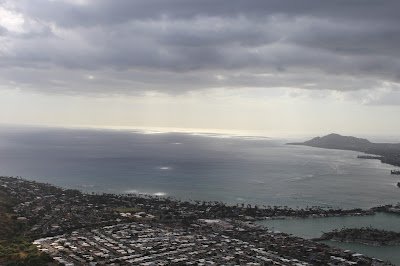
The hike took me about 30 minutes, and it was tiring but not at all the hardest hike I've ever done. Once on top I took a photo of Maunalua Bay, where I had just paddled:

That's Diamond Head over in the right side of the photo. The town of Hawaii Kai lies in the foreground. The actual finish line of the Molokai world championships is in the little protected harbor in the bottom right corner.
Monday photo feature

I apologize for not posting more photos of my time on Oahu. I've actually snapped numerous photos as I've explored here and there, but not many that are relevant to a canoe and kayak racing blog. The photo above is a not-quite-in-focus selfie I took while getting ready to paddle near Kaena Point on Friday. Note the sparse vegetation on the hillside along Oahu's semi-arid leeward coast.
As a consolation for my lack of photo sharing, I give you this shot of my first cousin once-removed James demonstrating proper shaved-ice-eating form:

Sunday, February 21, 2016
I'm out of the loop here
Yesterday I decided to head for Kailua Beach, a popular spot on the windward side of Oahu. But first I wanted to do the February strength routine, and since the pavilion at Ke'ehi Lagoon Beach Park had been a good workout spot on Thursday, I went back there to exercise again.
After that I hopped on the Pali Highway bound for Kailua, and when I got to the beach there I found a canoe and kayak race in progress. It was sort of a rinky-dink affair that might happen every Saturday morning here: a triangular course that went a short distance offshore and was no longer than maybe 2000 meters or so; multiple heats for a variety of age groups and boat classes; lots of kids in attendance for whom socializing on the beach was just as much fun as the racing.
I was kicking myself for not finding out about this or any other races ahead of time. I came to Hawaii mostly just wanting a little vacation and a chance to do some training in warm weather, but a laid back 2000-meter sort of event would have been perfect for me at this early moment in the season. Alas, the surf ski classes were finishing up right as I got there.
Oh well. I paddled out onto the course and worked on my balance in the swells. There were actually some decent waves coming back in toward the beach, and I got several sweet rides. The rides weren't easy to get because the waves were far apart: I really had to throw in a sprint the moment I felt my stern lifting. That made the rides I did get very satisfying. It would have been fun to catch one while coming in to the finish line of a race.
Back on the beach it was nice to see a whole bunch of surf skis just like mine:

Saturday, February 20, 2016
A change in landscape
I've mentioned before that my cousin here in Hawaii is a colonel in the United States Army. He works at a facility on a ridge top in the Koolau foothills, but his family lives in a comfy little condo down on the Hickam Field portion of Joint Base Pearl Harbor Hickam. It's been a nice base of operations for me during my vacation in the Aloha State.
For most of this past week, my routine was to go out and paddle in the morning and do some kind of sightseeing in the afternoon. Besides a trip to Haleiwa on Tuesday, I didn't venture that far from JBPHH and the southern portions of Oahu. I didn't have to leave the base to paddle in Hickam Harbor on Wednesday, and Ke'ehi Lagoon is a short distance to the east, on the other side of Honolulu International Airport.
Yesterday I decided to go a bit farther afield. I drove up along the western coast of Oahu, commonly known as "Leeward Oahu" because it's in the lee of the prevailing northeast winds. Because the Koolau and Waianae Ranges block the moisture that these winds carry, Leeward Oahu is much drier than Windward Oahu, and its slopes lack the lush forests common over on the eastern side of the island.
Leeward Oahu for some reason does not attract tourists the way the rest of the island does, and the coast has much more of a local small-town feel. In places it's even a bit seedy, and as I drove through the town of Waianae I thought I'd found the Hawaii version of Memphis's Summer Avenue.
I finally found the place I wanted to paddle when I came to Yokohama Beach near the northernmost point of Leeward Oahu. I put my boat in the water and started paddling toward Kaena Point, a sharp peninsula that forms sort of a "northwest corner" of the island of Oahu. The closer I got to the point, the more I could feel the northeast wind and the more I could see some downwind runs moving from right to left. Soon I found myself among some large swells with long periods: the water I was on wasn't rough, but I had the sensation of paddling up an incline toward a distant ridge top.
I finally decided it was time to turn around and try my luck with some downwind surfing. There weren't really any waves I could just sit on all day long, but there were all kinds of little bumps that I got brief rides on. I had fun sprinting after each one and seeing what would happen.
The waves were moving at a slight angle away from the shoreline, and it wasn't long before I realized that I was getting pretty far offshore. So I tore myself away from the surfing and started angling back. I was never in any doubt that I would make it, but it took what felt like an awfully long time to make progress back to where the car was parked.
The skies were overcast for most of my time on the water, but as I approached the beach the sun started finding gaps in the clouds and illuminated the deep, clear blue seawater beneath my boat. Paddling water so clear is a novel experience for a guy who spends most of his time on the Mississippi River, and once my boat was back on the beach I just had to dive back in and swim for a few minutes.
Friday, February 19, 2016
Paddling in a reputed paradise
I've checked the forecast for Memphis and it looks like they'll be having Fahrenheit highs in the 60s for the rest of the time I'm in Hawaii. Hmm... should I ask for my money back? At least the water here in Hawaii is a lot warmer than the Mississippi at this time of year.
Hawaii is certainly a beautiful and fascinating place, very different from any other place I've ever been. But mainland Americans like me are led to believe in a certain stylized version of it that's not entirely accurate. You know what I'm talking about: you picture yourself whiling the day away in a hammock between two palm trees, sipping the milk from a coconut through a straw, the entire landscape bathed in sunshine, a gentle ocean breeze caressing your skin...
I'm told that in fact the weather here is often like that during the summer months, but right now it's rather unsettled. At just about any moment it's raining somewhere on Oahu, especially up along the Koolau Range. And the wind from the northeast is pretty persistent. This week we've had stronger winds than normal, according to my cousin; but I think 10-15 miles per hour is pretty standard. And while the air temperature is generally pleasant, it's not always quite warm: at this time of year, the highs average around 78 or 80 degrees Fahrenheit. I don't find myself yearning for a swim in the ocean until it hits the mid 80s or higher.
But... that's okay. All that matters is that the weather is not bad, and there are all kinds of fascinating things to occupy my attention.
A really, really cool thing about Hawaii is (a) outrigger canoe racing is an official high school sport here, and (b) it's on TV! The 2016 state championships took place on February 6 on Ke'ehi Lagoon, and my cousin recorded the telecast of it so that we could watch it during my visit. Athletes competed in OC-6 for state titles in girls, boys, and mixed. Kamehameha Schools of Kapalama claimed the girls title; Punahou was the winning boys' boat; and Seabury Hall won the mixed title. It was fun to see the teamwork and camaraderie among the athletes as they pursued excellence in a craft that's been practiced in this part of the world for thousands of years.
As for my own paddling, my biggest nemesis so far has been adjusting to the change in time zone: Hawaii is four hours behind Central Time. Wednesday morning I was feeling particularly sluggish and unenthusiastic as I paddled in Hickam Harbor. The wind was really blowing and I was skittish about venturing far from shore. I'd planned to paddle for 80 minutes, but ended up quitting after 50.
Yesterday morning I woke up feeling a bit groggy again, and my whole body felt stiff as a board. I drove over to Ke'ehi Lagoon, where the outrigger championships had taken place, and did a long, slow round of stretching and warming up before doing the February strength routine in the park pavilion there. The short power-oriented exercises seemed to give me a jump-start. By the time I was putting my boat in the water I felt awake and enthusiastic again, and I eagerly paddled out onto the lagoon to see what I might see on the way out to the Pacific.
Mind you, I didn't paddle entirely like a champ. Once I was out on the open ocean I found the water choppy and confused, not really the clean downwind run that a surf ski paddler craves, and my paddling felt tentative at times. Paddling by myself in a borrowed boat doesn't exactly inspire fearlessness in me. I could tell the wind was starting to pick up as I headed over toward Waikiki, so I turned back and looked for the channel marker that would lead me back into the lagoon.
All told, I was satisfied with the session and just happy to be in an interesting place for a while. As I paddled across the high school championships course back to the beach, I tried to treat it with the reverence it deserves.
Tuesday, February 16, 2016
Starting to settle in
I spent yesterday recovering from the traveling and getting familiar with my surroundings. The kids were out of school for the Presidents Day holiday, so my cousin's family and I spent the afternoon driving around the southeastern portion of Oahu, beholding some of the majestic beauty of this most unique archipelago.
This morning I did the February strength routine, and then spent several hours checking out part of Oahu's north shore. I visited the town of Hale'iwa, the reputed surfing capital of the world.
In the late afternoon I met Epic Kayaks representative Zsolt Szadovszki to pick up my rental boat, a V-10L. My boat at home is a V-12, but I'm considering a V-10L for my next boat purchase and am taking this opportunity to paddle one for a few days. I met Zsolt next to the Ala Wai Canal near Waikiki Beach, and once I had the boat I did a 60 minute paddle in the canal. I warmed up and did three 8-stroke sprints, and then just paddled around trying to get used to the boat. So far I like it.
Monday, February 15, 2016
Monday photo feature

I spent all day yesterday traveling from Memphis to Atlanta to Seattle to Honolulu, and the experience was a grisly reminder of how much I despise air travel.
As I got off the plane in Honolulu, I expected to be presented with a lei just like in all those 70s TV shows whenever people like Starsky & Hutch made a trip to Hawaii. But apparently they don't do that anymore, maybe because a trip to Hawaii is no longer the sort of once-in-a-lifetime luxury it was back then.
But my cousin Jimmy and his family saved the day! When I arrived at baggage claim, there were Leah and James to give me hugs and hang a flowery wreath around my neck. This trip just might be a success after all. Photo by Jimmy Matthews.
Saturday, February 13, 2016
Ready to go someplace warm
When I got down to the river on Thursday it was some ten degrees warmer than it had been on Tuesday and, more importantly, there was plenty of sunshine and the wind wasn't so bad. I warmed up with fifteen minutes of paddling toward the north end of the harbor, and did three 8-stroke sprints at two-minute intervals. Coming back south I did a couple of surges of maybe two minutes each, and they felt hard... I was bit tired, I guess. When I got back to the marina Joe had just gotten in his boat, and he joined me for another trip up to the north end of the harbor. When we returned to the marina Joe continued toward the south end of the harbor while I took out at the dock.
Yesterday I did another round of the February strength routine. Because this routine is so brief I'm doing three sets. I'm starting to get the hang of the exercises, even those "Rolling squat burpees," though I'm probably not doing them as well as the guy in the video yet. "Hannibal pushups" is the one I'm having the hardest time doing like the guy in the video does.
Today winter got one last shot at me before I escape to the tropics for a few days. A blast of Arctic air moved in last night, and as I pulled into a parking space at the marina this morning the temperature display in my car's dashboard read 30 degrees Fahrenheit. The sky was largely overcast, and the north wind, though not too bad, was bad enough for me to bury my chin down in my coat collar as I walked down the ramp to the dock.
I broke out my fleece-lined pogies for the first time this year--and maybe the last time, unless we have an unusually cold month of March. Most of the winter I use my unlined pogies, only getting out the fleece-lined ones when it's below freezing outside.
As I headed down the ramp I realized I'd made a grave mistake: I'd forgotten to throw my paddle jacket in my bag. Even the heavyweight fleece shirt I had wouldn't be enough on its own, and I briefly considered going all the way back home to get the jacket. But then I figured that the winter coat I was wearing, an "active-wear" sort of thing--fleece lining, nylon shell--would probably work. To the dock and into the boat I went.
As it turned out, I was hot after the first ten minutes of paddling. The sun came out shortly after I left the dock, and the fleece-lined coat on top of the heavyweight fleece was a bit much. I probably didn't need the fleece-lined pogies, either. But I'm used to sweaty summer days here, so a sweaty winter day wasn't going to kill me.
After warming up and doing three 8-stroke sprints, I did a couple of hard pieces of about eight minutes each, with five minutes or so of rest in between. Then I timed myself from the A.W. Willis bridge to the Hernando DeSoto Bridge. My best time over this distance is a little under three minutes; today I did it in about 3:16, which I think was pretty good considering how tired I was from the longer pieces.
If all goes according to plan, my next time in the boat will be in the Hawaiian Islands. Tomorrow I'll be sitting in airports and airplanes all day, and I'll probably spend Monday just getting acclimated, so maybe by Tuesday I'll be ready to paddle. I'll post updates here as circumstances allow.
Tuesday, February 9, 2016
Brrrrr
The mild weekend is over and we're back to the sort of weather I associate with the month of February. When I got down to the river today the temperature was in the mid-30s Fahrenheit and a wicked-cold wind was howling out of the northwest. There was some blue sky up among the clouds but not much sunshine was getting through.
I've remarked numerous times in the past that the hardest part of paddling on such an unpleasant day is getting yourself down to the dock in the first place. Once you're in the boat you'll probably feel fine as long as you're properly dressed. So it was with Joe and me as we paddled away from the marina toward the north end of the harbor. Knowing that very soon I will be getting "a nice Hawaiian punch" didn't hurt, either.
As we paddled north we enjoyed some protection from the trees that line the banks up in that end of the harbor. Coming back south, we had the wind mostly at our backs. The hardest leg of today's paddle was coming from the harbor's mouth back to the marina: the harbor isn't nearly as protected from a north wind in its southern half as in its northern half. I was good and chilled by the time we got back to the dock, and I spent the rest of the day trying to thaw out.
Subscribe to:
Posts (Atom)