By Friday morning my back was feeling better and I was starting to get focused on racing. I left home a little after 9 AM CDT and headed east through Nashville, Bowling Green, Glasgow, Somerset, Richmond. The drive took longer than I thought it would, and I lost an hour when I crossed into Eastern Time. And I was unfamiliar with my destination in the region south and east of Lexington, Kentucky. So I didn't manage to get in a pre-race paddle like I prefer to do. I'm a regimented creature of habit and it gnawed at me a little, but I tried to reassure myself that my performance the next day wouldn't be ruined.
It was getting on toward six o'clock when I arrived at Fort Boonesborough State Park, the site of the race start. I managed to locate Scott Cummins, Elaine Harold, and Lee Droppelman, all of Louisville, with whom I would be sharing a campsite in the park. Once I'd pitched my tent we went to the pre-race supper at a nearby restaurant called Halls On The River. By this time I was hungry enough to eat a horse, but I settled for a plate of catfish with hushpuppies and french fries. A few hours later I would wake up in my tent with some queasiness from all that fried food, but the feeling passed.
By Saturday morning a fifth person had joined our camp: Erik Borgnes of Stevens Point, Wisconsin. I had never met Erik in person but was familiar with his list of impressive victories in high-profile events. He told me he was a regular reader of this blog, and that was as big an honor as any I could possibly earn with my performance in the race.
We had to get our boats and gear in order quickly so that we could drive our vehicles down to the finish and catch the shuttle bus back up to the start. It's always one of the race-day challenges, making sure I pay proper attention to breakfast, hydration, bodily functions, stretching, and race prep while conforming to other people's schedules.
Finally we were back at the start and ready to go. The Bluegrass River Run featured a couple of competitions on the Kentucky River: Scott, Lee, Erik, and I would be racing down to the Valley View ferry, a distance of about 19 miles. Elaine was entered in the six-mile race, which also started at the state park but finished at a riverside restaurant called Proud Mary's beneath the Interstate 75 bridge.
After a few pre-race words from director Gerry James (also a reader of this blog, I was thrilled to learn), we put our boats on the water and got started promptly at 9:30 EDT. Scott, Lee, Erik, and I separated ourselves from the field and spent the early miles in a four-boat pack. The pace seemed comfortable to me, but I had to assess whether it was something I could sustain for the entire race, and this is where my unfamiliarity with the river and the race was a handicap. The best information I had was that Scott had won last year's race in about two and a half hours. I don't normally like to use a G.P.S. device while I'm racing, but this time it might have been helpful to know how far along the course I was and how fast I was getting there... those who snicker at me for being such a Luddite would have had some justification Saturday.
The pace seemed comfortable, like I said, but Lee provided the first clue that it was a little quick when he dropped off our pack several miles in. He remarked after the race that we were "flying."
Scott and Erik and I continued along, trading off the lead. I tried to get all the rest I could while riding their wakes. Scott and I both kept a wary eye on Erik, the most accomplished athlete among us: sooner or later, we figured, he was likely to make his move and break away. Then again, up in Wisconsin the water freezes over during the winter and there was no telling what kind of paddling shape he was in. Erik does have a reputation for staying fit, however.
So there was much to think about as we carried our three-boat chess match down the river. I tried my best to limit my worries to my own self. With four or five trips around the Loosahatchie Bar under my belt this season, I told myself to have faith in the work I'd done.
We passed Proud Mary's at the 47-minute mark. Our long-time racing friend Chris Hipgrave was entered in the 6-mile race and we agreed that we should haze him without mercy if he didn't break 47 minutes.
Erik seemed to make a little bit of a move around 1:15 or 1:20--just a subtle push in the pace as he took the lead. But Scott and I covered the move and we continued as a three-boat pack. By the 1:30 mark I was starting to feel some serious fatigue set in, and again I wondered how much race was left: 45 minutes? an hour? I don't think we were getting much help from the current: my guess is it was moving between 1 and 2 miles per hour, maximum.
At about 1:50, the other shoe finally dropped: with a sudden flurry of strokes, Erik began to break away from Scott and me. I made a feeble attempt to give chase but I knew within seconds I didn't have it in me. Scott went after Erik as well, and stayed with him for perhaps 30 seconds before he got dropped.
As the gap widened between Erik and Scott, I hung several waves back of Scott's stern with the hope of reeling him back in. But my body had had about enough and was shutting down on me. In other words, I bonked. My glycogen stores depleted, simply putting my body through the motions of paddling was suddenly excruciating. I sat there and watched as Scott pulled away from me and Erik pulled away from Scott. In a matter of minutes our tight, cozy, spirited little pack became strung out over at least a full kilometer.
The last 40 minutes of my race were pretty miserable. When I've bonked I tend to start wallowing in self-pity and wondering just how pathetic my result will be. During one of my breaks from paddling I looked upriver and could see Lee's boat three or four minutes back, and knew the possibility of him running me down to take third place was real. The Fahrenheit temperature had moved above 80 degrees and with low humidity the heat was deceptive. Several times in the final ten minutes I dipped my hat in the water and put it back on my head.
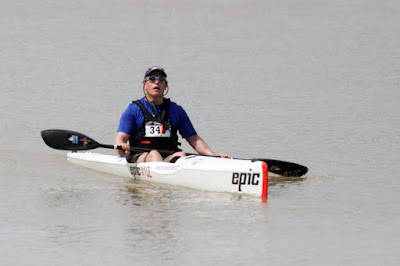
Erik extended his lead and crossed the finish line at Valley View in two hours, 25 minutes, 28 seconds. I don't think Scott was feeling much better than I was but he held on for a respectable second-place finish in 2:29:34. Somehow I managed to stay in third even though I was doing little more than floating with the current. My time was 2:32:01. Lee had indeed narrowed the gap on me and finished just 103 seconds back in 2:33:44. Michael Alexeev rounded out the top five in 2:36:07. Dan Mecklenburg and Debbie Brax paddled their USCA "pro boat" C2 across the line in 2:38:37.
Chris Hipgrave, a resident of Bryson City, North Carolina, saved himself a lot of grief from us by finishing the 6-mile race comfortably under 47 minutes, clocking 44:49. Elaine Harold was the fastest female and claimed second place overall in 53:16. The complete results are posted here. (Once you've clicked on this link, you have to click on "Results" at the top of the page, and then select the race you want from the "Select an event" menu.)
Somehow I found the energy to carry my boat up to the car and change into dry clothes. I drank some water and began the transition back into normal human existence. We all drove back to Proud Mary's for the post-race party and were served some yummy jambalaya and green beans. I accepted my third-place trophy in good spirits and began the long drive back to Memphis.
I was sore from head to toe, and that was no big surprise. But during the drive I also noticed some sharp pain in my left shoulder, in the deltoid area. The pain was still present when I woke up yesterday morning, and when I went down to the river to paddle it bothered me enough that I stopped after just 20 low-intensity minutes. It's feeling slightly better this morning and I hope it's nothing more than a strain that will get better if I treat it with care for the next few days.
The weekend's race turned out to be a bit longer than I care to do, but there's no reason to regret the experience. The Kentucky River is a beautiful place and I'm grateful to the organizers for realizing it was a worthwhile venue for racing.
Monday, May 14, 2018

Thursday, May 10, 2018
Changing seasons and an ailing back
I do believe the weather has shifted toward summer for good. Slowly but surely I'm moving into my summertime routines. Lately it's been warm enough for me to paddle in shorts and a short-sleeved shirt; I'll probably give it another week or so to be sure, but soon I'll be going through the annual ritual of washing my cold-weather gear and putting it away until next winter. Wearing less clothing in the boat means putting on more sunscreen, and since I hate having that greasy stuff all over me I usually wash it off under the water spigot after I paddle. I'll be enjoying those cool baths on the dock more and more as we get deeper into the summer. As the mercury rises I'll have to start thinking about in-the-boat hydration during training sessions.
The riverfront is teeming with signs of the season. The purple martins are in residence at the marina's birdhouse; the turtles are sunning themselves on floating logs; the gar are hanging out an inch below the harbor's surface; cottonwood blooms are everywhere.
On Tuesday morning I did the strength routine for the last time before this Saturday's race, and then I paddled with Joe in the harbor. Tuesday afternoon I somehow tweaked my back while working at my rental property: I can't remember any specific thing that caused it, but at some point I noticed that my lower-left back area was very sore and uncomfortable. It felt awful when I woke up yesterday morning and was a mood-dampening companion all day.
By this morning it had improved some but the discomfort lingered. Fortunately it didn't bother me much when I got in the boat and started paddling. I paddled for 60 minutes and did a set of six 12-stroke sprints. I felt as good as I have in a long time while sprinting: my turnover seemed easier and more fluid.
I'd already had an appointment scheduled with the chiropractor who has helped me out a lot with the plantar fasciitis I've had. I told her about the back discomfort and she worked on that area. Let's hope it runs its course before I line up to race on Saturday.
Monday, May 7, 2018
Monday photo feature

A guy named Mark Richards has been posting some photos he's taken of slalom racing in his native Great Britain over the years. Here's one he took when Nottingham hosted the world championships in 1995. Davey Hearn of the United States (left) celebrates his victory in the C1 class with U.S. team chiropractor Rick DiCarlo.
Sunday, May 6, 2018
Smokin', but not in a good way
I went down to the river yesterday morning under overcast skies. There was very little wind and the Fahrenheit temperature was in the low 70s. After warming up and doing three 8-stroke sprints in the harbor, I paddled out onto the Mississippi and saw a barge rig coming downriver. Downstream-bound towboats usually generate smaller wakes than upstream-bound ones, but this one must have been running behind schedule because its wake was huge. I fell in behind it hoping for some epic surf, but I was reminded that bigger is not always better: I'm no expert on wave dynamics, but something about the shape of these waves made it hard for me to get much of a ride at all. I followed the vessel down just below the Memphis-Arkansas Bridge and then gave it up. I paddled back upriver along the Tennessee bank at a strong tempo and got back to the dock just in time to make it a 60-minute session.
I did a round of the strength routine this morning. I normally would do it tomorrow but I have some things to do tomorrow that might not leave me enough time.
After lunch I headed down to the river and paddled for 80 minutes. With a race coming up Saturday I did some speed-polishing with a set of eight 12-stroke sprints. Then I ferried across the river and looped through the lower reaches of the Loosahatchie Chute before returning to the harbor. The weather was quite lovely--sunny skies and a temperature in the mid 70s--but it was not a "chamber of commerce" day because of a big fire at a metal-recycling yard not far from my marina. Thick smoke billowed from the facility and a haze covered the entire Memphis riverfront area. As I paddled along breathing the polluted air, all I could think about was the ravaged health of all those World Trade Center first-responders.
Friday, May 4, 2018
Week in review
I have made my decision of what race to attend on May 12: I'll be going to the region southeast of Lexington, Kentucky, for the Bluegrass River Run, a 19-mile race on the Kentucky River. It appears there will be some good competition there, and I'm looking forward to visiting a place where I've never raced before. I'm sorry to be missing the Osage Spring 12 event up near Jefferson City, Missouri; I raced there last year and had a great time, and I hope to return there in the future.
I did a cursory round of my new strength routine on Monday, then did full rounds Wednesday and today.
In the boat I paddled for 60 minutes both Tuesday and yesterday. They were fairly typical sessions for me--steady paddles with some surges.
I did a cursory round of my new strength routine on Monday, then did full rounds Wednesday and today.
In the boat I paddled for 60 minutes both Tuesday and yesterday. They were fairly typical sessions for me--steady paddles with some surges.
A new strength routine
Because of my family's annual beach trip later this month, this routine consists of "portable" exercises. Two of them are simple body-weight exercises, and I use my rubber bands for the other three.
1. Rubber band exercise demonstrated by Daniele Molmenti at 5:44 of this video
2. Lateral abdominal exercises demonstrated by Michele Ramazza at 3:52 of this video
3. Standing rubber band exercise similar to dumbbell flies
4. "Superman" back ups
5. "Pre-Hab" rubber band exercises (both inside and outside moves) demonstrated by Daniele Molmenti at 8:30 of this video
Monday, April 30, 2018
Monday photo feature

My friend John Kazimierczyk, the owner and builder at Millbrook Boats in Richmond, New Hampshire, is on vacation in Japan right now, and he's been posting some stunning photos of rivers and other scapes there. He took the photo above on the Tonegawa River in Ibaraki Prefecture.
Finally, good weather for a few days in a row
The weather was as gorgeous as we were promised on Saturday. I got in my boat and warmed up and did three 8-stroke sprints, and then paddled a strong tempo out on the river. I went down to the old bridges just below downtown Memphis and then paddled back up on the Arkansas side. The river continues to be quite high: Saturday's level was 27.9 feet on the Memphis gauge.
I had to rearrange my usual weekend schedule to accommodate some Sunday commitments. As a result, I did my usual Sunday "long" paddle today. Today is what my friend Joe would call a "chamber of commerce" day: blue skies, warm, a pleasantly gentle breeze. With the river level still hanging around 27.9 feet, it was a good day to paddle around the Loosahatchie Bar. I got in the boat and went about this trek in the following manner:
1. I used the section from the marina down to the mouth of the harbor to warm up and do three 8-stroke sprints.
2. I pushed the pace up the Mississippi along the Tennessee bank from the harbor's mouth to the mouth of the Wolf River.
3. I eased up during the stretch upriver from the mouth of the Wolf to the big eddy near the south end of DeWitt Spain Airport.
4. I paddled hard while ferrying across the main channel. I continued paddling a pretty strong pace as I worked my way up to the north end of the Loosahatchie Bar against the strong currents there.
5. Once I had rounded the Bar's north end, and had the current working in my favor, I took a breather. Then I slowly built into a good solid pace down the Loosahatchie Chute. I made sure to admire my surroundings: the Loosahatchie Chute might be my favorite outdoor spot in the entire greater Memphis area. With the picture-perfect weather and the forested banks becoming greener by the day, it was gorgeous today.
6. When I emerged from the Chute and began working my way back across the main channel toward the harbor, several upstream-moving barge rigs had just passed and there were some decent-sized waves to deal with. They weren't as rough as what I saw down in Vicksburg nine days ago, but they were big enough to demand my attention.
7. By the time I re-entered the harbor I was getting tired but still had enough energy to paddle at a decent clip. At times like this I try to focus extra hard on good stroke mechanics.
I got back to the dock about an hour and 52 minutes after I'd left it. My paddle today had had a little of everything: some flatwater, some smooth moving water, some waves, some paddling against the current, some paddling with the current, some hard paddling, some easy paddling. Not a bad morning's work.
Friday, April 27, 2018
Spring can do better than this
Joe and I had a good day for our loop of the harbor Tuesday--it was slightly warmer than it had been lately, and the wind was light.
Yesterday was another soggy day in what has been a wet year so far. Last time I checked, the greater Memphis area was some ten inches above normal in rainfall for the year up to this date. As I prepared to head to the river yesterday, rain pouring down outside, I looked at the Internet radar and saw a big mass of yellow (medium-heavy rain) parked over the city. It was sort of rotating but it wasn't going anywhere. I would be paddling in the rain, it was as simple as that. Sure, I could have waited until afternoon to paddle, but I generally don't like to do that. My energy level is usually flagging by late afternoon, and there's no telling what might come up during the day that would make me have to skip paddling altogether. So down to the river I went.
What's so terrible about paddling in the rain? Nothing, really; I've certainly done my share of rainy-day paddling, and as I've said before, some of the most beautiful days out in nature are the days of inclement weather. But I have to admit I'm weary of the chill and the moisture. I feel like we're overdue for a good run of beautiful sunny warm days with gentle breezes. We are in fact supposed to have such weather this weekend, so hope springs eternal, I guess.
Anyway, once I was in the boat the rain didn't really bother me. I warmed up and did three 8-stroke sprints, and then paddled up the Mississippi to the lower end of the Greenbelt Park before doing a strong tempo back downriver to the harbor. By then the rain was finally moving out, so I wasn't feeling like too much of a drowned rat when I got back to the dock.
I did the strength routine on Monday, Wednesday, and today this week. With the calendar about to turn over to another month, I think I'll come up with something new to start next week.
Monday, April 23, 2018
Race schedule update
Now that I've offered voluminous reflection on this past weekend's racing, let's look ahead! Down below you'll find a list of races that are on my radar for the remainder of this season.
Of course, there's now a gaping hole in the schedule for the month of June. Father's Day weekend will not be the same without the Outdoors, Inc., Canoe and Kayak Race this year.
As I've said before, it's unlikely I'll make every event that is on this schedule. In fact, it's impossible: the two events I'm interested in next month are on the same date. I attended one of these races last year and thought it was a good event, while I've heard good things about the other one. I expect they will offer a similar level of competition. They're both on what I would call medium-sized Class I rivers, and they're about the same driving distance from where I live. In the end I'll probably make my decision based on weather forecasts and river flow information.
Anyway, here's the schedule:
May
12 Osage Spring 12. Osage River near Osage City, Missouri. 12 miles total (10 miles downriver and then 2 miles back up) on a Class I river. Register
12 Bluegrass River Run. Kentucky River near Richmond, Kentucky. 19 miles down a Class I river. Register
June
9 Taylorsville Lake Paddle Battle. Taylorsville Lake, Taylorsville, Kentucky. A 10-mile flatwater race. Register
July
7 The Lovely Laurel River Lake Paddle Blast. Laurel River Lake, Corbin, Kentucky. A 10-mile flatwater race. Register
16-21 Gorge Downwind Championships. Columbia River, Hood River, Oregon. A race for surf skis and outrigger canoes in the legendary downwind conditions of the Columbia River Gorge.
August
4 The Paddle Grapple. Fontana Reservoir near Bryson City, North Carolina. A 6-mile flatwater race. Register
9-12 U.S. Canoe Association National Championships. Onondaga Lake and Erie Canal, Syracuse, New York. Marathon races in a variety of boat classes sanctioned by the USCA.
September
1 Big River Regional. Mississippi River, Baton Rouge, Louisiana. 13 miles down the largest river in North America.
8 Lower Atchafalaya Sprints. Atchafalaya River, Patterson, Louisiana. A series of 3-mile races on flatwater. Register
22 Gator Bait Race. Barnett Reservoir outside Jackson, Mississippi. A 5.5-mile flatwater race. Register
29 River Rat Paddle Challenge. Ouachita River at Monroe, Louisiana. 6.5 miles on a Class I river.
Monday photo feature

Susan Jordan of Lucedale, Mississippi, navigates a particularly mighty Mississippi River en route to Vicksburg on Saturday. Her "V8 Pro" surf ski put her in the "K1 Fast" class, and she was the winner of that class as well as the second-fastest female competitor overall. Photo by Paul Ingram.
Sunday, April 22, 2018
Got me some press
Hey, check it out! I got my name in the paper! The Vicksburg Post ran this article about Saturday's race in today's edition.
Racing at Vicksburg
I got up bright and early yesterday morning and got myself down to Vicksburg's riverfront, site of the race finish. There I got on a bus that took racers up to the start at Madison Parish Port.
By the time we got up there the Fahrenheit temperature was rising into the 60s. The river appeared smooth but there was a breeze coming upriver that one sensed would be picking up soon. The forecast had called for a headwind around 13 miles per hour.
After a brief racers' meeting we got in our boats and lined up, and off we went. I moved into the lead with Andy Capel of Maumelle, Arkansas, maintaining contact.
Here's a map of the section of the Mississippi we were racing on:

As you can see, there are sort of three "legs" to the S-shaped course. I spent the first leg paddling strong but controlled, knowing there was a lot of race left and I should conserve energy for the rougher conditions that might arise later on. For the time being the river conditions and the headwind weren't too bad, though the wind was blowing just hard enough to be noisy in my ears and trick my mind into thinking things were worse than they really were. With Andy hanging out on my stern wake I threw in an occasional surge to test his mettle, and he hung tough each time. This photo taken by Paul Ingram shows the state of affairs for most of that first leg:

It wasn't until we were entering the first big bend ("Marshall Point Cut-Off") that I finally opened a bigger gap. From this point on I could no longer find Andy in my peripheral vision, but I had to assume he wasn't too far back. Meanwhile the conditions were beginning to roughen a little. In the middle leg of the course we had more of a beam wind and the waves were moving from left to right, and I had to pay close attention to keep my balance.
One of the things on my mind was the elapsed time: I had last broken two hours in this race in 2014. Though there were perfectly good reasons (low water being chief among them) for my slower times since then, I had this feeling in the back of my mind that maybe my aging body no longer had any sub-two-hour performances in it. With the river running at about 43.1 feet on the Vicksburg gauge yesterday--a tenth of a foot above the official "flood stage"--one could expect faster times, but the weather conditions had dampened any thoughts of miracles.
As I rounded the second big bend I could see a string of barge rigs idling near the river-left bank, and off in the distance I could see a Coast Guard vessel coaxing a couple of more to do the same. The Coast Guard had ordered a halt to commercial traffic while the race was going on, but it appeared that these recalcitrant towboats were only just now complying for fear of a USCG wrist-slap. Even though these machines had now throttled down their engines, the waves they'd already produced, driven by the wind, would linger a long, long time. The approach to the city of Vicksburg promised to be a rough one.
Soon I was climbing up and over one wave after another, with an occasional four-foot breaker crashing over my bow. I kicked open the drain valve in my footwell and tried to grin and bear the soakings. I looked for the driest lines and tried to keep the boat moving as consistently as I could, knowing that Andy and maybe others couldn't be too far behind. I reminded myself that the conditions were challenging for them, too.
The river got nothing but rougher as I inched closer and closer to Vicksburg. Timing my strokes so I was paddling on the crest of each wave, I was having serious doubts about breaking two hours. By this time I was just trying to keep my boat upright until I was in the more protected waters of the Yazoo River. The sun was peeking through the clouds and it was hard to see, but little by little the mouth of the Yazoo came into view. I could see the calmer water there and in the last few hundred meters my only thought was getting there.
At last I was there. I reached down and closed my drain valve and began to think about going fast again. The finish line was some 1600 meters up the Yazoo, and I would be paddling against a mild current to get there. My watch had read 9:02 AM when the starting gun fired, and it was now about 10:50, so after all my struggles out on the Mississippi I still had a shot at breaking two hours. I was plenty tired but still had the energy for a good sustained surge, so I bore down and got to work. I stayed close to the Yazoo's river-right bank, away from the main current, for about two-thirds of the distance. The finish line was at the foot of the "Vicksburg Front" on the river-left side, so I had to ferry across, but I made it a steep ferry, trying to find that happy medium between adding extra distance to my trek and fighting the Yazoo's current. I sprinted as hard as I could for the last 300 meters and crossed the finish line at 10:59 on my watch. I knew I'd made it in an hour and 57 or 58 minutes (my official time was 1:57:36, as it turned out). This photo, also by Paul Ingram (or maybe one of his minions), captures the moment:
Elated to be finished at last, I turned around expecting to see Andy not too far back, but there were no paddlers in sight. I began my cool-down paddle and headed back down the Yazoo to cheer on some of the other racers. After a while I spotted the orange surf ski of David Dupree of Rayville, Louisiana, headed up the river-left bank. Andy's father Phil Capel of Sherwood, Arkansas, was several boatlengths behind David. These two would take second and third place overall.
More racers began to come into view, but there was still no sign of Andy. Eventually I headed back up to the finish area. Phil saw me and asked if I knew anything about his son. I said I didn't. The Coast Guard vessel was making its way up the river and Phil paddled over to speak to them.
I got out of my boat and carried it to my car, which I'd left parked a short distance from the finish area. Once I'd put some dry clothes on I walked back over to the riverfront and found Andy standing there. He told me that he had in fact been just a few hundred meters behind me as we approached the mouth of the Yazoo; then, just when he thought he'd made it to the protected water, a wave knocked him over. Drifting down the turbulent Mississippi, away from the Yazoo's mouth, Andy made numerous attempts to re-mount his surf ski before he finally succeeded. Then he had to fight his way back up to the Yazoo and to the finish. The mishap knocked him back to 14th place overall with a time of 2:22:39; it's possible he might have broken two hours if he'd stayed on track.
Karen Kesselring of Hot Springs Village, Arkansas, was the first overall female finisher, clocking two hours, 18 minutes, 58 seconds. The complete results are posted here.
As soon as the awards were over I made the four-hour drive back to Memphis. I was unbelievably tired and was in bed before ten o'clock. I woke up this morning feeling sore in my midsection; that's pretty typical after a long hard race. A short, easy recovery paddle was in order, but it was pouring down rain this morning and I just couldn't bring myself to immerse myself in the elements again. Instead I spent the morning alternating between lazing around and unpacking the car and doing a load of laundry and doing some overdue house cleaning. Yes, even a big canoe and kayak race winner has to clean his own house and do his own laundry.
I finally made it down to the river after four o'clock this afternoon. The post-race recovery paddle is a ritual that must be observed... I told you in my last post that I was regimented. I was still quite sore but once I was warmed up I felt pretty good in the boat. The clouds were giving way to some sunshine and it was a lovely late afternoon on the Memphis riverfront.
By the time we got up there the Fahrenheit temperature was rising into the 60s. The river appeared smooth but there was a breeze coming upriver that one sensed would be picking up soon. The forecast had called for a headwind around 13 miles per hour.
After a brief racers' meeting we got in our boats and lined up, and off we went. I moved into the lead with Andy Capel of Maumelle, Arkansas, maintaining contact.
Here's a map of the section of the Mississippi we were racing on:

As you can see, there are sort of three "legs" to the S-shaped course. I spent the first leg paddling strong but controlled, knowing there was a lot of race left and I should conserve energy for the rougher conditions that might arise later on. For the time being the river conditions and the headwind weren't too bad, though the wind was blowing just hard enough to be noisy in my ears and trick my mind into thinking things were worse than they really were. With Andy hanging out on my stern wake I threw in an occasional surge to test his mettle, and he hung tough each time. This photo taken by Paul Ingram shows the state of affairs for most of that first leg:

It wasn't until we were entering the first big bend ("Marshall Point Cut-Off") that I finally opened a bigger gap. From this point on I could no longer find Andy in my peripheral vision, but I had to assume he wasn't too far back. Meanwhile the conditions were beginning to roughen a little. In the middle leg of the course we had more of a beam wind and the waves were moving from left to right, and I had to pay close attention to keep my balance.
One of the things on my mind was the elapsed time: I had last broken two hours in this race in 2014. Though there were perfectly good reasons (low water being chief among them) for my slower times since then, I had this feeling in the back of my mind that maybe my aging body no longer had any sub-two-hour performances in it. With the river running at about 43.1 feet on the Vicksburg gauge yesterday--a tenth of a foot above the official "flood stage"--one could expect faster times, but the weather conditions had dampened any thoughts of miracles.
As I rounded the second big bend I could see a string of barge rigs idling near the river-left bank, and off in the distance I could see a Coast Guard vessel coaxing a couple of more to do the same. The Coast Guard had ordered a halt to commercial traffic while the race was going on, but it appeared that these recalcitrant towboats were only just now complying for fear of a USCG wrist-slap. Even though these machines had now throttled down their engines, the waves they'd already produced, driven by the wind, would linger a long, long time. The approach to the city of Vicksburg promised to be a rough one.
Soon I was climbing up and over one wave after another, with an occasional four-foot breaker crashing over my bow. I kicked open the drain valve in my footwell and tried to grin and bear the soakings. I looked for the driest lines and tried to keep the boat moving as consistently as I could, knowing that Andy and maybe others couldn't be too far behind. I reminded myself that the conditions were challenging for them, too.
The river got nothing but rougher as I inched closer and closer to Vicksburg. Timing my strokes so I was paddling on the crest of each wave, I was having serious doubts about breaking two hours. By this time I was just trying to keep my boat upright until I was in the more protected waters of the Yazoo River. The sun was peeking through the clouds and it was hard to see, but little by little the mouth of the Yazoo came into view. I could see the calmer water there and in the last few hundred meters my only thought was getting there.
At last I was there. I reached down and closed my drain valve and began to think about going fast again. The finish line was some 1600 meters up the Yazoo, and I would be paddling against a mild current to get there. My watch had read 9:02 AM when the starting gun fired, and it was now about 10:50, so after all my struggles out on the Mississippi I still had a shot at breaking two hours. I was plenty tired but still had the energy for a good sustained surge, so I bore down and got to work. I stayed close to the Yazoo's river-right bank, away from the main current, for about two-thirds of the distance. The finish line was at the foot of the "Vicksburg Front" on the river-left side, so I had to ferry across, but I made it a steep ferry, trying to find that happy medium between adding extra distance to my trek and fighting the Yazoo's current. I sprinted as hard as I could for the last 300 meters and crossed the finish line at 10:59 on my watch. I knew I'd made it in an hour and 57 or 58 minutes (my official time was 1:57:36, as it turned out). This photo, also by Paul Ingram (or maybe one of his minions), captures the moment:

Elated to be finished at last, I turned around expecting to see Andy not too far back, but there were no paddlers in sight. I began my cool-down paddle and headed back down the Yazoo to cheer on some of the other racers. After a while I spotted the orange surf ski of David Dupree of Rayville, Louisiana, headed up the river-left bank. Andy's father Phil Capel of Sherwood, Arkansas, was several boatlengths behind David. These two would take second and third place overall.
More racers began to come into view, but there was still no sign of Andy. Eventually I headed back up to the finish area. Phil saw me and asked if I knew anything about his son. I said I didn't. The Coast Guard vessel was making its way up the river and Phil paddled over to speak to them.
I got out of my boat and carried it to my car, which I'd left parked a short distance from the finish area. Once I'd put some dry clothes on I walked back over to the riverfront and found Andy standing there. He told me that he had in fact been just a few hundred meters behind me as we approached the mouth of the Yazoo; then, just when he thought he'd made it to the protected water, a wave knocked him over. Drifting down the turbulent Mississippi, away from the Yazoo's mouth, Andy made numerous attempts to re-mount his surf ski before he finally succeeded. Then he had to fight his way back up to the Yazoo and to the finish. The mishap knocked him back to 14th place overall with a time of 2:22:39; it's possible he might have broken two hours if he'd stayed on track.
Karen Kesselring of Hot Springs Village, Arkansas, was the first overall female finisher, clocking two hours, 18 minutes, 58 seconds. The complete results are posted here.
As soon as the awards were over I made the four-hour drive back to Memphis. I was unbelievably tired and was in bed before ten o'clock. I woke up this morning feeling sore in my midsection; that's pretty typical after a long hard race. A short, easy recovery paddle was in order, but it was pouring down rain this morning and I just couldn't bring myself to immerse myself in the elements again. Instead I spent the morning alternating between lazing around and unpacking the car and doing a load of laundry and doing some overdue house cleaning. Yes, even a big canoe and kayak race winner has to clean his own house and do his own laundry.
I finally made it down to the river after four o'clock this afternoon. The post-race recovery paddle is a ritual that must be observed... I told you in my last post that I was regimented. I was still quite sore but once I was warmed up I felt pretty good in the boat. The clouds were giving way to some sunshine and it was a lovely late afternoon on the Memphis riverfront.
Friday, April 20, 2018
Fun in north Mississippi
I got an early start this morning, so I didn't feel in a rush to get to Vicksburg.
I like to get a short paddle in the day before a race so I can rev the engines and move some blood through the relevant muscles. I decided to stop at Enid Reservoir, just off Interstate 55 in Yalobusha County, for this purpose. Enid Reservoir, about 70 miles south of Memphis, was created by the construction of a dam on the Yocona River. One reason I picked it for today's paddle was something I'd heard about for years but had never seen first hand: apparently there's a short section of whitewater just below the dam. When I stopped to check it out today, this is what I found:

I was wishing I had a whitewater boat with me. But I didn't, so once I'd beheld the sight of Mississippi whitewater to my satisfaction, I drove up to the flatwater impoundment above the dam and found a place to put in.
A calm, quiet expanse of water to do my pre-race paddle on was what I'd had in mind. Instead I got offshore conditions, with wind-driven waves moving from southeast to northwest. As an athlete I tend to be regimented and don't always like when things don't go as expected, but today I made myself relax and go with it. Instead of the 12-stroke sprints I might have done, I did my sprinting in the effort to catch waves and ended up getting some nice rides. I would have liked to do it for hours, but with a race tomorrow I limited myself to 40 minutes of playing around.
Back at the car I put my dry clothes back on and ate the lunch I'd brought with me. I hit the road and reached Vicksburg around 3 o'clock. I continued across the river and up to Madison Parish Port, where I dropped my boat at the start. Then I returned to Vicksburg and picked up my race packet.
Now I'm at my motel streaming the Cardinals game on my computer and settling down for what I hope will be a good night's sleep.
Thursday, April 19, 2018
It's about time to race again
On Monday I got myself signed up for the Bluz Cruz Canoe and Kayak Race, a 22-miler down the Mississippi River starting at Madison Parish Port and finishing at Vicksburg. So I'm committed now. This week is being spent getting myself race-ready. That means doing the strength routine Monday and Wednesday, but not Friday. It means polishing my speed in the boat. And it means getting as much rest as I can--the mental kind as well as the physical.
Joe and I did our usual loop of the harbor on a warm, breezy day Tuesday. Yesterday it was breezy again and the temperature exceeded 80 degrees Fahrenheit in the afternoon. Today it is cooler, with a high in the 50s expected, but it seems that our cool spells are getting less chilly and shorter in duration. I paddled for 60 minutes, starting with a set of six 12-stroke sprints and then spending some good time out on the Mississippi in preparation for Saturday's race.
Joe and I did our usual loop of the harbor on a warm, breezy day Tuesday. Yesterday it was breezy again and the temperature exceeded 80 degrees Fahrenheit in the afternoon. Today it is cooler, with a high in the 50s expected, but it seems that our cool spells are getting less chilly and shorter in duration. I paddled for 60 minutes, starting with a set of six 12-stroke sprints and then spending some good time out on the Mississippi in preparation for Saturday's race.
Monday, April 16, 2018
Monday photo feature

How often does an ordinary guy like me get lumped together with the two best male Olympic sprint kayakers the United States has ever had? Not very often. But it happened here at Memphis in 2002, when Greg Barton and Mike Herbert were the top two finishers in the Outdoors, Inc., Canoe and Kayak Race, and I managed to beat everybody else to the finish line. Photo by my mom.
Greg and Mike are two of a number of "heavyweights" that have attended the OICK race over the years. But there's a lot more to the event than that. I consider it to be an annual celebration of this incredible natural resource our city has at its doorstep, and the wonderful recreational opportunities it affords. Park remodeling has doomed the event for this year but I hope it will be back better than ever in 2019.
Sunday, April 15, 2018
No racing in Memphis this year
This past week I got some bad news from my friend Joe, the director of the long-running Outdoors, Inc., Canoe and Kayak Race on the Mississippi River here at Memphis. This year's race, scheduled for June 16, has had to be called off. The reason is that Mississippi River Park, the park next to the finish line that has always been the site of the awards and other post-race festivities, will be closed for construction and remodeling during the month of June. Even though Joe had submitted his permit application to use the park back in January, the Riverfront Development Corporation, the private organization that contracts with the city to manage the public land along the riverfront, did not notify him of this closure until the week before last.
And so, the event that is typically the highlight of my season is off the schedule. I believe it will be sorely missed this year--not just by the canoe and kayak racing community, but by the entire city of Memphis as well, in ways that are less tangible but no less valid. The good news is that Joe says he intends to bring the event back in 2019. Here's hoping that racers will be back on the water with the full support of the R.D.C. and the city of Memphis, and that this year's loss will seem like nothing more than a blip in the history of this great tradition.
And so, the event that is typically the highlight of my season is off the schedule. I believe it will be sorely missed this year--not just by the canoe and kayak racing community, but by the entire city of Memphis as well, in ways that are less tangible but no less valid. The good news is that Joe says he intends to bring the event back in 2019. Here's hoping that racers will be back on the water with the full support of the R.D.C. and the city of Memphis, and that this year's loss will seem like nothing more than a blip in the history of this great tradition.
Feverish goings on this spring
This past week was a crazy one with a lot of out-of-the-boat things to deal with. I managed to do about all the training stuff I'd do in a normal week, but the time to write about it here proved elusive. Here's my attempt to make up for that.
I got in the usual three rounds of the strength routine this week: Monday, Wednesday, and Friday.
At this time of year warmer weather is typically accompanied by strong winds, and that's what we had in the later part of the week. When Joe and I met to paddle on Tuesday, it was still calm, sunny, and cooler: the temperature was in the mid 50s Fahrenheit. By the time I got back in the boat on Thursday it had warmed up into the 70s and the wind was screaming out of the south. I dealt with it by staying in the harbor and arranging for a workout with the wind at my back. I warmed up paddling toward the mouth of the harbor, into the wind, and I did three 8-stroke sprints into the wind as well. Then I turned around and commenced the workout: ten 30-second sprints at three-minute intervals. Tiring as they were, the sprints felt good and smooth and fluid.
On Saturday I would be involved in an all-day event in the arts district where my workshop is, so I decided to paddle Friday afternoon. By then I was dead-dog tired, I guess from the strength routine that morning combined with all the things that had been going on all week. I felt as sluggish in the boat as I'd felt in a long time. The wind was blowing again, and I just tried to stay relaxed and paddle easy for 40 minutes.
Some heavy rain came through yesterday, and today we're immersed in the cooler air than moved in behind it. The temperature was in the mid 40s when I got down to the riverfront this morning, with a pretty stiff wind blowing out of the west. My usual Sunday routine is to do a longer paddle, but with a race coming up next weekend I didn't want to make it super long. So I paddled for 70 minutes, doing a set of eight 12-stroke sprints at two-minute intervals and then paddling on the fast side of medium the rest of the time. I paddled out on the Mississippi for a short while--I didn't stay out there long due to some towboat wakes intensified by the windy conditions. In any case, by the time I returned to the dock I was feeling better than I'd felt at the outset, and that was satisfying after Friday's lethargic session on the water.
Monday, April 9, 2018
Monday photo feature

The recent cold weather has me dreaming of warm sunny days, the kind of days when you can run a cool mountain stream with no layers on under your life jacket. That's what Billy Treadway and I did on the Pigeon River near Hartford, Tennessee, in the summer of 1993. Photo by Mike Davis.
Sunday, April 8, 2018
Cooling my enthusiasm
I was slow to get some new strength work going last week. I got back to doing some work on my rental property that I'd had to put aside for a while, and I didn't do anything Monday or Wednesday. On Friday I finally did a cursory round of the new routine, just to get my body used to doing something new.
The weather forecasters had predicted unseasonably cold weather for yesterday, and Mother Nature delivered. When I got up it was overcast and cold, with a howling north wind. I donned clothing I thought I'd worn for the last time this season and headed down to the river. When I arrived the temperature display in my car said it was 34 degrees Fahrenheit. The pogies came out of my bag and went back on my paddle... yarrgh.
I mentioned in my previous post that nothing should seem too bad after the weather I paddled in at the beginning of the year, but in a way today might have been worse: I've been saying for years that I'd rather paddle when it's 24 degrees and sunny and calm than when it's 34 degrees and overcast and windy.
But seeing as how there was not a thing I could do about the weather, I just got in my boat and started paddling. And from then on I felt fine. The hardest part of cold-weather paddling is not the paddling itself but the time spent on the dock readying the boat beforehand and putting it away afterward.
I warmed up by paddling to the north end of the harbor so I'd have a nice long stretch with the wind at my back. After doing three 8-stroke sprints, I did a workout consisting of eight two-minutes-on-two-minutes-off pieces.
It didn't warm up much while I was on the water. As I drove home my car said it was 36 degrees. The forecast high was in the mid 40s but I don't think it actually got out of the 30s yesterday.
When I got up this morning the temperature was right at freezing, but the sun was shining through a patchwork of clouds and the wind was lighter. With one of my longer races of the year coming up in two weeks I wanted to get in a good long paddle today. With the Mississippi River flowing at 27.5 feet on the Memphis gauge, there was plenty of water for a good unimpeded trip around the Loosahatchie Bar. By the time I got down to the river the temperature was up to 43 degrees and I got in my boat envisioning a lovely wilderness tour on a cool but sunny day.
But you know how that saying goes: "Man plans, God laughs," or something like that.
I paddled south from the marina, doing three 8-stroke sprints along the way. When I got to the mouth of the harbor I found heavy barge traffic out on the river: one rig had just passed by and was moving upriver under the Hernando DeSoto Bridge, and I could see two more coming up from the President's Island area. This would have been less of an issue in the middle of summer, but on a chilly day like today I didn't want to push my luck by ferrying across the river in a bunch of rough water.
As I was making this decision to stay on the Tennessee side, I realized I was stuck. The southern tip of Mud Island sort of plateaus as it slopes down into the water at the harbor's mouth, and at today's water level this plateau was no more than a couple of inches beneath the surface. My rudder had sunk deep into the mud and I spent a couple of minutes jerking the boat forward with my body to get it into deeper water. Once I was finally there I realized that my rudder's post had gotten bent so that the rudder would not swivel freely.
Exasperated, I muscled my boat across the harbor to the cobblestones, the nearest place where I could easily get out of the boat and fix the rudder. Of course, getting out of the boat someplace other than a dock means getting my feet wet, and with the waves created by that first barge rig crashing against the cobblestones, I got drenched up to my knees. I managed to get my pogies wet, too. And thickening clouds were beginning to cover up the sun. I was able to bend my rudder post back so that it functioned properly again, but by this time I was angry at everything--at the heavy commercial traffic on the river, at my failure to read the water in an area I've paddled through zillions of times, at the presence of February-like weather a week into April... everything.
I headed up the river, and it took me most of the way up to the mouth of the Wolf River to calm down and get my mind back on the task at hand. I paddled about a mile up the Wolf before turning around and coming back. When I got back to the Mississippi the last barge rig was passing by, and I paddled somewhat gingerly downriver in the ensuing turbulent water. The cold weather combined with my blown concentration had me in complete self-preservation mode.
Finally I was safely back in the harbor and I returned to the dock to finish up a 120-minute session. In the end I did get a good long paddle in, but it was nowhere near as enjoyable as I'd hoped for.
Friday, April 6, 2018
New strength routine
(What follows is a re-post of something I wrote last year to explain the "Smart Bell" workout that will serve as my strength routine for the next little while.)
At my last teaching job in the 1990s I became good friends with the school's wrestling coach, and he introduced me to a thing called a Smart Bell, invented by a friend of his, U.S. National Team wrestler Paul Widerman. A Smart Bell is a steel object that sort of looks like a steering wheel; it is precisely balanced to facilitate numerous strength-in-motion exercises. My Smart Bell, more than 15 years old, weighs 15 pounds; it appears that modern-day Smart Bells are lighter. That suits my general attitude toward weight training, that the amount of weight is less important than precise technique.
I've got a set of Smart Bell exercises that my wrestling-coach friend showed me years ago. I've looked all over You Tube for video footage of these exercises, but haven't had much luck; perhaps one day I'll post videos of myself doing them. In the meantime, I'll point you to this video in which a guy does some of my exercises in one approximate form or another. (Actually, he does some other exercises I'd never seen before that I should consider incorporating into my routine.)
My routine goes like this:
1. Standing torso-twists (similar to what the guy is doing at 1:37 of the video)
2. Orbital circle (not on the video)
3. The Russian (what the guy is doing at 0:28)
4. Pushups, placing the Smart Bell on the floor and gripping it
5. Situps, holding the Smart Bell behind my head
6. Squats (what the guy is doing at 1:10)
7. Circle (what the guy is doing at 0:44)
8. Lunges (the guy does lunges at 1:23, but I do them with the Smart Bell behind my head, and I actually walk across the room)
It really IS all relative
Spring is definitely here, but it hasn't yet taken the form of idyllic, tranquil, balmy days. When Joe and I got together to paddle Tuesday morning it was around 70 degrees Fahrenheit but the south wind was as fierce as anything I've paddled in in a long time.
By yesterday the conditions were calm, but a cool spell had set in. The temperature was barely over 50 degrees as I put my boat in the water for a 60-minute paddle. I warmed up and did three 8-stroke sprints in the harbor, and then did a fast ferry across the river to the Arkansas side and did a couple of long surges both up and down the river before returning to the harbor and heading back to the dock.
It's chilly and rainy today, and the forecast for tomorrow looks rather miserable. By April I'm starting to feel entitled to some lovely warm weather, and when we go through spells like this it's tempting to get all whiny and maybe even blow off a workout. This is why I think it's worthwhile to get myself out on the harshest winter days we get here in the Mid South: when I get down to the dock tomorrow and stand there in the unpleasant sub-40-degree weather that's predicted, I'll know deep down that it's really not that bad.
Monday, April 2, 2018
Monday photo feature

Jake Stachovak and I depart downtown Memphis, bound for the Tunica Riverpark some 35 miles downstream, in December of 2010. Photo by Ernest Kelly.
Sunday, April 1, 2018
Computers don't compute everything
Yesterday's weather was breezy but otherwise lovely. When I got down to the riverfront the sun was out and the Fahrenheit temperature was in the mid 60s and rising toward a high in the low 70s. I warmed up and did three 8-stroke sprints, and then practiced my strokes at varying levels of intensity.
It was overcast and cooler when I got in the boat today, but the conditions were the calmest they'd been all week. It would have been a good day to paddle around the Loosahatchie Bar again, but having done that some four times already in 2018, I'm a little weary of it. I decided to stay on the Tennessee side instead.
I warmed up and did three 8-stroke sprints in the harbor, and then headed up the Mississippi. The paddle upriver was slow-going: at the current water level (24.6 feet on the Memphis gauge) there was a lot of swirly water along the bank but not many eddies to paddle up, and the north wind was blowing just hard enough to make me feel like I was fighting a bit. But I made it to the mouth of the Wolf River, and I figured the bottom section of the Wolf would be a good place to do a workout with my G.P.S. device. When the Mississippi is high like it is now, it backs up the Wolf for several miles and the water there is basically flatwater. That's what I'd always thought, anyway.
The plan was to do a four-minutes-on-four-minutes-off sort of thing, with the target pace for each "on" piece being about 7 miles per hour. But once I got started I found it very difficult to go more than 6.8 or so. I figured the wind had something to do with it, but even in places where I had good protection from the wind I struggled to hit 7 mph.
I paddled two miles up the Wolf, or about two tenths of a mile above the Danny Thomas Boulevard bridge, and then turned around. Coming back downriver I suddenly had no trouble at all going 7 mph; in fact, at times I exceeded 8 mph. Now, anybody reading this will tell me the obvious explanation--that there was in fact some current. But each time I paddled under a bridge I took a close look at the pilings and couldn't see any eddy lines coming off them.
I was quite puzzled about it all until I took some time to do the arithmetic in my head. Going up the Wolf my speed had been 6.5ish and coming back down it was 8.0ish, so the water must have been moving only about three quarters of a mile per hour, and that might not be enough to create any visible eddy lines. If I'm right about that, then my speed during the "on" pieces was in fact 7.2 or 7.3 mph, and that's pretty much what I'd wanted to do in the first place. In any case, today's experience was a good example of why I don't rely too heavily on a G.P.S. in my training: it's hard to get reliable information from it when you're doing an outdoor wilderness type of sport, even when the conditions seem as ideal as can be.
In all I did six cycles of the workout. The sixth piece actually took me back out onto the Mississippi, and on that mighty river I could go much faster: I got it up as high as 12.7 mph... world class, baby!
I was plenty tired by the time I was back in the harbor. I tried to relax and take good strokes all the way back to the dock. I listened to the baseball game as I drove home. Those mean old Mets had beaten the Cardinals twice to open the new season, but the Cardinals came back and won today.
Friday, March 30, 2018
Continuing to get good work in
On Monday I did a round of the current strength routine. Tuesday was another warm and windy day. I was on my own to paddle because Joe was in an extended meeting, and as I was still feeling tired from Sunday's paddle as well as Monday's strength work, I decided a nice taut 60-minute sort of thing in the harbor was what I needed. I warmed up and did three 8-stroke sprints, and then paddled on the fast side of medium for the rest of the hour. I tried to keep my body relaxed, even when I was paddling into the teeth of that wind.
A bunch of rain moved through the Mid South Wednesday and yesterday. By the time I was in the boat yesterday morning it had just about moved out, but the wind was blowing again. I felt that another good "speedy" session was in order. I warmed up paddling south, into the wind, and then did three 8-stroke sprints with the wind at my back. Then I paddled south again, to the mouth of the harbor, and turned around for a good long downwind leg. When I reached the monorail bridge I timed myself from there to the Hernando DeSoto Bridge--a distance of about 450 meters. My time was a second or two under two minutes--very wind-aided, yes, but it's always nice to be able to break two minutes at this point in the season. I hope that a in a couple of months I'll be doing sets of four of these sprints all under two minutes. I spent the rest of the hour paddling a strong tempo.
I did rounds of the strength routine on Wednesday and today. I believe I'll come up with something
new for the month of April.
Monday, March 26, 2018
Monday photo feature

Having just competed in the Olympic Games the year before, the C2 team of Wayne Dickert and Horace Holden gets the 1997 season underway at the Nantahala Doubleheader.
It's been known for a few years now that the 2016 Olympics would be the last for this most fascinating of boat classes. In the 2020 Games at Tokyo, men's C2 will be replaced by women's C1. The purpose of the change is to bring about greater gender equity, and that's certainly an honorable goal. But the sad reality for what the IOC considers "fringe" sports is that the addition of female athletes must always be made at the expense of some male athletes.
Now, in a weekend announcement that practically nobody saw coming, the International Canoe Federation has declared that, effective immediately, men's C2 will no longer be contested at any of its elite-level international events (i.e., the world championships and the World Cup series). Any male C2 teams that have spent this past winter training are suddenly, inexplicably, out of luck. Slalom racers and fans around the globe are stunned and outraged.
Early-spring adventures
Saturday was a warm but windy day. The south wind was strong when I arrived at the river in the morning, and I stayed in the harbor, doing three 8-stroke sprints and then paddling at varying intensities with some balance drills in beam waves.
Yesterday it was quite a bit cooler--mid 50s Fahrenheit--and overcast and almost dead calm. I decided it was a good day to paddle around the Loosahatchie Bar and set off on my way, out of the harbor and up the Mississippi. Like I've said before, I never do this paddle as a time trial but I sort of aim to get it done in two hours or less. I was making good time as I paddled up past the Maynard C. Stiles sewage treatment plant and then ferried across the river.
Then, as I approached the north end of the Bar, a guy in a johnboat came over and started peppering me with questions about where a person might camp in the area and where the nearest road access on the Arkansas side was. I was annoyed at the interruption but tried my best to be polite and neighborly. We spoke for two or three minutes, but I probably lost a couple of minutes on top of that because we were drifting downstream the whole time.
Finally I continued on my way and paddled up to the top end of the Bar. The big flood of 2011 deposited a bunch of sand in this area, and at yesterday's river level (16.3 feet on the Memphis gauge) I found myself having to continue upstream to find an open passage into the Loosahatchie Chute. I thought I found one but it turned out to be only inches deep, and I ended up getting out of my boat and carrying it to deeper water. The sand was soft and I sank almost knee-deep several times.
Back in the boat I started down the Chute, but my shoes were full of sand and after a few minutes I decided the discomfort was more than I wanted to deal with for the forty minutes or so back to the dock. I stopped and took off my shoes--not the easiest thing to do on a tippy surf ski. The water was cold and I really didn't want to take a swim if I could help it. As it was, my legs were getting good and soaked as I struggled out of my shoes, rinsed them out, and gingerly slipped them back on.
At last I was on my way again, and there was now no way I would be breaking two hours, so I tried to relax and enjoy the environs. Even on this cloudy, chilly day, the Loosahatchie Chute is quite a beautiful place. Even though it's only maybe three miles from the concrete jungle of downtown Memphis, a person can feel like he's in a remote wilderness by paddling down into the Chute. Yesterday the water was as smooth as glass and reflected the trees on either bank.
I was getting pretty tired by the time I emerged at the downstream end of the Bar and paddled back into the main river channel toward the mouth of the harbor. I tried to take good strokes and keep the boat gliding. I ended up back at the marina about two hours and fifteen minutes after I'd started. On the dock in my wet clothes, I was chilled to the core and would spend the rest of the afternoon trying to get some warmth back into my body.
The stiffness in my upper back seems to be easing, and that's a figurative relief as well as a literal one. Four years ago I went through a period of months where I couldn't shake this ailment, and on some days the discomfort was enough to make me just plain miserable.
Friday, March 23, 2018
Getting back down to business
I spent Saturday night in Ocean Springs, and Sunday morning I went down to the "East Beach" section of the waterfront to do a 60-minute paddle. A dense fog hung over the seascape and I made sure to keep the shoreline in sight. I paddled along this piece of Mississippi Sound to the entrance to the Back Bay of Biloxi, under the U.S. 90 bridge, around the rotating section of the railroad bridge, and back to where I'd parked at East Beach.
I drove through a few masses of rain and got home about 6:00 PM CDT. I spent the next couple of days getting back into the routine, doing the strength routine on Monday and paddling with Joe on Tuesday. The weather was warm and sunny Monday but breezy, overcast, drizzly, and chilly on Tuesday.
On Wednesday I stayed in and did another round of the strength routine. By Thursday the weather was still cool but nice and sunny again as I put my boat in the water. I warmed up and did three 8-stroke sprints and then paddled a decent tempo out on the river. The river is dropping fast now: it was down to 24.6 feet on the Memphis gauge Thursday morning. Places like the Greenbelt Park are no longer flooded.
I woke up this morning stiff and sore in my upper back, right in the middle between the shoulder blades. It's similar to some discomfort I dealt with four years ago that lasted for months. I can't think of anything I did to cause it other than maybe sleeping on it wrong, but I hope this won't be a long-lasting ailment. I was very tempted to skip the strength routine today but I sucked it up and got that done, and I think I'm feeling slightly better as a result. At least the area is warmed up.
Monday, March 19, 2018
Monday photo feature

We canoe and kayak racers are a frugal bunch, and we don't pass up an opportunity to couch-surf at friends' houses while traveling to races. This past weekend I stayed with my friend Nick Kinderman in Ocean Springs, and he even provided me with a sure-enough bed.
Nick shares his home with this beautiful Australian shepherd. Her name is Sierra, and she's extremely protective of her master and wary of strangers like me. I'm usually pretty good at making friends with animals, but I've never quite been able to win Sierra over. My offers of petting are always greeted with low growls, and when I move about the house she wants to "herd" me by nipping at my ankles.
Oh well... I love her anyway. I wouldn't be much of a human being not to love a pretty and loyal creature like Sierra.
Sunday, March 18, 2018
Race schedule update
Now that the year's first race is under my belt, I reckon it's a good time to have a look at what's still to come in 2018. What follows is a list of races that are on my radar.
I'll mention once more that I probably won't make it to every single one of these events, and there may well be an event or two that I will make it to that I don't yet know about. This schedule is the proverbial "working document" and it will probably remain so as the year goes along.
April
7 Top Of The Teche. Bayou Teche, Leonville, Louisiana, to Arnaudville, Louisiana. 7.7 miles down a Class I river. Register
7 Kayak Trader Oyster City Challenge. Apalachicola River, Apalachicola, Florida. 15 miles down a coastal river. Register
21 Bluz Cruz Canoe and Kayak Race. Mississippi River from Madison Parish Port, Louisiana, to Vicksburg, Mississippi. 21 miles down the largest river in North America. Register
May
12 Osage Spring 12. Osage River near Osage City, Missouri. 12 miles total (10 miles downriver and then 2 miles back up) on a Class I river. Register
12 Bluegrass River Run. Kentucky River near Richmond, Kentucky. 19 miles down a Class I river. Register
June
9 Taylorsville Lake Paddle Battle. Taylorsville Lake, Taylorsville, Kentucky. A 10-mile flatwater race. Register
16 Outdoors, Inc., Canoe and Kayak Race. Mississippi River, Memphis, Tennessee. The 37th edition of this classic. 5000 meters down the largest river in North America. Register
July
7 The Lovely Laurel River Lake Paddle Blast. Laurel River Lake, Corbin, Kentucky. A 10-mile flatwater race. Register
16-21 Gorge Downwind Championships. Columbia River, Hood River, Oregon. A race for surf skis and outrigger canoes in the legendary downwind conditions of the Columbia River Gorge.
August
4 The Paddle Grapple. Fontana Reservoir near Bryson City, North Carolina. A 6-mile flatwater race. Register
9-12 U.S. Canoe Association National Championships. Onondaga Lake and Erie Canal, Syracuse, New York. Marathon races in a variety of boat classes sanctioned by the USCA.
September
1 Big River Regional. Mississippi River, Baton Rouge, Louisiana. 13 miles down the largest river in North America.
8 Lower Atchafalaya Sprints. Atchafalaya River, Patterson, Louisiana. A series of 3-mile races on flatwater. Register
22 Gator Bait Race. Barnett Reservoir outside Jackson, Mississippi. A 5.5-mile flatwater race. Register
29 River Rat Paddle Challenge. Ouachita River at Monroe, Louisiana. 6.5 miles on a Class I river.
Opening the season on the Gulf Coast
I woke up yesterday feeling stiff in my midsection. I couldn't really think of an explanation other than maybe having sat in the car for six hours the day before. I hoped it would loosen up once I was in the boat.
Nick and I made our way to the waterfront by the Gulf Hills Hotel where the race would begin. A good-sized collection of racers had gathered, though race director Mike Pornovets said registration was down. The likely reason, he said, was the rainy forecast. But as the nine-o'clock start time approached there was no rain in sight and the sun was even trying to peek through at times. The Fahrenheit temperature was in the mid 60s.
We got in our boats and assembled at the starting line in a cove near the east end of the Back Bay of Biloxi. When the gun went off we all sprinted for several hundred meters toward a point where we would turn left up into Old Fort Bayou.
A couple of team boats were among the fastest starters. One of them was a tandem kayak paddled by Mike Herbert and his daughter Savanna from Rogers, Arkansas. Another was a 3-man rig powered by the 16-year-old Pellerin triplets of Breaux Bridge, Louisiana. And then there were a few solo paddlers vying for the early lead. Along with yours truly, there was Christian Massow of Cypress, Texas; Bruce Poacher of Isle of Palms, South Carolina; and Andy Capel of Maumelle, Arkansas.
Mike and Savanna opened a lead of several boatlengths once we were headed up the Bayou. I'd raced this tandem team once before, and in that race they'd jumped out to an early lead as well (you can count on any boat with Mike Herbert in it to have a fast start). But I was able to reel them in with some help from a couple of other tandem boats, and I was hoping maybe I could do the same yesterday.
Part of the early-race excitement was a series of waves created by motorized boats nearby: they were about as perfect for surfing as I've ever seen in a non-downwind race. We tried to get whatever we could from them before they petered out and the mid-race pecking order began to take shape.
Bruce Poacher and I found ourselves riding the wake of the triplets' boat. I was a bit surprised to see all three Pellerins competing yesterday, as Peyton had spent the winter dealing with a wrist injury and his grandfather Ray had told me a few weeks earlier that he wasn't expected to race at all this year. But there he was manning the stern, with Conrad in the bow and Carson in the "engine room" amidships. As we navigated the first half of this 8.5-mile out-and-back course the boys were moving their boat with authority and I was having to fight hard at times to hold onto their wake. It felt as though we were slowly closing the gap on Mike and Savanna and I figured it was about the best place I could be.
The race course wends its way up the bayou for about four miles before it rounds an island and sends racers back to where they'd started. Bruce and I continued to pursue the triplets, occasionally moving from their stern wake to their side wake or vice-versa. When we reached the island we had to follow a narrow channel around one side of it, and this channel was shallow due to the low tide. It was in these tight quarters that the Pellerins faltered: I don't know exactly what happened, but their usual smooth, perfectly-synced paddling rhythm gave way to some confusion and bickering. I saw my chance and threw in a big surge to open up a gap.
At this point I was feeling good despite the hard paddling I'd had to do so far--a good sign of my early-season fitness level. The bad news was that I was now on my own in the effort to run down Mike and Savanna, who were looking strong some thirty or forty seconds ahead of me. I tried to stay relaxed and focus on taking the sort of strokes I'd been practicing all winter, and keeping my stroke rate down like Morgan House had instructed last fall. As the second half of the race wore on I could tell that Mike and Savanna were extending their lead a bit, and this sign that I might be dropping off the pace made me fret about the boats behind me. But I stole a couple of glances back there as I rounded the tight turns just above the Washington Avenue drawbridge, and I saw no close pursuers.
When I pass under the drawbridge I feel like I'm almost done, but in fact there's at least a good 2000 meters still to go at that point. By this time yesterday I was pretty sure catching Mike and Savanna was a lost cause and I just tried to stay as efficient as I could to ensure my strongest possible finish. As I rounded the turn into the long approach to the finish line I could see Mike and Savanna making their final sprint, and I told myself that anytime I actually see Mike Herbert finish a race, my own performance can't have been too bad. The Herberts stopped the clock at one hour, 12 minutes; I crossed the line just over a minute later at 1:13:02.
Bruce Poacher claimed third place overall with a time of 1:14:35. About two and a half minutes later the Pellerins came in; they were understandably less than thrilled with their result, seeing as how they'd looked truly dominant at this same race last year. I have no doubt they will be back to that kind of form soon enough.
Andy Capel took fifth place overall, just one second ahead of Christian Massow. I later found out that Andy had flipped just after the start, and he must have done a textbook remount to keep himself in contention. Christian, whose surname is spelled Maßow in German (the German letter ß is like the English double-s), had been dealing with some injury problems for several years, and it was good to see him back on the water.
Susan Jordan of Lucedale, Mississippi, was the fastest overall female finisher (not counting Savanna Herbert). Competing in a fast touring kayak, Susan clocked 1:31:40.
In the end, 90 boats completed the race. That's definitely down from this event's peak participation level of more than two hundred. The racers who'd stayed away fearing bad weather missed what turned out to be a lovely morning for racing. The complete results are posted here.
Racers all over the Gulf South region owe much gratitude to Mike Pornovets, Ed Hornsby, Jessica Watters, and all the volunteers who kept this event going for another year. When the day was done, I knew I couldn't have asked for a better way to get a new race season started.
Friday, March 16, 2018
It's about time to do some RACIN'!
My prediction of how long the Gen. Jackson would continue to sit in Memphis was wrong. The vessel resumed her voyage upriver early Tuesday morning. So you see, I am wrong once in a blue moon.
I did the strength routine on Monday and Wednesday this week, and now I'm grateful for a brief break from that with a race coming up tomorrow.
Joe and I did our usual loop of the harbor on Tuesday, and yesterday I got in a 50-minute session in the harbor with another set of six 12-stroke sprints. The Mississippi remains quite high: the Memphis gauge reading was 38.1 feet when I paddled yesterday morning. The river is usually very nice when it's dropping slowly from a crest. It cleans itself out a bit as the debris it had picked up is either flushed downstream or redeposited on the banks.
Today I drove through a lot of rain down to Ocean Springs, Mississippi, site of the Battle On The Bayou canoe and kayak race tomorrow. I arrived in the late afternoon and did a 40-minute paddle in and around the mouth of Old Fort Bayou. I did four 12-stroke sprints and otherwise tried to work out the stiffness from the drive.
I'm spending the night at the home of my friend Nick Kinderman, who happens to be the founder of this weekend's event. He served as race director from 2010 until 2015 before handing that duty off. Tomorrow he'll be just a racer like me.
Right now I'm sleepy and ready for bed, and not in much of a mood to think about what kind of shape I'm in or how I might do tomorrow. But I'm glad to be getting another race season started. As U.S. whitewater slalom Olympian Casey Eichfeld likes to say, "Let's race!!!!"
Monday, March 12, 2018
Monday photo feature

The Gen. Jackson, a river excursion boat based in Nashville, has been docked at Beale Street Landing since March 1, and it's likely to remain there for at least another week. Why? Well, to get back to Nashville the vessel must travel up the Mississippi to the mouth of the Ohio River, cruise up the Ohio to the mouth of the Cumberland River, and go a-lumberin' up the Cumberland to the self-proclaimed "Music City." And apparently there's a bridge on the Ohio leg of the route that the boat can't fit under during this current high-water period. So the boat and her crew are hanging out in Memphis until the water drops.
To be honest, there's something about this whole scenario that makes me smile. I mean, this seems like a nineteenth-century sort of problem, and yet here we are in 2018 and a boat still has to cool its heels for many days because of one bridge hundreds of miles upriver.
Sunday, March 11, 2018
Time to rest a little
By yesterday morning the Mississippi had dropped almost two tenths of a foot from its crest, but it was still plenty high. I got in the boat and warmed up and did three 8-stroke sprints and headed out of the harbor and up the river.
The flooded portion of the Greenbelt Park is mostly slack and I figured it was a good place to do my workout. I did ten 30-second sprints at three-minute intervals. By the time I'd finished the seventh sprint I was at the north end of the Greenbelt Park, so I did the last three coming back down the river.
My arms and shoulders felt tired during yesterday's paddle. Even though I've gotten over the soreness of the current strength routine, I think it's a bit more taxing than the average routine I put together.
Now, with my first race of the season coming up next weekend, I'm hoping to get some rest this week. That means I'll be dialing down the volume a little bit, but I'll be doing a few extra short sprints because I want to be not just rested but also sharp. Today I paddled for 50 minutes, and did six 12-stroke sprints at two-minute intervals. At times like this I lengthen the sprints from eight strokes to twelve with the hope of getting in a few more smooth strokes once the boat is up to speed.
I'll do similar stuff as the coming week moves along. I plan to do strength work tomorrow and Wednesday but not Friday.
Friday, March 9, 2018
Aside from the high water, it was a generic week
I took my boat home and repaired that broken rudder pedal on Monday. By Tuesday the boat was back on the water. Joe had a conflict and couldn't make it, so I paddled by myself for 60 minutes. I paddled up the Mississippi and into the flooded Greenbelt Park, and attracted no attention from local authorities.
I did another 60-minute paddle yesterday. After warming up and doing three 8-stroke sprints, I paddled a quick tempo for 30 minutes before cooling down and returning to the dock.
The Mississippi River crested today at 39.44 feet on the Memphis gauge. It's dropping now, but slowly: it isn't expected to fall below the official "flood stage" of 34 feet until the end of next week.
I did the strength routine this week on Monday, Wednesday, and today.
Monday, March 5, 2018
Monday photo feature

I like some good old-fashioned Go Pro photography. It had been a long time since I'd taken my camera out, so yesterday I did. Here I'm paddling the channel that connects Dacus Lake to the main Mississippi River. Paddling from one body of water to the other becomes possible when the Mississippi rises into the mid 30s on the Memphis gauge.
Sunday, March 4, 2018
Training hard but looking hapless anyway
Yesterday I did my annual time trial over one full loop of the harbor. I discuss this ritual in more detail in this post I wrote last year.
I went into it yesterday not expecting any miracles. I wasn't feeling particularly rested: I was still quite sore from the new strength routine, and I'd slept poorly for a couple of nights because of a professional problem I'm having to deal with.
Furthermore, I'm almost never in peak racing form at this time of year. One reason I do this at this point in the season is so I won't be going into my first race completely cold in two weeks. And I never use my nicest racing gear for this time trial; I use my old beat-up training paddle and an older surf ski that I still use for training but don't take to races anymore. I guess that's just a way of reminding myself that this is, in fact, a training exercise, and not something I should take any more seriously than that.
The weather was not terrible but not the best either. It was sunny and beautiful, actually, but there was a swirling wind from the northeast. On the plus side, the Mississippi was up to 36.9 feet on the Memphis gauge, meaning that I could paddle more direct lines. (The harbor is quite a bit more sinuous at low water.)
I warmed up paddling from the marina to the harbor's north end, and did three 8-stroke sprints before settling into the usual starting gate between two submerged trees. I sprinted hard for about 45 seconds before settling into a pace I hoped I could maintain. As I noted last year, 7.2 miles per hour is about what my average speed would have to be to achieve my sub-50-minute wish-list item. Because of the squirrelly winds there were moments when I exceeded this speed and moments when I fell well short even though I was maintaining a pretty consistent intensity.
When I reached the turnaround point at a predetermined location next to the Beale Street Landing dock, I was somewhat surprised to see that my time was about 25:15--not far off the pace for a sub-50. But I knew that a negative split in the second half would be a tall order because of the mostly-north winds as well as my mounting fatigue. Sure enough, my G.P.S. device was reporting speeds around 6.5 mph a lot more often than speeds at or above the magic 7.2.
I tried to stay relaxed and take the best strokes I could. One thing I focused on was keeping the stroke rate a bit lower than I'm used to: in the stroke clinic I took last fall, Morgan House emphasized hesitation between strokes to avail oneself of that extra half-second of glide. I've always been a bit overeager to take that next stroke.
As the finish line came into view I knew a sub-50 wasn't going to happen, but I tried to finish strong. I crossed the line in 51:47, and that was a bit of a moral victory because it had been several years since I'd last broken 52 minutes. My G.P.S. device measured the course at 5.92 miles... interestingly, that's a hundredth of a mile more than the measurement I got last year when the water level was 11.3 feet. Maybe high water doesn't make as much difference as I thought it did.
Glad to have this time trial over for another year, I relished the lovely day as I paddled the mile and a half or so back to the marina. I ate the apple and drank the water I'd left on the dock and went home and had a nourishing lunch. Then I took a nap.
I slept better last night and woke up to another lovely morning today. I headed down to the river with the intention of doing nothing but enjoying the nice weather and the high water on the river, now up to 37.8 feet.
Things didn't quite go according to plan, and in fact one should never count on everything going according to plan when doing things outdoors. Shortly after I'd paddled out of the harbor and headed up the Mississippi, one of my boat's foot pedals broke. I wasn't terribly surprised, as my boat is eight years old and the pedal broke in a place that gets a lot of routine wear and tear. I paddled up into the flooded Greenbelt Park and found a place to get out of my boat to inspect the damage, and I decided that the pedal should still be functional enough for me to continue.
I ferried across the river and did a loop through some of the flooded bottomland on the Arkansas side. Once I'd had enough of that I ferried back across and re-entered the harbor. I immediately encountered a boat from the Memphis Police Harbor Patrol. One of the men on board asked me if I'd seen any other kayakers out on the river. I said I hadn't. He told me the Coast Guard had gotten a report of a "kayaker in distress" and passed it on to them. I repeated that I hadn't seen anything and continued on my way. Moments later a cop on the bank waved me over and asked me again if I'd seen anybody in trouble. I replied that I hadn't. He asked me if I had flipped my boat at any time. "Not today," I told him.
I continued paddling north, back toward the dock. I noticed a police helicopter circling overhead. I had a feeling somebody had seen me out on the river, thought I was in distress, and reported me. I figured I'd better just get back to the marina and put my boat away before any other law enforcement types ran me down and tried to accuse me of raising a false alarm or setting a poor example for my fellow citizens or something like that.
As I approached the marina, I was hailed by an officer at the Coast Guard station directly across the harbor. I paddled over to him and was relieved to be greeted in a friendly manner. It was he who had taken the original report, and he asked me if I had paddled across the river. I told him I had. He felt certain that the caller had mistakenly thought I was in some sort of trouble, and that he would call off the search.
It's actually not the first time somebody has mistakenly thought I was in trouble. And I try so hard to look competent out there. Oh well.
Subscribe to:
Posts (Atom)